
ASTANA – Language is often described as the soul of a nation, but its script is the face the world sees. The Kazakh language has undergone a long transformation, from Arabic script to modern Latinization, shaped by major political and cultural shifts, including the spread of Islam, Soviet reforms and Kazakhstan’s independence.
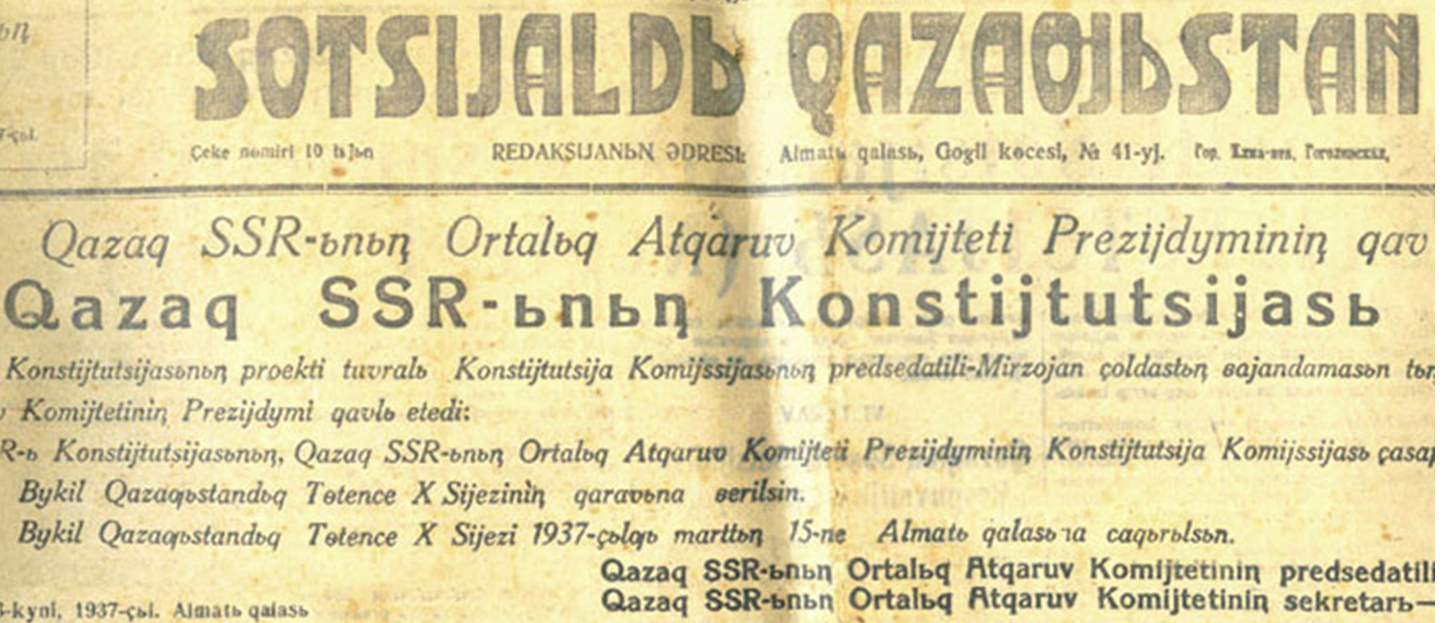
A 1937 issue of Sotsijaldyq Qazaqstan (Socialist Kazakhstan), printed in the Latin script, dedicated to the Constitution of the Kazakh SSR. Photo credit: e-history.kz
The Astana Times examined a range of studies on the evolution of the Kazakh language, exploring how it developed and what factors shaped it.
Early writing systems
For centuries, nomadic societies relied less on writing and more on memory. Oral tradition carried history, poetry and identity across generations. Epic tales, proverbs and songs formed a living archive, one that proved remarkably resilient even without widespread literacy.
Writing, when it appeared, served more specific purposes, such as diplomacy, political decisions and commemorative inscriptions. One of the earliest known systems, the Old Turkic script, emerged between the 2nd and 8th centuries across present-day Kazakhstan, Mongolia and Western Siberia. It became widely known through stone inscriptions discovered in the Orkhon, Yenisei and Talas regions.
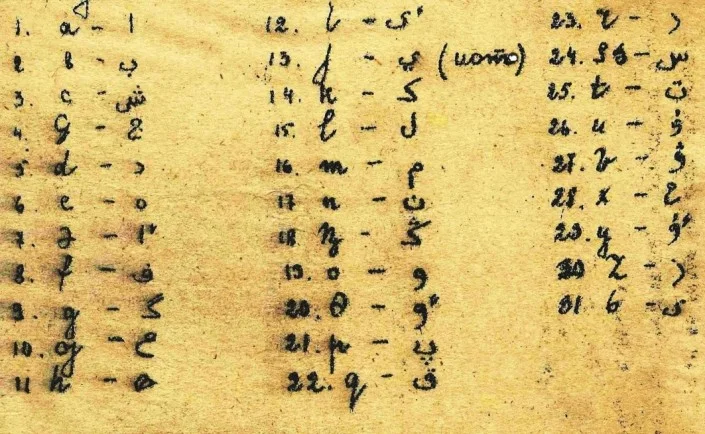
The alphabet of Akhmet Baitursynuly. Photo credit: Kazakh Central State Archive
These inscriptions were first documented in the early 18th century by German scholar Daniel Messerschmidt and Swedish officer Philip Johan von Strahlenberg, who referred to them as “runic writing.” In 1889, Russian ethnographer Nikolai Yadrintsev discovered major monuments in Mongolia’s Orkhon Valley, now known as the Orkhon inscriptions. Danish scholar Vilhelm Thomsen became the first to decipher the words “Turk” and “Tengri” on the monuments.
Some researchers point to even earlier proto-writing, including symbols found on a silver bowl from the “Golden Man” burial, dating back to the 5th century BCE, though their classification remains debated.
Alongside Old Turkic script, Turkic-speaking peoples also used the Uyghur script in the 8th -9th centuries, derived from Sogdian writing. This script later influenced Mongolian writing systems during and after the era of Genghis Khan.
Rise of the Arabic script
The spread of the Arabic script in Kazakhstan is closely linked to the spread of Islam and the expansion of the Arab Caliphate. The script began spreading in the region after the Battle of Talas in 751. Its influence grew significantly after the Karakhanid state adopted Islam in 960.
Under the Golden Horde, particularly during the reign of Uzbek Khan in the 14th century, Islam became the state religion, further strengthening the use of the Arabic script across the region.
Arabic writing remained widely used in Kazakhstan until the early 20th century in education, administration and architecture. A variant influenced by Persian tradition, known as Chagatai script, was used for official and diplomatic purposes.
During the Russian Empire, Arabic script remained in use, though knowledge of Russian writing gradually spread among the Kazakh elite.
As the Russian imperial administration sought to integrate the steppe, it pursued policies aimed at Christianizing the Kazakh population through baptism – known in Kazakh as shokyndyru. This strategy included missionary activity, the establishment of schools and social incentives designed to weaken Islamic influence and introduce Orthodoxy.
In response, many Kazakhs embraced Islam more actively as a means of preserving cultural and religious identity, and village schools teaching Arabic script became widespread. The Kazakh intelligentsia increasingly emphasized language and culture as tools of resistance and preservation.
Reform and Soviet transformation
In 1912, prominent Kazakh linguist and reformer Akhmet Baitursynuly adapted the Arabic script to better reflect Kazakh phonetics. His system, known as “Zhana Emle” (New Orthography), was widely adopted and used in education and publications, including the newspaper Kazakh.
However, following the establishment of Soviet power, sweeping reforms reshaped the writing system.
In 1928, the Soviet government introduced a Latin-based alphabet, effectively rendering much of the population illiterate overnight and requiring mass re-education. A decade later, in 1938, the script was again changed this time to Cyrillic as part of broader efforts to standardize languages across the Soviet Union.
Although earlier attempts to use Cyrillic date back to the late 19th century, including work by educator Nikolai Ilminsky and reformer Ibray Altynsarin, it became dominant during the Soviet period.
Speakers noted that its expanded set of letters made it less suited to Kazakh phonetics compared to earlier systems.
Modern debate: return to Latin
Despite repeated transitions, Kazakh society demonstrated strong adaptability. Today, Kazakhstan is again considering a transition to a Latin-based alphabet. The country formally launched the initiative in October 2017, proposing a 32-letter alphabet based on the Latin script. The plan sought to replace Cyrillic letters with Latin equivalents reflecting Kazakh phonetics, including the use of apostrophes to denote specific sounds.
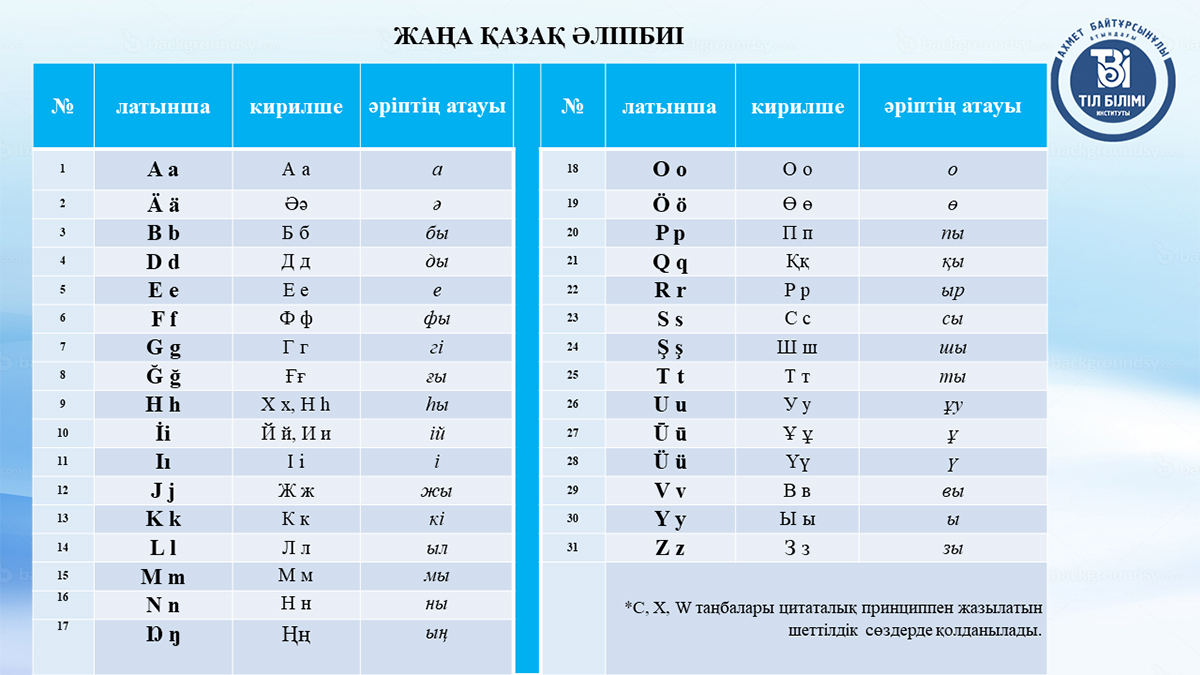
The new version of the alphabet presented in 2021. Photo credit: primeminister.kz
Following public debate and criticism, the government revised the proposal and introduced a new version of the alphabet in 2021, reducing it to 31 letters. The transition is being implemented in phases and is expected to be completed by 2031.
Experts say Latin script could simplify integration into the global information space while preserving linguistic identity. At the same time, the shift raises questions about cultural continuity, given the extensive literary heritage created in Cyrillic.
“Latin script is more concise and practical for our language,” experts note, adding that Kazakhstan has historically adapted to such transitions and is capable of doing so again.
