
ASTANA – Whether a real conflict existed between Genghis Khan and his eldest son Jochi remains one of the most debated questions in early Mongol history, historian Artem Porsin said in an interview with Kazinform.
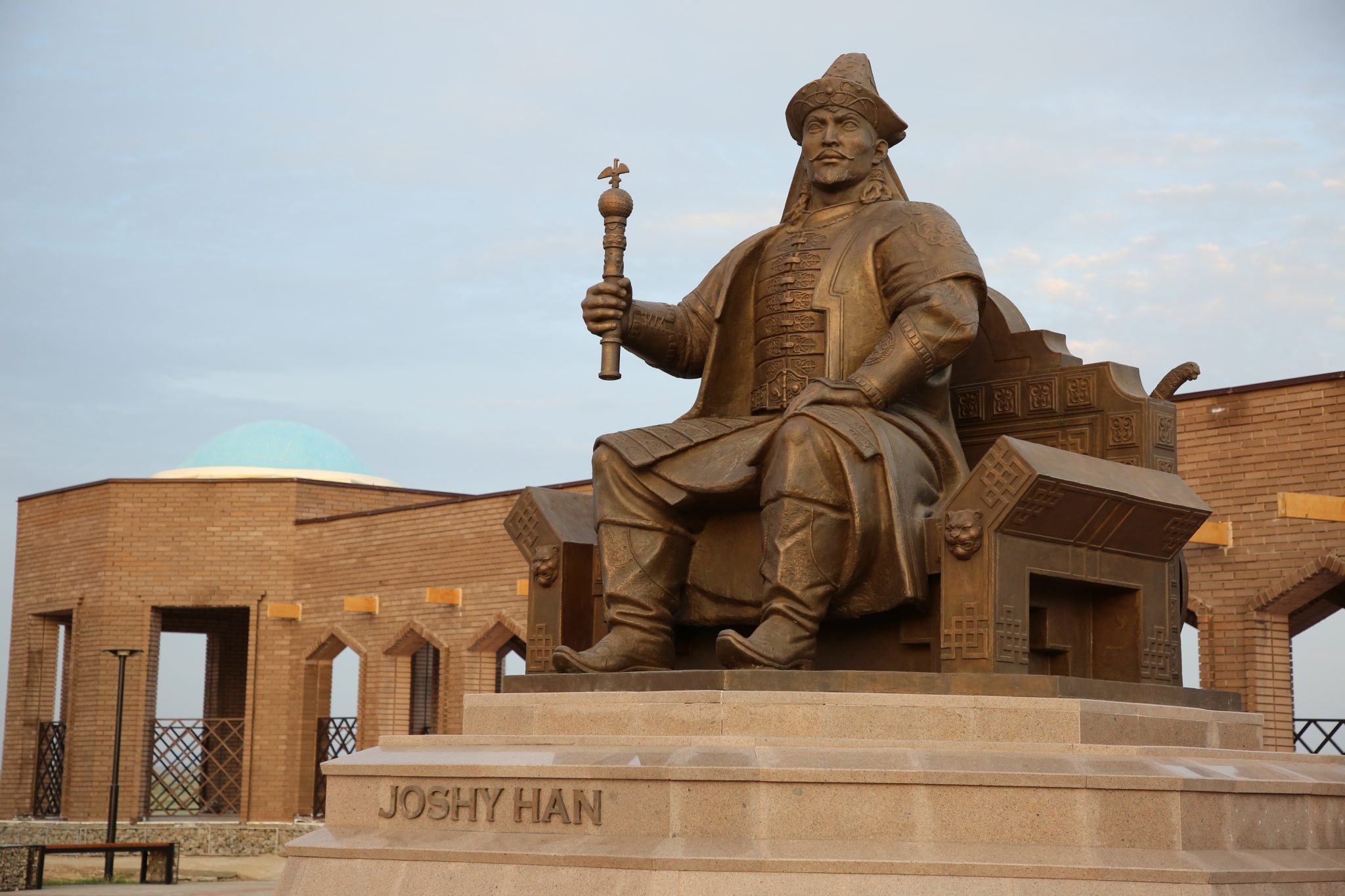
The monument of Jochi Khan is located in the Ulytau region. Photo credit: Akimat of Ulytau region
According to Porsin, a PhD historian and chief research fellow at the Research Institute for the Study of the Ulus of Jochi, accounts of relations between the father and the son, especially toward the end of Jochi’s life, are filled with contradictions, leaving scholars sharply divided.
Only two known sources explicitly refer to a conflict. One is the Indian historian Juzjani, writing around 1260, decades after the events. The other is the Persian historian Rashid al-Din, a court historian at the Mongol court in the late 13th and early 14th centuries.
Juzjani wrote that after the conquest of Khorezm and the fall of Urgench, Genghis Khan sent his sons, Jochi and Chagatai, to conquer the Dasht-i-Kipchak. According to Juzjani, Jochi admired the region and criticized his father’s policy of mass destruction. He wrote that Jochi considered an alliance with Khorezmshah Muhammad and even plotted to kill Genghis Khan. Juzjani claimed that Chagatai exposed the plot and that Jochi was assassinated on his father’s orders.
“Modern historians view this version skeptically. Juzjani wrote from India after fleeing the Mongol invasions and was openly hostile toward the Mongols, a bias that may have shaped his narrative,” Porsin said.
He noted that the story also contains clear factual errors: by the time Jochi moved west, Khorezmshah Muhammad was dead.
Porsin suggested that Juzjani may have misinterpreted reports that actually reflected accusations made by Chagatai against Jochi. Chagatai favored extremely harsh methods in conquering the Khorezmian Sultanate and may have accused Jochi of sympathizing with Muslims and local populations, even of plotting alliances that never existed.
Rashid al-Din’s account, closer to the Mongol court, is considered more credible, said Porsin.
Rashid al-Din does not claim that Genghis Khan ordered Jochi’s death. Instead, he describes a dispute after Urgench, when Jochi refused orders to continue west and withdrew to his lands along the Irtysh River. When reports surfaced that Jochi was hunting despite claiming illness, Genghis Khan ordered troops to be assembled. Shortly afterward, news arrived of Jochi’s death.
“Genghis Khan was deeply distressed and sought to clarify what had happened, but the informant who accused Jochi disappeared,” Porsin said.
Other sources add to the uncertainty. The 14th-century Arab historian al-Umari mentions that Jochi was killed but provides no details, while the 17th-century Mongolian chronicle Altan Tobchi preserves a confused legend implying a son’s execution, likely referring to Jochi.
“Together, these accounts suggest the idea of a violent death and conflict with Genghis Khan existed, though its historical accuracy remains uncertain,” Porsin said.
A rivalry between brothers
Historians agree there is no definitive evidence explaining how or why Jochi died.
“What can be stated with greater confidence is that a serious conflict existed within the imperial elite. Most likely between Jochi and Chagatai rather than between Jochi and their father,” Porsin said.
According to him, the brothers clashed over how new territories should be conquered and governed. Jochi favored negotiation, alliances, and gradual integration of local populations. Chagatai advocated uncompromising force, submission, or destruction. These differences became particularly pronounced during the campaign against the Khorezmian Sultanate and the siege of Urgench.
“Jochi, with Genghis Khan’s initial support, attempted to incorporate parts of Khorezm peacefully into his domain, including plans for a treaty with the Kangly tribes, relatives of Turkan Khatun, the mother of Khorezmshah Muhammad. These tribes formed the backbone of Khorezm’s military power, but negotiations ultimately collapsed, leading to a brutal siege and heavy losses on both sides,” Porsin said.
The rivalry intensified in the 1220s as plans took shape for a western advance into the Dasht-i-Kipchak. The failure of that campaign, combined with political tensions and rival visions of empire, appears to have pushed the conflict to a breaking point.
“Mongol official sources were reluctant to record internal dynastic conflicts, especially those ending in death. As a result, Jochi’s fate remains unresolved. If he was killed, Chagatai is the most likely suspect, a view indirectly supported by Rashid al-Din,” Porsin said.
Before his own death in 1227, Genghis Khan reportedly grew dissatisfied with Chagatai, excluding him from key campaigns and from the gathering that named another son, Ogedei, as the heir.
The article was originally published on Kazinform.
