
ALMATY – Mukhtar Auezov Kazakh National Drama Theater celebrates its 100th anniversary on Jan. 13, marking a century-long contribution to the country’s cultural and spiritual life.
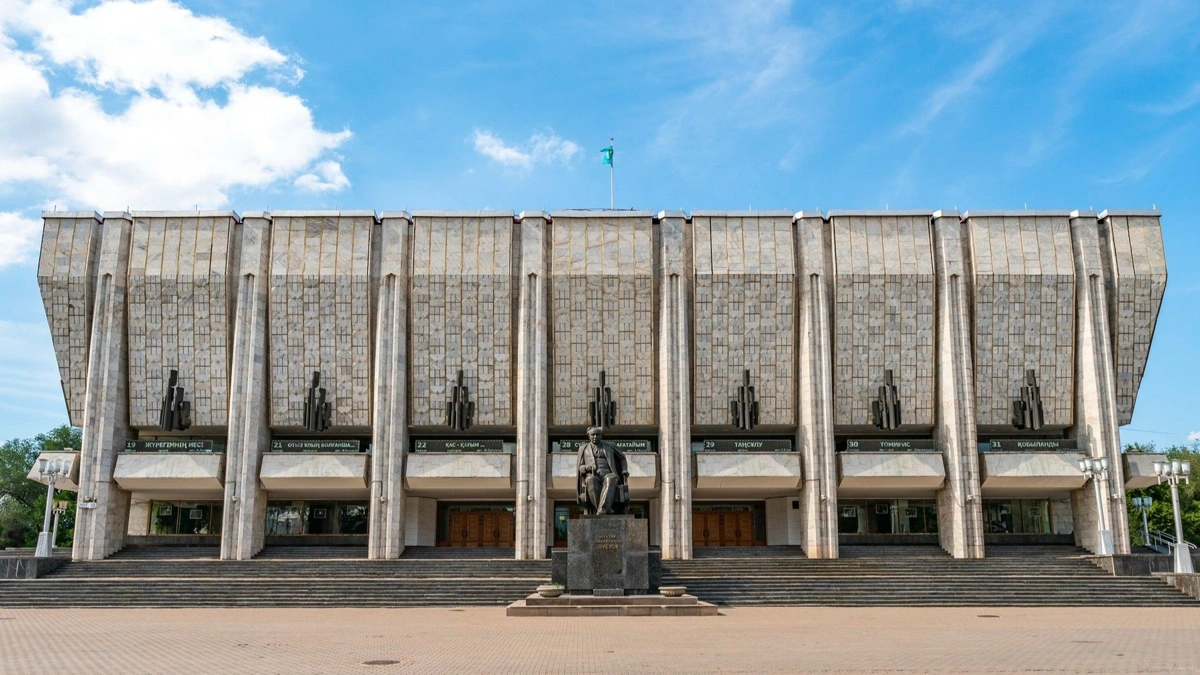
Mukhtar Auezov Kazakh National Drama Theatre. Photo credit: auezov-theatre.kz
The Auezov theater was founded in Kyzylorda in 1925, then the capital of the Kazakh Autonomous Soviet Socialist Republic. The theater officially opened on Jan. 13, 1926, with a performance based on an excerpt from “Enlik–Kebek” by Auezov. A century later, the anniversary will be marked symbolically with the same production, honoring continuity, heritage, and the origins of the national stage, reported the theater’s press service.
The formative years of the theater were closely associated with its first director Dinmukhamed Adilov and first chief director Zhumat Shanin, who laid the foundations of a national theatrical tradition rooted in Kazakh language, folklore, and literary heritage.
Vice Prime Minister and Minister of Culture and Information Aida Balayeva congratulated the theater on its milestone.
“This is a whole century of service to the stage, the audience, and national culture. But the greatest treasure is the people and the school created by generations of outstanding actors and directors. And, of course, today’s team, which knows how to preserve traditions while speaking to audiences in a modern language. I wish you inspiration, creative success, and sold-out houses,” she wrote on her Instagram page.
The birthplace of professional Kazakh drama
Since its founding, the theatre has held a unique place in Kazakhstan’s cultural history as the country’s first professional Kazakh dramatic troupe. It became a platform where national values, moral ideals, and the spiritual worldview of the Kazakh people were brought to life on stage.
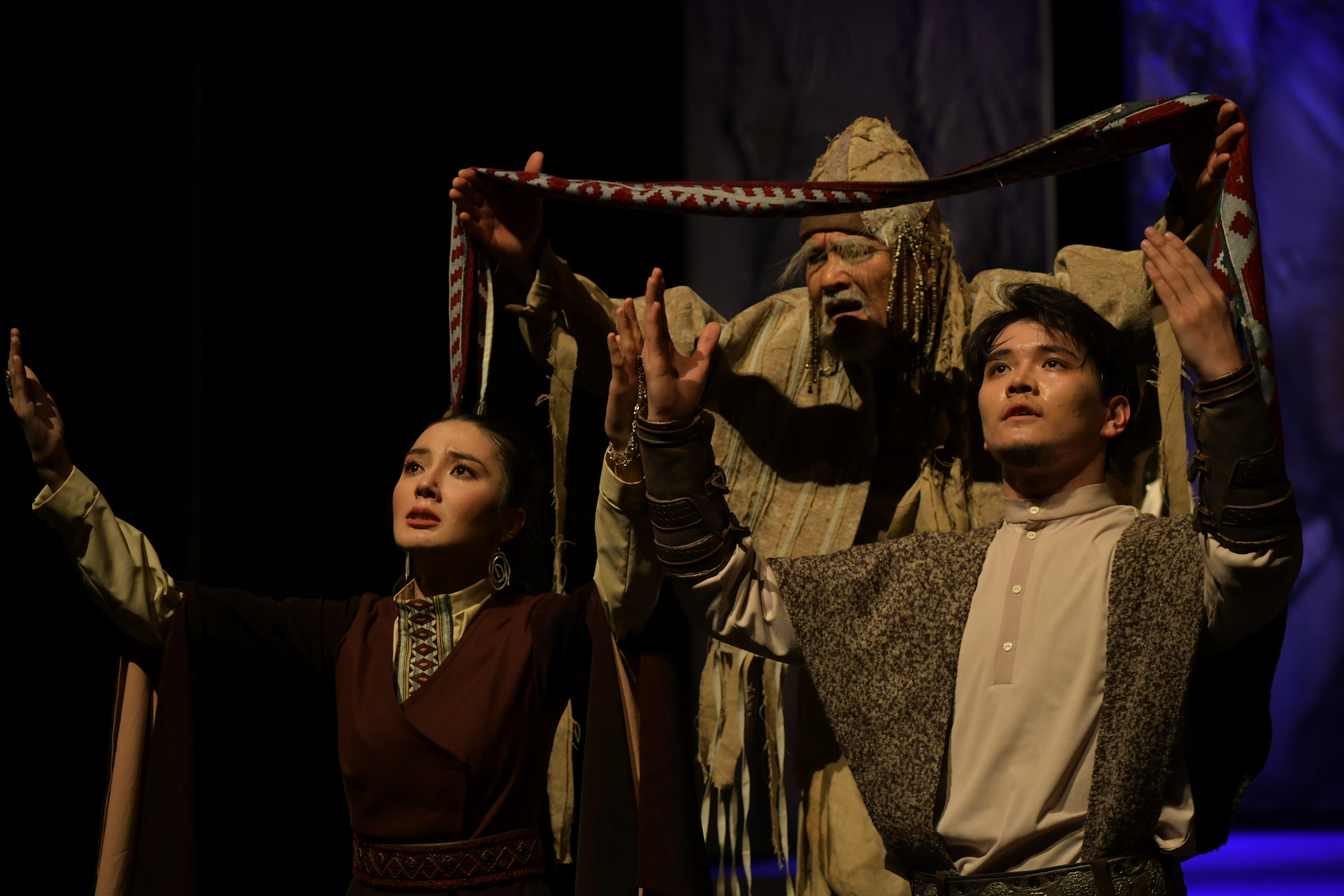
An excerpt from a modern staging of “Enlik–Kebek” at the Mukhtar Auezov Kazakh National Drama Theatre. Photo credit: auezov-theatre.kz
Over the decades, the theater has produced landmark works of Kazakh dramaturgy, including “Enlik–Kebek,” “Abai,” “Koblandy,” “Karagoz,” and “Aiman–Sholpan”. These productions laid the foundation of the Kazakh theatrical school and shaped generations of performers and directors.
A living chronicle of the nation
Often described as a spiritual mirror of the nation, the theater’s creative legacy reflects Kazakhstan’s history, character, and collective memory. Its stage has witnessed the evolution of Kazakh society, preserving cultural identity while engaging with contemporary themes.
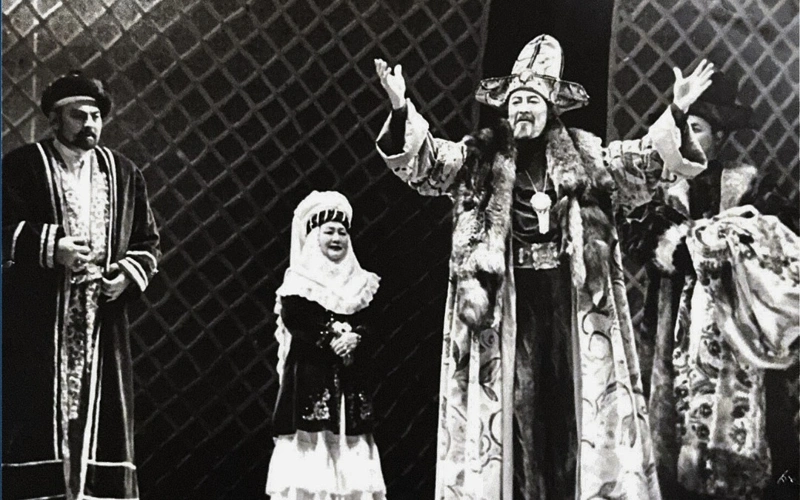
Archive image from the early stage productions of the Kazakh National Drama Theatre. Photo credit: auezov-theatre.kz
The theater was founded by a constellation of iconic cultural figures whose names are inseparable from the history of Kazakh art. Among them were Serke Kozhamkulov, Kalibek Kuanyshbayev, Yelubai Umirzakov, Amre Kashaubayev, and Kazhimukan Munaitpasov. Their contributions permanently shaped the national stage and artistic tradition.
Relocation and institutional growth
In 1928, the theater was relocated to Almaty. The team was soon joined by a new generation of prominent performers, including Kulash and Kanabek Baiseitov, Zhusupbek Yelebekov, Shaken Aimanov, Manarbek Yerzhanov, and Sabira Maikanova, who would later define the golden age of Kazakh theater.
In 1934, the theater became the nucleus for the creation of several major cultural institutions. The State Opera and Ballet Theater, the national philharmonic, and Kazakh concert all emerged as independent creative collectives originating from its structure.
Academic status and national recognition
The theater received academic status in 1937 as formal acknowledgment of its artistic leadership. Its repertoire expanded to include works by leading Kazakh playwrights such as Auezov, Beimbet Mailin, Ilyas Zhansugurov, Gabit Musrepov, and Sabit Mukanov, alongside Russian and world classics.
One of the most significant milestones came in 1940, when director Askar Tokpanov staged “Abai,” a production that would later become one of the most celebrated works in Kazakh theatrical history.
Awards, legacy, and creative leadership
In 1946, marking its 20th anniversary, the theater was awarded the Order of the Red Banner of Labor. In 1952, it received the USSR State Prize for Abai, directed by Shaken Aimanov and performed by an ensemble that included Kalibek Kuanyshbayev, Kapan Badyrov, Khadiya Bokeeva, and Serke Kozhamkulov.
The following decades saw the team strengthened by professionally trained actors from Almaty, Moscow, and Tashkent. In 1958, the theater represented Kazakhstan in Moscow during the Days of Kazakh Literature and Art, presenting five productions to a union-wide audience.
In 1961, the theater was officially named after Auezov. A defining era followed under director Asanali Mambetov (1965–1994), whose productions earned multiple USSR State Prizes. In 1976, the theater was awarded the Order of Friendship of Peoples.
Preserving history while seeking new forms
Since 1968, the theater has operated a dedicated museum with two exhibition halls, documenting its artistic heritage. Since 1995, it has hosted the annual Theatrical Spring festival, providing a platform for creative dialogue and experimentation.
While honoring its classical legacy, the theater has continuously pursued new forms of stage expression, working with successive generations of directors and actors to reinterpret national and world drama for contemporary audiences.
