
ASTANA — Uzbek President Shavkat Mirziyoyev inaugurated the Nur Bukhara project, the country’s first utility-scale integrated solar and battery project, developed by Abu Dhabi Future Energy Company PJSC – Masdar, on Dec. 8 in Tashkent.
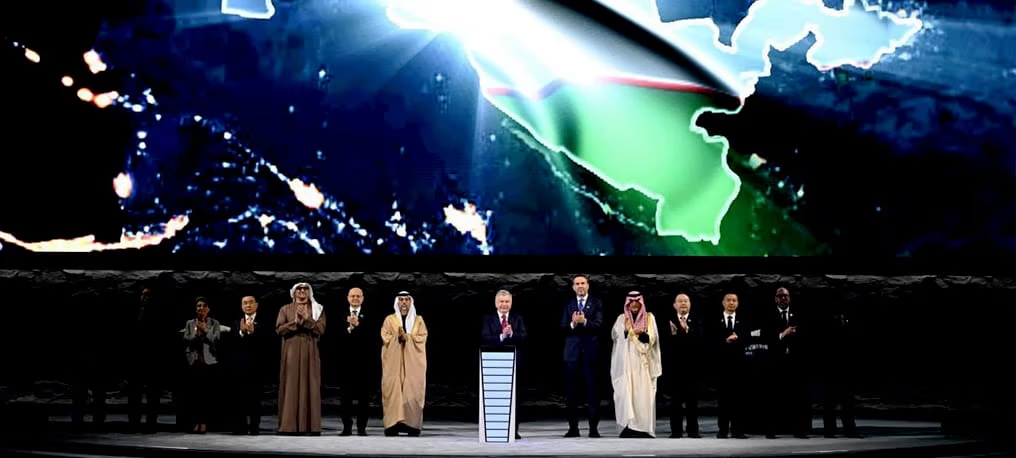
Photo credit: masdar.ae
Mirziyoyev also formally broke ground on Masdar’s 300-megawatt (MW) solar photovoltaic (PV) and 75-megawatt hours (MWh) battery energy storage system (BESS) Guzar project during a ceremony, reported Masdar’s press service.
High-level guests witnessed the exchange of investment, transmission connection and battery storage system agreements for the Zarafshan BESS project, the nation’s largest standalone battery project, and a development roadmap for a 1,000 megawatt wind power project in the Navoiy region.
UAE Minister of Energy and Infrastructure Suhail Mohamed Al Mazrouei emphasized that cooperation between the UAE and Uzbekistan is strengthening energy security and supporting the transition to clean, reliable energy sources. He noted that Masdar’s projects in Central Asia now exceed 2,000 megawatts.
Jurabek Mirzamahmudov, Uzbek minister of energy, highlighted that relations between Uzbekistan and the UAE have reached the level of a strategic partnership, noting the successful commissioning of multiple solar and wind power plants in cooperation with Masdar.
Masdar CEO Mohamed Jameel Al Ramahi said the inauguration of Nur Bukhara represents a key milestone, introducing integrated solar and battery storage at scale for the first time in Uzbekistan.
The Nur Bukhara 250 megawatt solar photovoltaic power plant (PV) and 63 megawatt/126 MWh megawatt-hour BESS project can produce enough electricity to power over 55,000 homes, while avoiding 367,000 tons of carbon dioxide emissions annually. The Guzar project, scheduled to begin operations in 2027, will be capable of powering 60,000 homes. The 300 megawatt/600 megawatt-hour Zarafshan BESS project is scheduled to begin operations in 2028.
These initiatives expand Masdar’s growing footprint in Uzbekistan, which includes around 2 gigawatt (GW) of clean energy capacity. Uzbekistan is targeting at least 25 gigawatt (GW) of renewable energy capacity and generating 54% of its power from renewables by 2030.
The CIS region is a strategic market for Masdar, as it aims to reach a global portfolio capacity of 100 gigawatts (GW) by 2030. Beyond its footprint in Uzbekistan, the company has an active presence across Armenia, Azerbaijan, Kazakhstan, the Kyrgyz Republic, and Turkmenistan.
