
ALMATY – President Kassym-Jomart Tokayev arrived in Ashgabat on Dec. 11 to participate in a high-level forum dedicated to the International Year of Peace and Trust, the International Day of Neutrality, and the 30th anniversary of Turkmenistan’s status as a permanently neutral state.
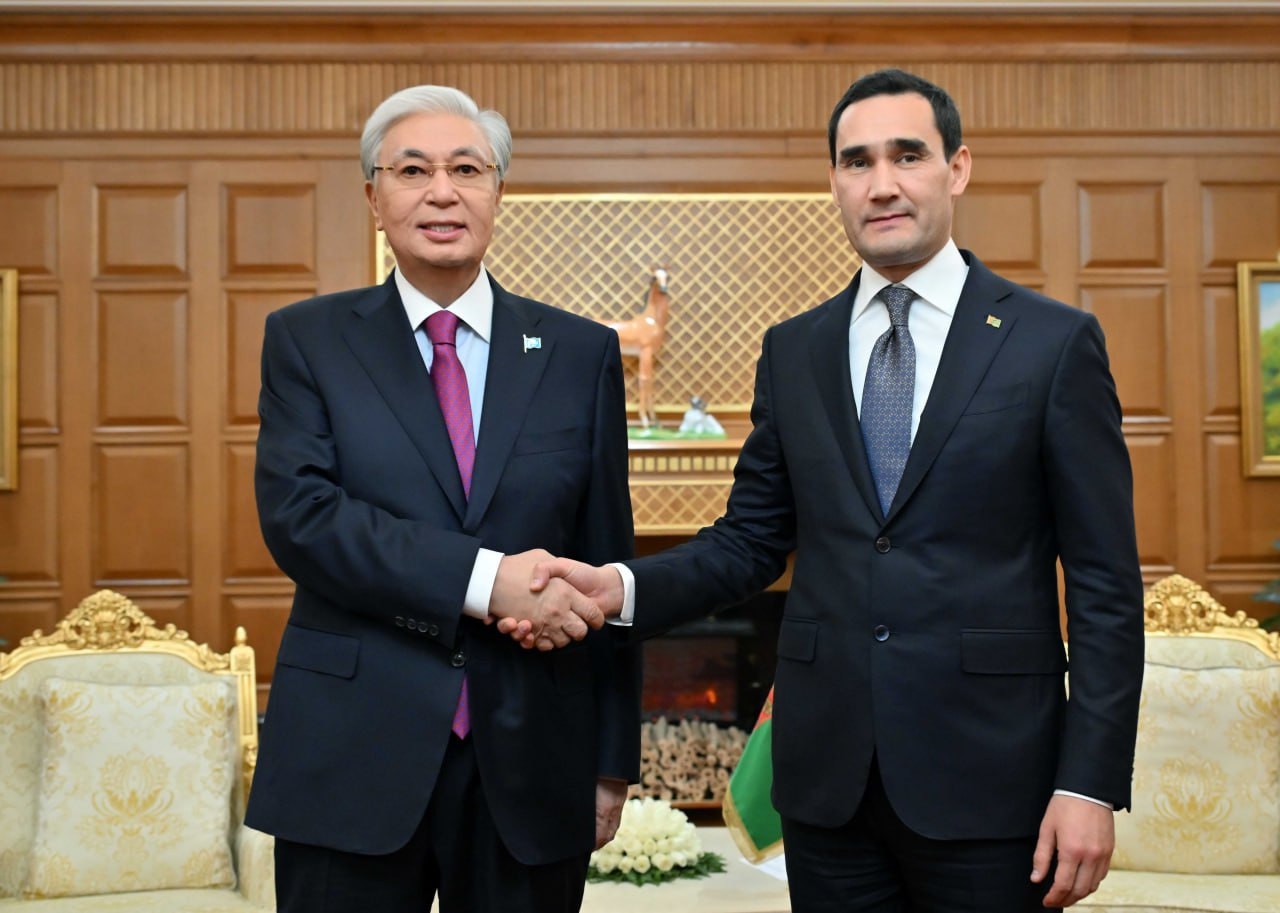
From L to R: President Kassym-Jomart Tokayev _and_ President of Turkmenistan Serdar Berdimuhamedov. Photo credit: Akorda.
Upon arrival, Tokayev was welcomed by the Chairman of the Halk Maslahaty of Turkmenistan, Gurbanguly Berdimuhamedov, with whom he held a brief exchange before beginning a series of official meetings, reported the Akorda.
President Tokayev noted the positive outcomes of Turkmen President Serdar Berdimuhamedov’s state visit to Kazakhstan in late November, stressing the importance of implementing the high-level agreements into practical cooperation.
During his meeting with Berdimuhamedov, Tokayev congratulated Turkmenistan on the anniversary of its permanent neutrality and emphasized the relevance of the forum’s agenda.
Both leaders reaffirmed their intention to expand mutual trade, strengthen economic ties, and advance joint projects in energy, logistics, and agriculture.
UN reform and greater global dialogue
Speaking at the forum on Dec. 12, Tokayev emphasized that Turkmenistan’s political vision has contributed meaningfully to stability and sustainable development across Eurasia. He noted that the proposals voiced at the forum highlight the importance of neutrality.
Tokayev underscored the importance of Turkmenistan’s initiative to designate the International Year of Peace and Trust, noting Kazakhstan’s support for the United Nations (UN) resolution. He also warned that global tensions continue to rise, undermining the principles of international law and the effectiveness of multilateral institutions.
“Without restoring strategic balance and building a just world order, international stability and security will remain only a figure of speech,” said Tokayev.
Kazakhstan, he noted, advocates for reforming the UN, including expanding the Security Council and strengthening the role of the General Assembly. Tokayev also recalled his proposal at the 80th UN General Assembly to establish a “group of like-minded states” dedicated to developing recommendations for UN reform.
Kazakhstan welcomes peace dialogue
Tokayev expressed support for diplomatic efforts to resolve regional conflicts and urged global powers to demonstrate political will and promote large-scale dialogue.
He welcomed Turkmenistan’s proposal to establish a UN University for Peace and Neutrality and noted recent developments related to the conflict in Ukraine.
“Kazakhstan welcomes the activation of the negotiation process on the Ukrainian conflict. The discussions following the meeting between the presidents of Russia and the United States indicate the possibility of achieving long-awaited peace,” Tokayev said.
He emphasized Kazakhstan’s long-standing support for the establishment of a sovereign Palestinian state as a key element of a lasting settlement.
Tokayev also welcomed the signing of the joint declaration on peace between Azerbaijan and Armenia, calling it a historic step that opens new prospects for cooperation in the South Caucasus.
Assistance to Afghanistan and regional stability
President Tokayev reaffirmed Kazakhstan’s commitment to continued support for Afghanistan, highlighting the role of the newly established UN Regional Centre for Sustainable Development Goals in Almaty.
He also highlighted the importance of the Conference on Interaction and Confidence-Building Measures in Asia (CICA). He expressed gratitude for support in transforming it into a full-fledged international organization.
Tokayev stressed Kazakhstan’s longstanding commitment to fostering interethnic, interreligious, and intercultural dialogue. He recalled that at the recent Eighth Congress of Leaders of World and Traditional Religions, Kazakhstan launched the Movement for Peace initiative.
“This is essentially a call to end military violence and seek peaceful solutions based on our collective responsibility to future generations,” he said, adding that sustainable socio-economic development is crucial for global stability.
“Kazakhstan’s economic growth this year will exceed 6%, with GDP surpassing $300 billion and per capita income reaching more than $15,000,” Tokayev added.
Water security
Tokayev noted that Central Asian countries are rapidly expanding their transit and transport potential to enhance connectivity across Eurasia. Kazakhstan, he said, is prioritizing development of the Trans-Caspian International Transport Route and modernizing its railway, port, and road infrastructure.
He also emphasized the urgent need to address water security, transboundary resource management, and the environmental conditions of the Aral and Caspian Seas.
“Kazakhstan has proposed developing a special interstate program to prevent the degradation and drying of the Caspian Sea. We call on the international community to support our efforts to preserve this unique body of water,” Tokayev said.
Tokayev stressed that global water diplomacy requires deeper institutional coordination and noted the absence of a dedicated UN body focused exclusively on water issues. He announced that Astana will host a Regional Environmental Summit next April, at which Kazakhstan intends to initiate global consultations on establishing such an organization.
Concluding his remarks, Tokayev expressed confidence that the Ashgabat forum will deepen constructive cooperation among participating states and reinforce collective efforts to build a fair and trust-based international order.
