
ALMATY — Kazakhstan has signed memoranda of cooperation with the European Bank for Reconstruction and Development (EBRD) and the European Investment Bank (EIB) on Oct. 10 to expand investment in renewable energy, hydropower, and power grid modernization.
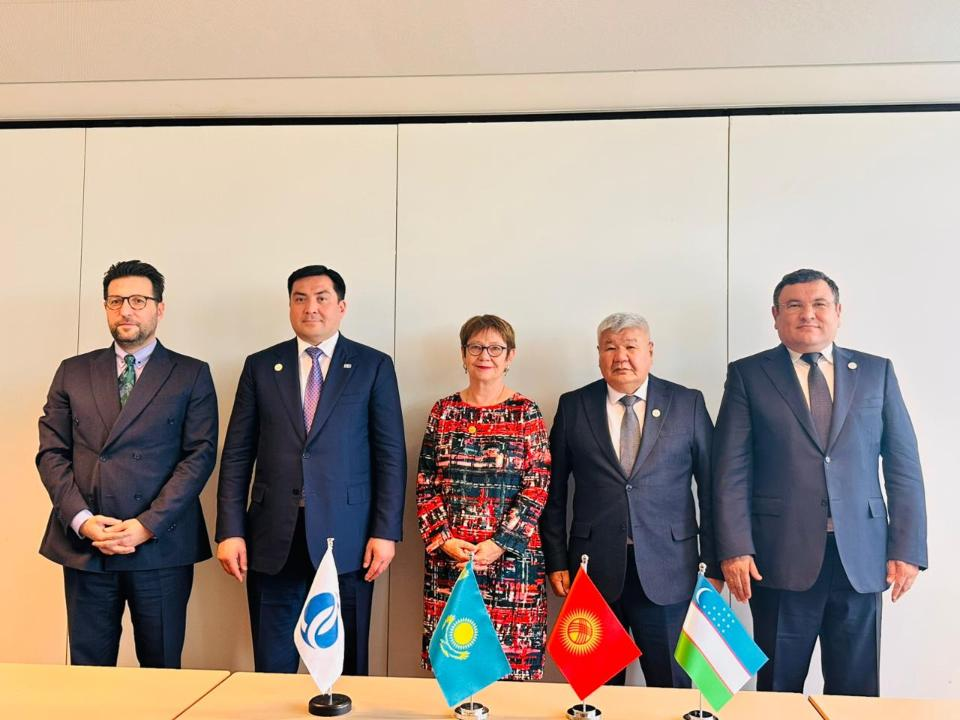
Photo credit: Kazakh Ministry of Energy
The agreements were concluded during the Global Gateway Forum in Brussels, where the Minister of Energy of Kazakhstan Yerlan Akkenzhenov held a series of high-level meetings with European Union officials and heads of major financial institutions.
The signed memoranda aim to mobilize European capital for strategic regional projects, including the Kambarata-1 Hydropower plant and renewable energy initiatives across Central Asia, reported the Ministry of Energy press service.
During the forum, Akkenzhenov met with European Commissioner for International Partnerships Josef Sikela and European Commissioner for Neighborhood and Enlargement Marta Kos. The discussions focused on strengthening cooperation in energy security and advancing the green transition.
At the forum, Akkenzhenov also held talks with the President of the EBRD Odile Renaud-Basso, Director of the French Development Agency Cyril Bellet and representatives of Italy’s Cassa Depositi e Prestiti. Discussions centered on attracting private and institutional investment to Kazakhstan’s energy modernization agenda.
On the sidelines of the Central Asia Partnership Dialogue, organized by the German Agency for International Cooperation, energy ministers from Kazakhstan, the Kyrgyz Republic, Uzbekistan, Tajikistan, and Turkmenistan met.
Akkenzhenov presented Kazakhstan’s stance on regional electricity trade, joint hydropower development, and technical harmonization of renewable energy standards.
“Kazakhstan is a reliable supplier of energy resources and is ready to become Europe’s strategic ally in green energy, critical raw materials, and green hydrogen production,” he said.
Kazakhstan’s Ambassador to the European Union Roman Vassilenko emphasized that participation in such initiatives and cooperation with other international partners is vital for Kazakhstan, reported Kazinform news agency on Oct. 11.
“Kazakhstan is interested in transforming the region from being landlocked to land-linked. Therefore, our country’s participation in initiatives such as this fully aligns with the goal of reviving the Great Silk Road,” said.
He recalled that nearly two years ago, an investment forum in Brussels focused on developing Central Asia’s infrastructure, during which the European Union and other partners pledged around €10 billion (US$10.9 billion) for the region.
“Now, almost two years later, we can say that investments – or more precisely, loans – supported by the European Union amount to about $800 million in Kazakhstan alone,” he said, adding that all parties are interested in accelerating the process given the growing demand for overland transport routes across Eurasia.
Vassilenko underscored that the value of the Trans-Caspian International Transport Route has increased significantly amid global geopolitical shifts.
“The importance of the Middle Corridor has multiplied, as have the volumes of transportation along this route. The European Union views Kazakhstan as a serious and reliable partner,” he said.
