
ASTANA – On Aug. 8, Armenia and Azerbaijan signed an agreement in Washington, D.C. under the mediation of the United States to normalize relations after decades of hostility and wars over Nagorno-Karabakh. The deal, described by the U.S. administration as a “historic” peace summit, is a concrete step toward ending one of Eurasia’s longest-running conflicts and reshaping stability in the Caucasus and Central Asia.
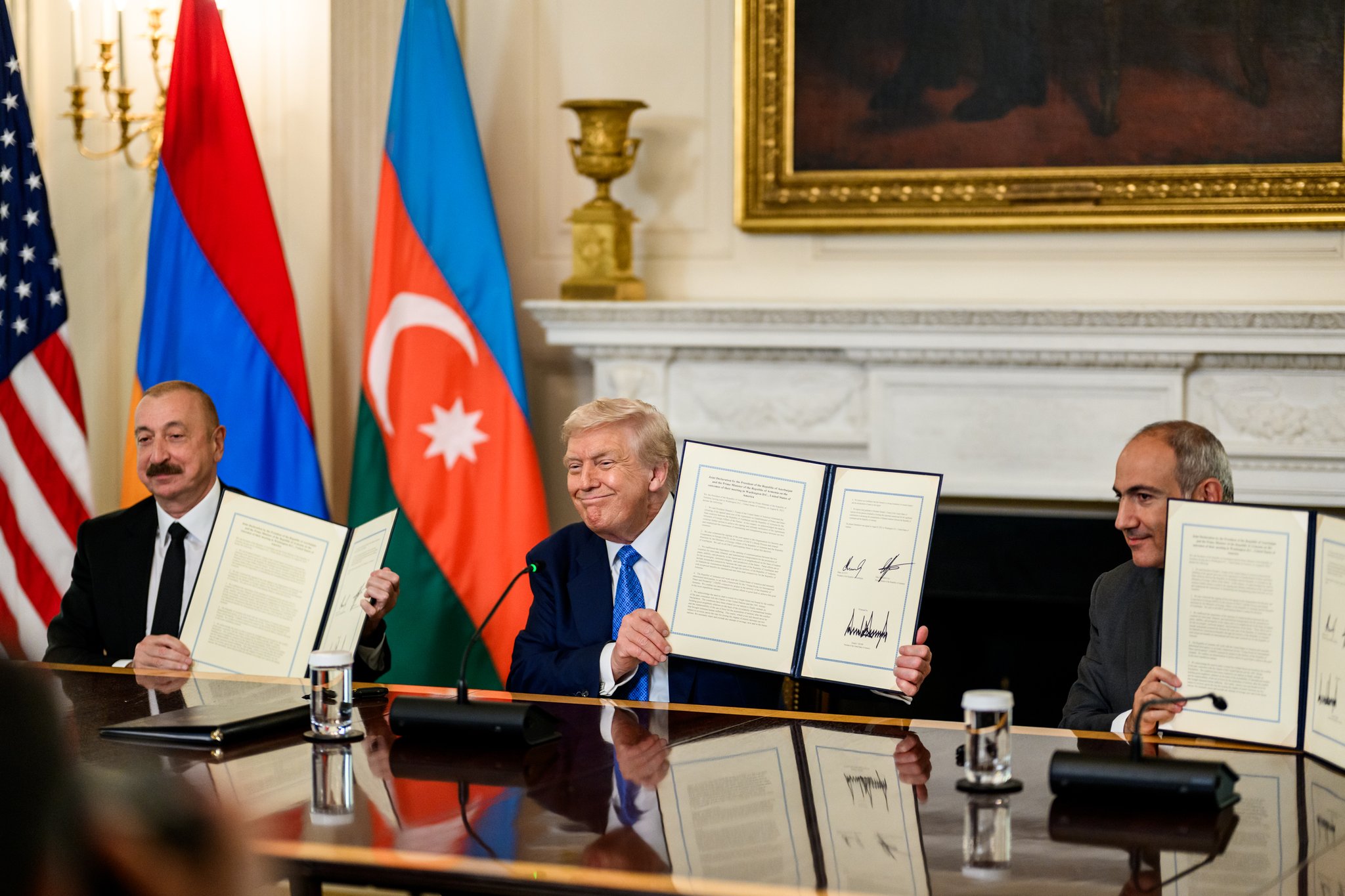
Aliyev, Trump and Pashinyan at White House on Aug. 8. Photo credit: White House’s X account
What are the deals about?
Armenia and Azerbaijan initialled the Agreement on the Establishment of Peace and Inter-State Relations. However, the leaders acknowledge the need to “continue further actions to achieve the signing and ultimate ratification of the agreement, and emphasized the importance of maintaining and strengthening peace between the two countries.”
In the agreement, both leaders pledged to respect each other’s sovereignty, territorial integrity, and political independence, and to refrain from raising territorial claims now or in the future.
The meeting in the Oval Office also witnessed the signing of a Joint Declaration and a Joint Appeal to dissolve the OSCE Minsk Group, which was established in 1992 to facilitate a peaceful resolution to the conflict. Trump also announced the lifting of some sanctions against Azerbaijan that had been in place since 1992.
One of the thorniest issues in the South Caucasus dispute has been Azerbaijan’s lack of a direct land link to its western, landlocked Nakhchivan exclave, which is cut off from the rest of the country by southern Armenia. With Armenia’s borders to the east and west closed, Baku has long pressed for control over transit through Armenian territory.
The deal also includes an agreement on the establishment of the Trump Route for Peace and Prosperity (TRIPP), a 27-mile transport corridor linking mainland Azerbaijan with Nakhchivan.
The joint declaration acknowledged the “need to chart a course for a bright future not bound by the conflict of the past, consistent with the Charter of the United Nations and the 1991 Almaty Declaration.”
“The conditions have been created for our nations to finally embark on building good neighborly relations on the basis of the inviolability of international borders and the inadmissibility of the use of force for the acquisition of territory after the conflict that brought immense human suffering. This reality, which is not and should never be subject to revision, paves the way for closing the chapter of enmity between our two nations. We resolutely reject and exclude any attempt of revenge, now and in the future,” reads the declaration.
Both Aliyev and Pashinayan mentioned the agreement in their speeches at the United Nations General Assembly High-Level Week.
“Regional connectivity has been at the core of our vision for lasting peace. Another key outcome of the Washington Summit is the Trump Route for International Peace and Prosperity, which will ensure unimpeded access through the Zangazur corridor and foster regional connectivity,” said Aliyev.
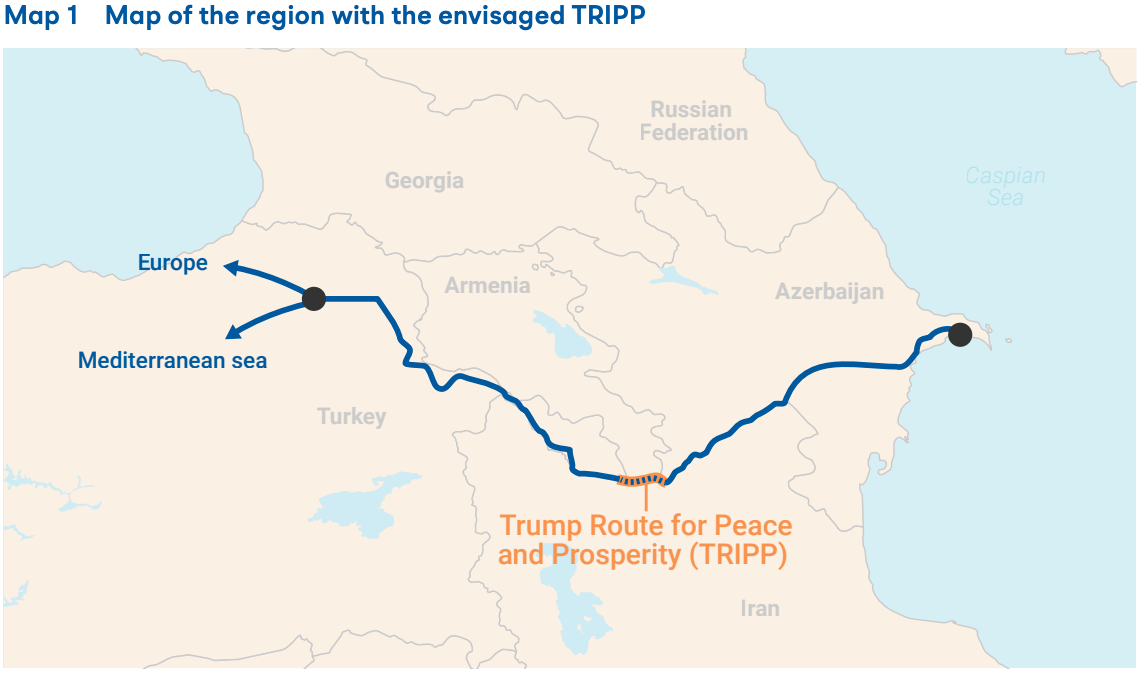
Map of the region where TRIPP is planned. Photo credit: clingendael.org
The agreements have “historic significance,” said Aliyev, also thanking President Trump for “opening a new chapter in the U.S.-Azerbaijan relationship, for his decision to elevate it to the strategic partnership level, and for his support to the peace process between Azerbaijan and Armenia.”
Pashinyan also mentioned the Washington agreement on the UN rostrum, but pointedly rejected Ilham Aliyev’s repeated references to a so-called “Zangezur Corridor.”
“Peace, thus, is established. But peace is not a vacation; it is work, everyday work,” Pashinyan said in his Sept. 27 remarks to the UN.
“And so, under the TRIPP route project announced in Washington on Aug. 8, a railway, a highway, pipelines, and electricity transmission lines will pass through the territory of Armenia, connecting the East to the West. As a result of this agreement, the North will also be connected to the South,” he said.
How durable is peace?
Experts, however, remain cautious about the agreement’s durability and scope, which remains far from settled.

Marina Ohanjanyan is a Senior Research Fellow at Clingendael’s Security Unit, focusing mostly on the developments in and surrounding Russia and Eastern Europe. Photo credit: clingendael.org
“While the imagery and potential positive consequences of this should not be underestimated, much is still unclear about what the agreements actually mean, including certain formulations and their interpretation as well as the question of how long the US commitment to the region will last,” writes Marina Ohanjanyan, senior research fellow at the Clingendael Institute, in a Sept. 25 policy brief.
Ohanjanyan indicates that much hinges on how vague terms in the text of the agreements, such as “unimpeded connectivity,” “reciprocal benefits,” or the clause on the “inadmissibility of the use of force for acquisition of territory,” are defined
The commitment of the U.S. administration to ensure these agreements are implemented is also a matter of question.
“The question, then, is whether a sufficient level of U.S. attention and effort will remain in this region for a sufficiently long period of time to ensure the conclusion of the peace deal and implementation of both agreements. If international attention shifts, nothing substantial stands in the way of the region reverting to instability and conflict,” she writes.
Implications for different actors
Ohanjanyan also explains how the deal and the TRIPP project can influence vested interests of different actors in the region, including those of Russia, Iran, Türkiye, and the European Union.
Notably, Türkiye benefits significantly from the deal, as it secures a transport link to Central Asia via Nakhchivan and the planned TRIPP corridor. On Aug. 25, Türkiye kicked off the construction of a Kars-Iğdır-Aralık-Dilucu railway line. Turkish officials say that the completion of the railway line, which will connect Azerbaijan with the Southeastern and Mediterranean regions, as well as the Caspian and Mediterranean basins, will leave a lasting impact on the future of the South Caucasus and Eurasia.
On the other hand, Russia, she argues, has been sidelined, with its role shifting from “an unquestionable leader and key decision-maker, to being completely and conspicuously absent from an issue of strategic importance to Moscow.”
Nona Shahnazarian, a senior research fellow at the Yerevan-based National Academy of Sciences, echoes this point.

Nona Shahnazarian, ade senior research fellow at the Yerevan-based National Acmy of Sciences.
“The framework sidelines Moscow’s mediator role and inserts a U.S.-backed operator into a critical artery on Iran’s northern flank, which Tehran publicly opposes. Brussels’ Global Gateway and ongoing connectivity loans further anchor a Western economic/security footprint,” Shahnazarian told The Astana Times in a written comment for this story.
She describes the U.S.-brokered agreement on a new corridor via Armenia as a “turning point in the geopolitics of the South Caucasus.”
“While critics warn that the project could compromise Armenia’s sovereignty, its design under Armenian jurisdiction also creates space for Yerevan to reposition itself as a key connector between Central Asia and Europe. The challenge lies in ensuring that Armenia is not reduced to a passive transit space for Azerbaijan [between Azerbaijan and Nakhichevan] and Turkiye but instead leverages the route to strengthen sovereignty, attract investment, and secure its place in Eurasia’s reconfigured order,” Shahnazarian said.
She stresses the importance of the agreement framework, “explicitly” stating that the corridor will operate under Armenian law and administration. “This design choice is critical,” she added.
For Yerevan, the stakes extend well beyond logistics. Shahnazarian explains that the corridor is not only a route for goods but also a test of Armenia’s ability to translate geography into leverage.
“Handled wisely, the TRIPP can transform Armenia into a bridge state, connecting Central Asia and Europe and repositioning Yerevan within a rapidly shifting Eurasian order. Mishandled, it risks cementing Armenia’s role as a junior partner in a Turkic-led transit architecture. The balance between vulnerability and opportunity will depend on whether Yerevan can assert jurisdictional control and design policies that turn geography into strategy,” she said.
According to her, this development also ties Armenia into the wider re-routing of Eurasian trade corridors.
“It slots into a broader push to diversify Eurasian trade away from Russia, creating the Trans-Caspian ‘Middle Corridor.’ EU money and policy cover are already flowing into Armenian connectivity: the North–South road; the Global Gateway. If Armenia captures even a spur of Middle Corridor flows (Caspian-Azerbaijan-Armenia-Georgia-EU), it becomes relevant to Kazakhstan/Uzbekistan shippers seeking non-Russian, non-Iranian options and thus diversifying economic strategies and gains,” she explained.
No obstacles to full-fledged peace

Anar Valiyev is an Associate Professor, Advisor to Vice Rector for Academic Affairs, the School of Public and International Affairs of ADA University in Baku. Photo credit: ada.edu.az
When asked what remains the biggest challenge to ensure this peace holds, Dr. Anar Valiyev, Associate Professor at Baku-based ADA University, suggests that there are not many obstacles to full-fledged peace.
“One of the obstacles that still make it difficult is the Armenian constitution that has references and claims to Azerbaijani territories. Other than that, there are no obstacles to finalizing the peace agreement,” he told The Astana Times.
For Baku, it is not only about bilateral deals, but a broader reconfiguration of Eurasia’s connectivity.
“The Middle Corridor and its final part, TRIPP, will connect the East and Europe. It will allow both the biggest economies, China and the EU, to reach each other faster and with minimal expenses. If the corridor can capture even a quarter of trade, it would create a huge breakthrough,” he explained.
Geopolitical implications for Eurasia
Kamran Bokhari, foreign policy expert and senior director at the New Lines Institute for Strategy & Policy, sees the peace agreement between Azerbaijan and Armenia “among the most geopolitically consequential developments of our time.”
“The South Caucasus region connects the West with the heart of Eurasia, so Washington’s involvement in ending the standoff was both urgent and crucial. Having improved ties with Azerbaijan places Washington in a strategically advantageous position with regard to Russia and Iran, and it could counter, if not curb, China’s influence in Central Asia,” Dr. Bokhari said in a written comment for this story.
While some steps remain before the peace agreement is finalized, Washington’s entry into the process marks a watershed moment.

Dr. Kamran Bokhari. Photo credit: newlinesinstitute.org
“The U.S. has now gained a major foothold in the land bridge between the Black and the Caspian Seas,” said Dr. Bokhari.
He sees this development as an opportunity for the U.S. to improve ties with the Central Asian region.
“The signing of the TRIPP deal is nothing less than the decongestion of a crucial chokepoint for connectivity between Central Asia and the West. China still has the geographic advantage in the region, so it will still likely have the upper hand there for the foreseeable future – that is, unless Washington and Moscow reach an understanding on Ukraine that gives Russia the time it needs to regain its footing. Either way, U.S. involvement in the South Caucasus is a significant opportunity to enhance ties to the Central Asian nations,” he said.
