
ASTANA — Nearly 20 years ago, a young biology student stood on the Kazakh steppe at dawn and caught sight of his first wild saiga. For Albert Salemgareyev, a lead specialist at the Association for the Conservation of Biodiversity of Kazakhstan (ACBK), that fleeting moment became the seed of a lifelong journey in wildlife conservation.
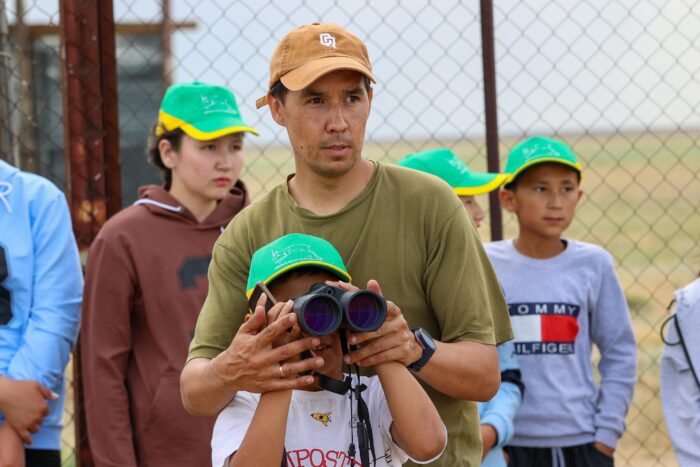
Salemgareyev shares that the team’s conservation measures included protecting more than 3.5 million hectares of land. Photo credit: Salemgareyev’s personal acrhives
“There was a day that set my path. As a biology student, I saw my first wild saiga at dawn on the steppe. Knowing how close the species had come to collapse in the late 1990s, that moment felt like a second chance,” Salemgareyev said in an interview with The Astana Times.
Key strategies behind saiga recovery
A decisive turning point came in 2009, when he joined his first joint expedition to identify new protected areas for saiga.
“I remember unrolling a map on a car hood and tracing potential boundaries around calving grounds. That was when conservation stopped being an idea and became my life’s work,” said Salemgareyev.
One of the reintroduction center of ungulates. Photo credit: Nagima Abuova / The Astana Times
Since then, Salemgareyev has been at the heart of one of the world’s most dramatic wildlife comebacks. Kazakhstan’s saiga population, which had dropped to around 50,000 in 2006, now numbers nearly four million. He credits a strategy built on evidence, space, and people.
Since 2007, ACBK has established the largest saiga telemetry program, which allowed them to capture over 500 saigas, fitting 180 of them with collars to track movements. They restarted scientific studies of calving areas at more than 25 sites, modernized aerial counts with drones, and protected over 3.5 million hectares of land.
Salemgareyev noted that the team’s conservation measures also included protecting more than 3.5 million hectares of land, reopening a key migration route by adjusting 200 kilometers of border fence, and raising community awareness after the 2015 mass die-off.
“With strong national protection in place, the species’ natural resilience did the rest,” he said.
Turning conflict into cooperation
Conservation, however, is not only about animals. In 2023, Salemgareyev received the Whitley Award for resolving conflicts between saiga and farmers competing for scarce water.
“My team mapped surface and groundwater and overlaid livestock and saiga data to identify agreed ‘hotspots’ of water pressure across the four districts,” said Salemgareyev.
The process involved feedback from more than 80 herders, rangers, veterinarians, and water officials, leading to a jointly agreed map and a final report submitted to regional and national authorities. The recommendations focused on repairing canals, digging new wells, improving pipelines, and strengthening pasture planning.
“We also trained reserve staff and involved farmers in monitoring around water points to keep the process transparent and build trust,” said Salemgareyev.
“In short: credible data plus participatory decision-making helped communities and government move from blame to a shared plan,” he added.
Harnessing technology for the steppe
In today’s world, conservation efforts cannot succeed without the use of technology. Salemgareyev explained how drones, artificial intelligence (AI), and environmental DNA (eDNA), a genetic material collected from soil, water, or air to detect species, are helping build lasting solutions for the steppe.
“Drones, especially when paired with AI, have had the most surprising impact. We use them to monitor Przewalski’s horses and kulan with minimal disturbance, cover large areas fast, and produce auditable photo/video records. I’m now developing an AI workflow to detect and count saiga, kulan, and goitered gazelle, which should make our estimates more accurate and consistent,” said Salemgareyev.
Over the past two decades, monitoring has shifted from paper maps and biplanes to GPS devices, drones, camera traps, and genetic sampling. Salemgareyev noted that satellite collars remain vital, as they help identify migration routes, expand protected areas, and address infrastructure barriers.
“The challenges though are practical – drone permits, wind and extreme temperatures, short batteries, and the hard work of building and validating robust training datasets for AI (…) eDNA and acoustics are promising but require strict contamination control and solid lab logistics. The tech is powerful, but making it work depends on people, training, and good data standards,” said Salemgareyev.
Bringing the wild horse home
Among ACBK’s most significant projects is the reintroduction of Przewalski’s horses, which had been extinct in Kazakhstan for more than a century.
“As someone who grew up on this steppe, I see two dividends from bringing Przewalski’s horses home – ecological and cultural. Ecologically, free-ranging herds will restore a natural grazing rhythm,” said Salemgareyev.
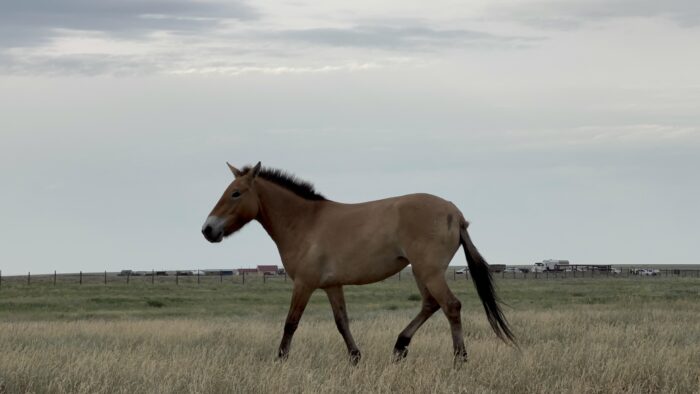
One of the Przewalski’s horses being released to the reintroduction center of wild ungulates. Photo credit: Nagima Abuova / The Astana Times
“They create a patchwork of short and tall grasses, recycle nutrients, feed invertebrates with their dung, slow shrub encroachment, and in winter, they break crusted snow so other wildlife can reach forage. They don’t replace saiga or kulan, but they complement them, using slightly different forage heights and habitats, which spreads grazing pressure and makes the system more resilient to drought and climate swings,” he said.
He also noted the cultural part, as horses have become a cultural symbol of the Kazakh steppe, inspiring pride and creating opportunities for local jobs in guiding, education, and stewardship.
“With ACBK, we are building school and community programs so the next generation sees the steppe as a living asset. None of this is automatic as we have to manage disease risks with domestic horses, avoid conflicts over pasture and water, keep corridors open, and watch tough winters closely,” said Salemgareyev.
“But success, for me, is not just horse numbers, it is a healthier, better-connected steppe and stronger community custodianship,” he added.
Life lessons from the steppe
Years on the steppe, often in harsh and isolated conditions, have shaped Salemgareyev’s worldview.
“Years on the steppe have made me slower, humbler, and more grateful. Out there you learn that nature runs on its own clock. You can work for weeks and still have a day when the wind erases every track and nothing shows. That teaches patience and respect,” he said.
The 2015 saiga die-off, in which more than 200,000 animals perished, reinforced the species’ fragility and the importance of teamwork.
“I stopped seeing conservation as a heroic individual effort. Nothing I do happens alone. It’s rangers, herders, pilots, vets, and communities, sharing tea before dawn and holding the line through winter,” said Salemgareyev.
He describes seasons through moments such as migrations resuming after fences are moved, the first foal in a new herd, or a corridor staying open through a harsh year.
“It taught me to plan for uncertainty, to accept limits, and to keep showing up anyway. When a band of saiga or Przewalski’s horses crests a ridge at sunset, you feel small, in a good way. That feeling keeps me grounded, and it’s why I still love this work,” he said.
