
ALMATY – King of Jordan Abdullah II Bin Al Hussein pays an official visit to Kazakhstan on Aug. 26–27 at the invitation of Kazakh President Kassym-Jomart Tokayev. The visit is expected to mark a new stage in strengthening political dialogue and expanding strategic cooperation between the two nations.
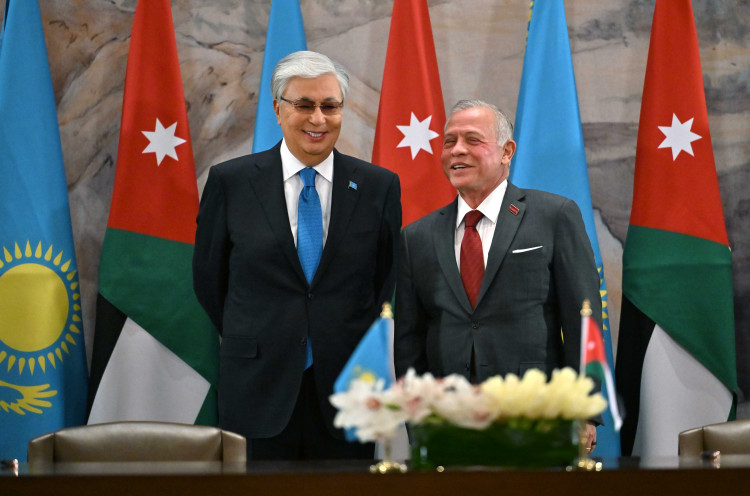
Kazakh President Kassym-Jomart Tokayev with King of Jordan Abdullah II Bin Al Hussein. Photo credit: Akorda
The visit follows President Tokayev’s trip to Amman, which laid a solid foundation for enhancing relations between Kazakhstan and Jordan.
Building on the agreements reached earlier this year, the two countries are now focused on implementing joint projects across a wide range of sectors, including energy, agriculture, pharmaceuticals, digitalization, education, transport logistics and tourism, reported Kazinform news agency on Aug. 26.
Strengthening strategic dialogue
The upcoming talks in Astana will also address issues of regional and international security, including efforts to stabilize the Middle East, as well as enhanced coordination within international organizations. Both leaders aim to further institutionalize political dialogue and create mechanisms for long-term cooperation.
At the heart of the visit is the Kazakhstan–Jordan Business Forum, scheduled to take place in Astana and bring together around 300 entrepreneurs and investors from both countries. The forum is expected to become a key platform for launching new projects and deepening trade and investment ties.
Expanding economic cooperation
In agriculture, the Kazakh Ministry of Agriculture and Jordan’s Ministry of Industry and Trade have already formed a working group to facilitate Kazakh wheat exports to Jordan, with the state-owned Prodcorporation being considered as the primary supplier.
Jordan’s Aljazeera Agricultural is preparing to sign a memorandum of understanding with the Kazakh Ministry of Agriculture to establish a pedigree poultry reproduction facility in Kazakhstan, a project that was first discussed during Tokayev’s visit.
In the pharmaceutical and medical sectors, Jordan’s Sana Pharma and other companies have expressed strong interest in entering the Kazakh market. A distribution agreement between Sana Farm and Kazakh Inkar Group, also initiated during earlier talks, is expected to be formalized at the upcoming business forum.
Jordan’s DadVet and Kazakh KazbioPharm have reached a preliminary agreement on veterinary cooperation, including the export of Kazakh veterinary vaccines – another area that has progressed since the February discussions.
Boosting digitalization and education
Digital transformation and technological exchange are key priorities in the growing partnership. Kazakh Astana Hub and Jordan’s King Hussein Business Park are implementing a memorandum aimed at supporting joint IT projects and startups.
In parallel, Astana IT University and Hussein Technical University have launched an educational partnership, with the first Jordanian students already enrolled in Kazakh programs. The initiative is expected to expand academic exchanges and foster stronger ties between young professionals in both countries.
Advancing energy and infrastructure projects
Energy cooperation remains a central focus. In February, the two countries signed a memorandum of understanding between Kazakhstan’s Ministry of Energy and the Jordan Atomic Energy Commission to strengthen collaboration in the peaceful use of nuclear energy.
In the field of construction and infrastructure development, Kazakh BI Construction Group is preparing to sign agreements with Jordan’s Amman Vision Investment & Development (AVID) and the Jordan Security Investment Fund. These projects aim to support urban development and modernization initiatives in both countries.
Launching direct flights
An important outcome of the ongoing dialogue is the planned introduction of direct flights between Astana and Amman. According to the Kazakh Ministry of Foreign Affairs, the legal framework has been fully prepared, and regular flights are scheduled to begin in June 2026, operating twice a week.
Jordan has confirmed its readiness to subsidize the initial phase of the route, making air travel more accessible and boosting tourism, business exchanges and people connectivity.
