
ASTANA – Kazakhstan called for renewed diplomacy to end the wars in the region while condemning attacks on infrastructure carrying its crude oil through the Black Sea as Foreign Minister Mukhtar Tileuberdi addressed the UN General Assembly on Sept. 25, warning of a deepening breakdown in international cooperation.
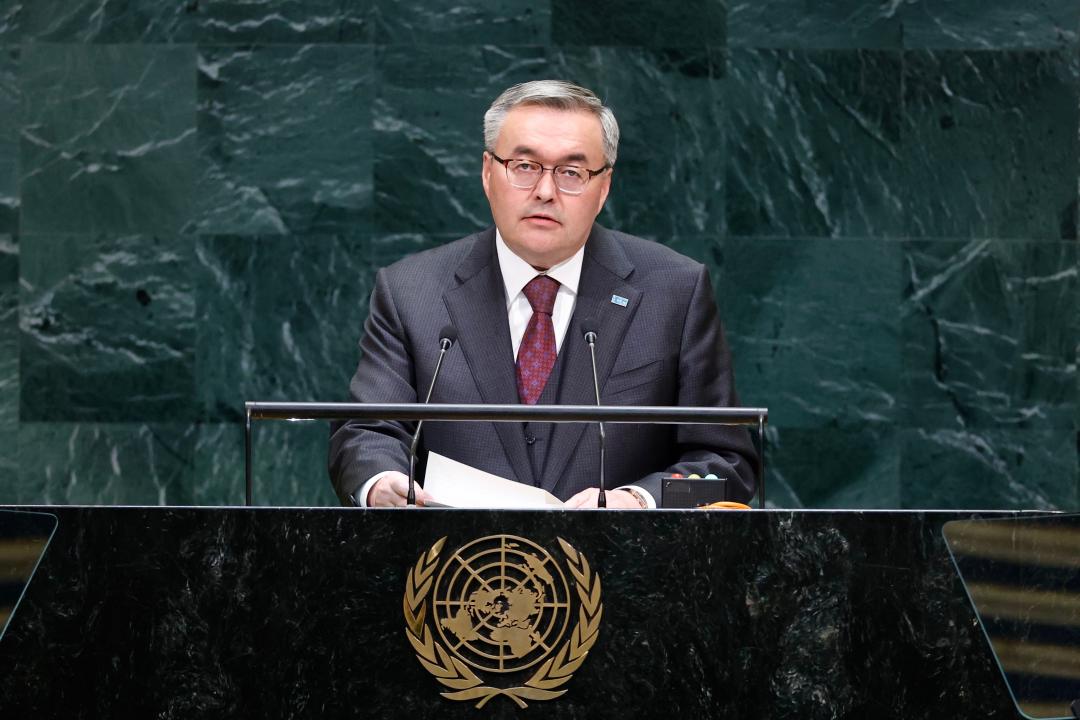
Mukhtar Tileuberdi. Photo credit: Kazakh Foreign Ministry
“We remain deeply concerned by the Ukrainian crisis, which continues to take lives, erode global trust and undermine international security. Even the most difficult conflicts must ultimately be resolved through diplomacy and negotiation,” said Tileuberdi, who heads Kazakhstan’s delegation at the UN high-level week this year.
“Beyond the tragic loss of life, Kazakhstan strongly condemns the repeated drone attacks against eight Kazakh crude oil export infrastructure, including against commercial vessels in the Black Sea basin. Such incidents endanger civilian navigation, disrupt international trade, and threaten the stability of global energy supplies,” he said.
Renewed call for diplomacy on the Middle East
Turning to the Middle East, Tileuberdi said political and diplomatic efforts remained the only viable path toward ending hostilities and reaching a sustainable settlement. He warned that continued escalation was affecting not only regional security but also economic stability, transport links and energy security.
“A just and lasting peace in the Middle East requires an independent, sovereign, and viable State of Palestine living side by side with Israel in peace and security. We support the New York Declaration as a framework for tangible, time-bound and irreversible steps towards the two-State solution,” said Tileuberdi.
“Kazakhstan calls for the full and good-faith implementation of the Comprehensive Plan to End the Gaza Conflict and Security Council resolution 2803. As a member of the Board of Peace, President Tokayev has committed to contribute to the stabilization of Gaza, by supporting civilian reconstruction, ensuring food security, and providing digital government solutions,” he said.
He also said Kazakhstan had formally announced its intention to join the Abraham Accords, describing them as an additional platform that could reinforce the UN-led political process toward a two-state solution.
Afghanistan needs more than humanitarian assistance
According to the Kazakh foreign minister, Afghanistan’s stability was inseparable from Central Asian security and development. He called for gradual international engagement coordinated through the UN rather than humanitarian assistance alone.
“Humanitarian assistance remains indispensable, but it cannot by itself break the cycle of poverty, displacement and dependency. Kazakhstan supports pragmatic, coordinated and step-by-step international engagement with Afghanistan, with the UN playing the central role,” he said.
Preserve biodiversity, not nuclear weapons
Kazakhstan also offered to host renewed high-level talks among nuclear powers, linking the proposal to its experience of relinquishing the arsenal it inherited after independence.
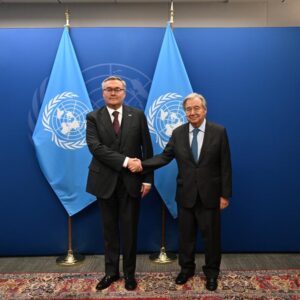
Mukhtar Tileuberdi held a meeting with UN Secretary-General António Guterres. Photo credit: Kazakh Foreign Ministry
“Our small planet is home to more than twelve thousand nuclear weapons, each one capable of untold damage and sorrow. Every year, we seem to lose more biodiversity yet gain more armaments,” he said, stressing that world military expenditures reached a record $2.9 trillion in 2025.
“For Kazakhstan, nuclear disarmament in particular is not an abstract doctrine. It is a responsibility born of national experience,” he added.
This year marks three important anniversaries: 35 years since the closure of the Semipalatinsk test site, 30 years since the Comprehensive Nuclear-Test-Ban Treaty (CTBT) opened for signature and 20 years since the Central Asian nuclear-weapon-free-zone treaty was signed.
Expressing concern over the erosion of trust between nations, Tileuberdi pointed to the expiration of New START, a nuclear arms reduction treaty between the United States and Russia, and the failure of the 2026 NPT Review Conference to produce a substantive outcome for a third consecutive cycle. He said nuclear-armed states remained bound by their responsibilities despite the lack of agreement and must continue working toward nuclear disarmament.
Erosion of trust
The international system is becoming less capable of preventing wars and humanitarian crises as trust between states erodes, said Tileuberdi.
“The erosion of trust among nations is rapidly reshaping the international order. Our collective inability to prevent conflicts, our collective indifference toward humanitarian crises, and our collective reluctance to seek common solutions to shared challenges are all becoming normalized,” said the minister.
“Trust cannot be restored when international law is applied selectively and commitments remain unfulfilled,” he added.
Kazakhstan also backed greater Security Council representation for Asia, Africa, Latin America, developing countries and middle powers, which the minister described as a “moral imperative.”
“Equitable geographical representation must apply throughout the United Nations system as a condition of legitimacy and credibility. The selection of the next Secretary-General will be one of the defining moments of this session. Kazakhstan supports a transparent, inclusive and merit-based process conducted in full accordance with the Charter,” he said.
The address reflected Kazakhstan’s broader effort to place a larger role for middle powers in international diplomacy. Tileuberdi said Kazakhstan would continue pursuing cooperation rather than confrontation, arguing that rebuilding trust would require states not only to reform international institutions but also to honor the commitments they make through them.
On the sidelines of the UN General Assembly, Tileuberdi also held a series of meetings focused on multilateral cooperation, regional connectivity and economic ties.
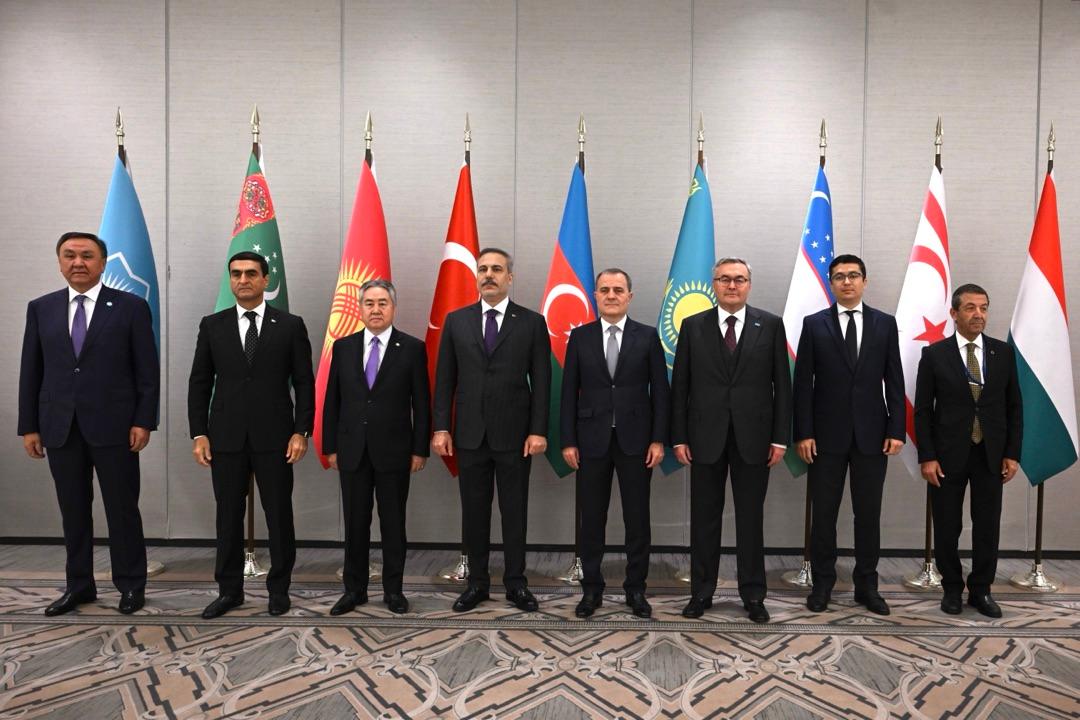
Tileuberdi participated in an informal meeting of the Council of Foreign Ministers of the Organization of Turkic States. Photo credit: Kazakh Foreign Ministry
In talks with UN Secretary-General António Guterres, he reaffirmed Kazakhstan’s support for UN reform and discussed the role of the UN Regional Center for the Sustainable Development Goals for Central Asia and Afghanistan in Almaty, while Guterres described Kazakhstan as a “bridge-builder” in an increasingly multipolar world.
Tileuberdi also joined an informal meeting of the Organization of Turkic States foreign ministers and held bilateral talks with counterparts from Cyprus, Georgia and Romania, covering energy, investment, transport and logistics, including the development of the Trans-Caspian International Transport Route and the Middle Corridor.
Earlier, Tileuberdi also held talks with his counterparts from Hungary, Moldova, Poland, Slovenia, Ukraine and El Salvador, the ministry’s press service reported.
