
On Aug. 29, 1991, Kazakhstan made a decision that would shape not only its own history, but also its place in the world. By decree, the Semipalatinsk nuclear test site was permanently closed.
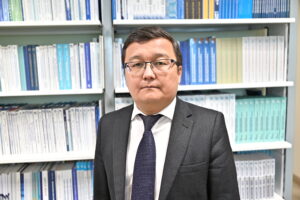
Dauren Aben. Photo credit:Dauren Aben’s personal archive
Thirty-five years later, the significance of that decision has acquired an even broader meaning.
Between 1949 and 1989, 456 nuclear explosions were conducted at Semipalatinsk, exposing local communities to radioactive contamination and leaving a legacy that continues across generations. The human and environmental consequences cannot be reduced to statistics. As UN Secretary-General António Guterres noted this year, “their suffering is not history. It is a warning.”
The closure of Semipalatinsk was therefore much more than an administrative act. It was a political choice: Kazakhstan chose to end nuclear testing even at a time when the Soviet Union still existed and the country’s own future was uncertain. That choice became one of the foundations of independent Kazakhstan’s foreign policy.
The legacy of Semipalatinsk also belongs to civil society. The Nevada-Semipalatinsk movement, founded in 1989 and led by poet and public figure Olzhas Suleimenov, helped turn opposition to nuclear testing into a powerful public cause. Demonstrations and peace marches in Kazakhstan and abroad helped create the political momentum that made the closure possible.
Kazakhstan subsequently renounced the world’s fourth-largest nuclear arsenal, joined the Treaty on the Non-Proliferation of Nuclear Weapons as a non-nuclear-weapon state, ratified the Comprehensive Nuclear-Test-Ban Treaty (CTBT), helped establish the Central Asian Nuclear-Weapon-Free Zone and worked with international partners to strengthen the global nonproliferation regime.
In 2009, Kazakhstan proposed that Aug. 29 become the UN International Day against Nuclear Tests. The General Assembly adopted the initiative unanimously. The date thus became more than a national commemoration: it became part of the global calendar of nuclear disarmament.
But Kazakhstan’s contribution did not stop with declarations.
Today, five stations on its territory form part of the CTBT’s International Monitoring System, providing real-time data for the global verification regime. Kazakhstan also hosts the IAEA Low Enriched Uranium Bank at the Ulba Metallurgical Plant in Oskemen, creating an important international mechanism for ensuring access to nuclear fuel while reducing incentives for countries to develop their own enrichment capabilities.
The country has also sought to give the humanitarian legacy of nuclear testing a stronger place on the international agenda. Together with Kiribati, another country profoundly affected by nuclear testing, Kazakhstan has led efforts under the Treaty on the Prohibition of Nuclear Weapons to advance victim assistance and environmental remediation. In 2022, the two countries proposed the establishment of an international trust fund to help affected communities and contaminated territories. The initiative has since developed into a broader international process.
This is an important point. Nuclear justice is not simply about remembering the past. It is about ensuring that those who continue to live with the consequences of nuclear testing receive meaningful assistance and that contaminated environments receive sustained attention. For Kazakhstan, the moral authority to speak on this issue comes from experience, but that experience also carries a continuing responsibility toward affected communities.
At the same time, Kazakhstan’s nuclear policy is not defined by opposition to nuclear technology itself.
This may appear paradoxical, but it is not. A country can reject nuclear weapons while embracing the peaceful uses of the atom. Kazakhstan is the world’s leading uranium producer and regards nuclear energy as an important element of its long-term energy security and technological development. It has embarked on plans to develop nuclear power generation, reflecting the distinction between nuclear weapons and the responsible civilian use of nuclear technology.
This evolution – from a nuclear testing ground to a center of nuclear diplomacy, from nuclear weapons to nuclear energy – is perhaps the most remarkable part of Kazakhstan’s story.
Yet the work remains unfinished.
2026 marks not only 35 years since Semipalatinsk was closed, but also 30 years since the CTBT opened for signature. The treaty has 188 signatories and 179 ratifications, but it has still not entered into force.
The lesson of Semipalatinsk is that history can change when governments are prepared to make difficult choices. Kazakhstan made such a choice in 1991. The international community now faces another one: whether to turn the existing global norm against nuclear testing into a permanent, legally binding prohibition.
Thirty-five years after Semipalatinsk, Kazakhstan’s message is therefore not simply “remember.” It is “remember and act”.
The world must ensure that the suffering caused by nuclear testing is never repeated, that its survivors are not forgotten, and that future generations inherit a world in which nuclear explosions belong to history.
As the UN Secretary-General reminded us recently, nuclear tests do not prove strength. They shatter trust, fuel arms races and betray communities still living with their consequences.
Today, the international security environment is once again marked by confrontation, mistrust and renewed debates about nuclear weapons. Semipalatinsk stands as both a warning from the past and a responsibility for the future.
The author is Dauren Aben, the deputy director at the Kazakhstan Institute for Strategic Studies under the President of Kazakhstan.
Disclaimer: The views and opinions expressed in this article are those of the author and do not necessarily reflect the position of The Astana Times.
