
ANTALYA – What began as an intellectual vision of unity in language and culture a century ago is now translating into concrete cooperation across the Turkic world, officials said on April 19 at the Antalya Diplomacy Forum. They highlighted joint initiatives and a UNESCO-backed recognition of Turkic languages.
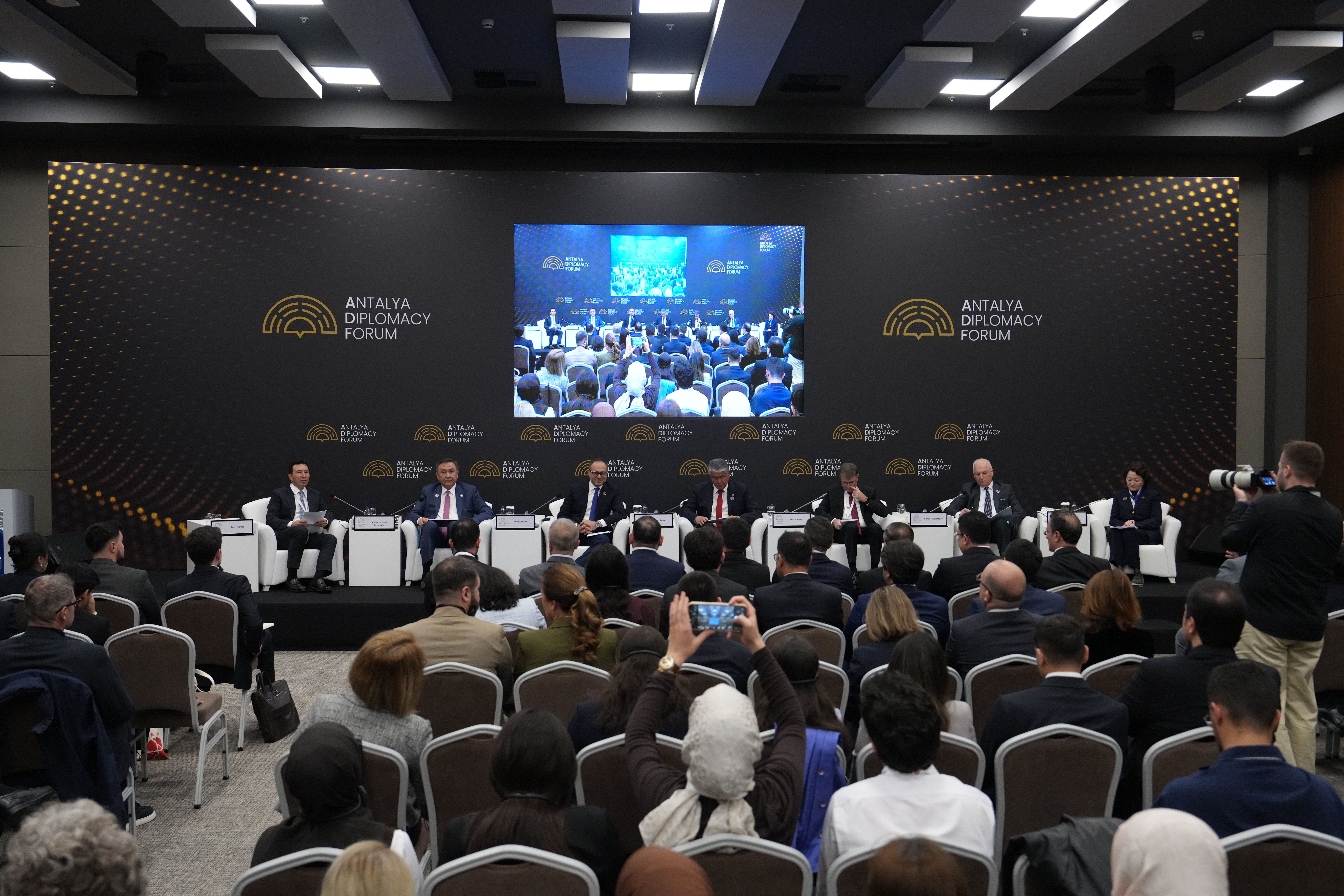
The panel took place at the ADF on April 19, titled A Century of Language and Identity From Baku Turkology Congress to Turkic Integration. Photo credit: ADF
Kubanychbek Omuraliev, secretary-general of the Organization of Turkic States (OTS), linked growing engagement in the Turkic world to a century-old vision of unity, first articulated by prominent Turkic thinker Ismail Gasprinski.
“However, due to the well-known historical and political circumstances, the realization of the ideas required almost an entire century. It was only in the 1990s, following the collapse of the Soviet Union, that the Turkic states regained independence. This historic turning point created for the first time the necessary political condition to transform the intellectual ideas of the Baku congress [the First Turkological Congress held in Baku in 1926] into concrete political will and practical cooperation,” said Omuraliyev.
He described the first summit of Turkic state leaders in 1992 in Ankara as a milestone event that laid the tradition of regular high-level dialogue among Turkic countries. “Over time, this engagement deepened mutual understanding and strengthened the institution’s foundation of cooperation,” he added.
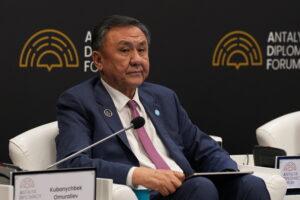
OTS Secretary General Kubanychbek Omuraliev. Photo credit: ADF
Cooperation deepened over time, culminating in the 2009 Nakhchivan Summit, which established the Turkic Council, later rebranded as the Organization of Turkic States at the 2021 Istanbul Summit to reflect its expanding scope and strategic role.
“In parallel with the institutional development, our current Turkic cooperation organizations have emerged, actively contributing to collaboration in various sectors such as culture, education, business, and investment,” he said.
Turkic cooperation spans more than 40 areas, supported by a network of institutions, including TURKSOY, the Turkic Academy and the Turkic Investment Fund, among others.
He also highlighted ongoing efforts to develop a common historical narrative, create a shared alphabet and preserve cultural heritage as key steps toward deeper integration. “Such initiatives have the potential to serve as powerful instruments for fostering deeper unity among the Turkic people,” he said.
Century-old vision brought to life
Shahin Mustafayev, president of the Turkic Academy, said the 1926 Baku Turkology Congress should be understood as a landmark intellectual and cultural moment. Speaking at the same panel, Mustafayev said the congress brought together, for the first time, scholars and intellectuals from across a vast geography to discuss the shared language, history and future of Turkic peoples.
“And at the same time, they had the opportunity to make very important decisions regarding the future of Turkic languages,” he added.
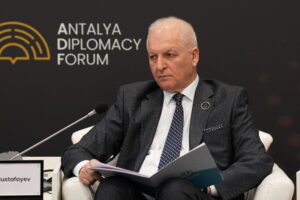
Shahin Mustafayev. Photo credit: ADF
Mustafayev said the congress laid the foundations for Turkology as a modern scientific discipline, expanding it beyond linguistics to include history, ethnography, folklore and social life. The congress, he noted, also contributed to the formation of a shared cultural consciousness across the Turkic world, including early discussions on a common alphabet, terminology and historical narrative.
“As a result of this congress, the concept of the Turkic world came to signify not only a geographical space or territorial unity, but also a cultural consciousness rooted in shared language, history and heritage. Today, when we use the term ‘Turkic world,’ we do so with the meaning and significance shaped by that congress,” Mustafayev said.
He noted that, at the initiative of the Turkic Academy, a major international symposium will be held in Almaty in May, bringing partner institutions from across the Turkic world.
UNESCO-backed recognition
Aktoty Raimkulova, head of the Turkic Culture and Heritage Foundation, said growing international recognition of Turkic languages and heritage reflects both historical continuity and renewed global engagement. Addressing the panel, Raimkulova welcomed UNESCO’s designation of Dec. 15 as World Turkic Language Family Day.
“The designation of Dec. 15 as World Turkic Language Family Day by UNESCO is an important step that strengthens global recognition of Turkic linguistic heritage and cultural unity. As you know, this decision was adopted at the UNESCO General Conference in Samarkand last year, held in November in Samarkand,” she said.
Raimkulova said the foundation has been contributing to this effort, including by organizing events at UNESCO and launching major cultural initiatives. Among them is a multilingual, multi-volume anthology of Turkic folklore, developed following a decision by leaders of OTS in Bishek in 2024.
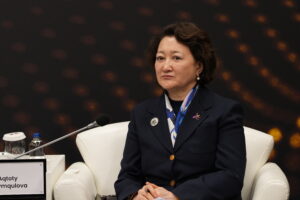
Aktoty Raimkulova. Photo credit: ADF
“It is a very necessary work, and last year we printed the first edition dedicated to heroic epics, which we also presented in Samarkand at the UNESCO General Conference,” she added.
Another flagship initiative is the creation of a comprehensive catalog of tangible and intangible cultural heritage across Turkic countries, covering around 70 monuments and cultural elements. The project aims to systematically document and preserve shared heritage, with a second volume currently in preparation.
“Many of the ideas we are implementing today were already articulated almost a century ago by our very famous scholars and intellectuals of that time,” she said, adding that the foundation plans to host a major event at UNESCO headquarters in Paris in December to mark the first Turkulogy congress’s 100th anniversary, with support from member states.
“Holding such an event at UNESCO is particularly important for all of us, as it gives additional international recognition and visibility to Turkic cultural heritage,” she said, noting that similar events were held dedicated to Mahmud al-Kashgari, Ajami Nakhchivani and Nurgisa Tlendiyev.
Language at the core of cultural identity
Sultan Raev, head of the TURKSOY, echoed Raimkulova’s remarks, saying the designation of Dec. 15 as World Turkic Language Day by UNESCO reflects years of coordinated effort among Turkic countries to elevate their shared linguistic and cultural heritage. Raev emphasized that language lies at the core of cultural identity, describing it as a carrier of memory, traditions and collective experience.
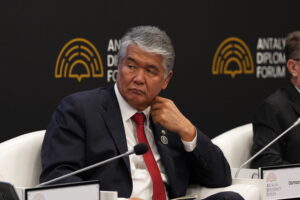
Sultan Raev. Photo credit: ADF
“Everything that a nation lives is carried in every other language it produces. In the Turkic world, it is not a matter of establishing a new relationship. These languages are already nourished from the same roots. The real issue is to make this common heritage stronger and to make it more visible to the world,” he said.
He said the growing economic role of the region should be matched by deeper cultural integration, driven by literature, cinema and the arts.
“A novel begins in the streets of Tashkent and continues on the coasts of Istanbul’s Bosphorus. The same spirit finds life in different forms. The same memory is told in different places. This is a story that extends from place to place,” he said.
The Antalya Diplomacy Forum convened on April 17 and brought together leaders, diplomats, policymakers and media from nearly 150 countries. President of Kazakhstan Kassym-Jomart Tokayev addressed a high-level panel, calling for greater responsibility and pragmatism among global leaders and renewed efforts to reform the United Nations.
On the sidelines of the forum, Kazakhstan’s Foreign Minister Yermek Kosherbayev joined an informal meeting of the OTS Council of Foreign Ministers. The ministers discussed key regional and global issues, including efforts to ease tensions in the Middle East, and exchanged views on potential pathways toward stabilization.
Kosherbayev added that the upcoming informal summit of the OTS scheduled to take place in Turkistan in May is expected to provide new momentum for strengthening cooperation and enhancing the organization’s role through closer coordination among member states.
