
Space debris isn’t just a hurdle for astronauts or a plot point for sci-fi movies—it is a looming threat to our modern way of life. Today, tens of thousands of cataloged objects larger than 10 cantimetres, from spent rocket stages to dead satellites, are hurtling through low Earth orbit at immense speeds. If we don’t act, we face the “Kessler Syndrome”: a chain reaction of collisions that could shroud Earth in a permanent cloud of junk.
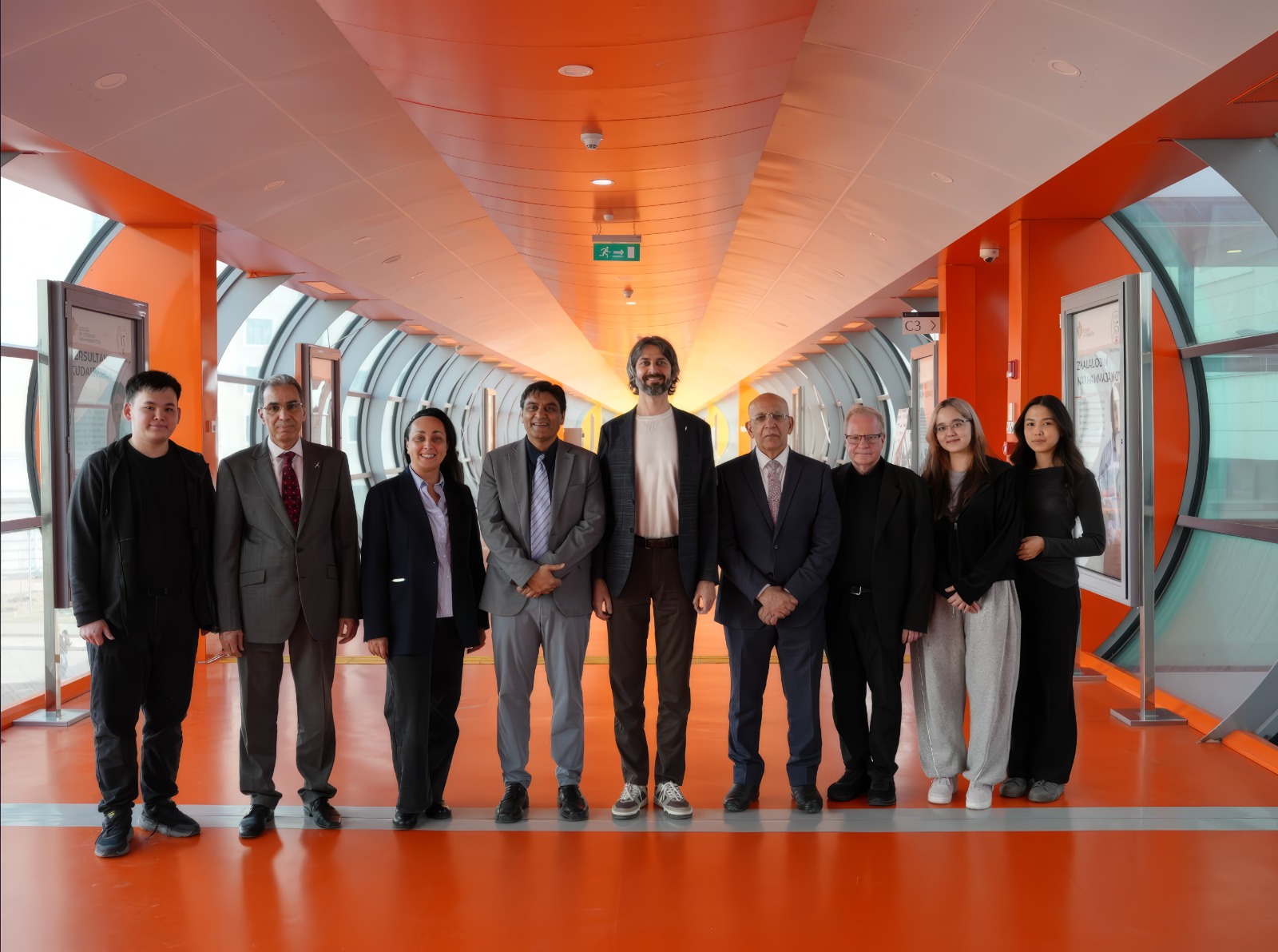
L to R: research assistant Zhambyl Muratkhan; Dr. Essam Shehab, Professor & Dept. Head at the Mechanical and Aerospace Engineering Department under the School of Engineering and Digital Sciences; Dr. Yelyzaveta Arkhangelsky, Dean & Professor at School of Engineering and Digital Sciences, Dr. Rehan Sadiq, Professor & Provost, Dr. Dmitry Sizov, Instructor, Principal Investigator of the TARAZ Project, School of Engineering and Digital Sciences, Department of Mechanical and Aerospace Engineering, Dr. Waqar Ahmad, Professor & President; Dr. Bjorn Birgisson, Professor & Vice Provost for Research and Innovation; research assistants Aruzhan Temreshova Aruzhan Bakyt.
The consequence? Our “door to space” could be slammed shut for centuries, marooning us on Earth and killing our dreams of Mars or lunar exploration. But more urgently, it would dismantle the invisible infrastructure that keeps our world running.
Life without the high ground
We often take space for granted, but our daily lives are tethered to it. A Kessler-style collapse of our satellite network wouldn’t send us back to the Middle Ages, but it would cripple the efficiency of the 21st century.
● Financial Chaos: Global markets rely on the hyper-precise time synchronization provided by GPS satellites. Without it, the world’s financial systems wouldn’t just slow down; they could face a systemic collapse until ground-based alternatives are built.
● Logistical Nightmares: Air and naval navigation would be forced to revert to legacy radio systems, complicating global trade and travel, leading to increased shipping times, higher costs, and potential safety risks for vessels at sea.
● Environmental Danger: Without meteorological satellites, our ability to predict natural disasters, track climate change, and manage high-tech agriculture would vanish.
In short, the loss of space is a financial and humanitarian crisis waiting to happen.
The “Empty Space” fallacy
Critics often argue that space is vast, and debris is sparse. While true, satellites aren’t scattered randomly; they occupy specific “orbital highways” that are becoming increasingly crowded. We’ve already seen the warning signs. In 2009, two satellites collided in a major orbital accident, and the International Space Station (ISS) must now frequently “dodge” debris to stay safe. With thousands of new satellites launching for global internet constellations, the clock is ticking.
From Cleaning Up to Recycling
The scientific community knows that simply “not littering” is no longer enough. To stabilize the environment, we must proactively remove at least five large objects from orbit every year.
Local innovation: Nazarbayev University in Kazakhstan is actively tackling this head-on. A research team led by Dr. Dmitry Sizov at the School of Engineering and Digital Sciences in the Department of Mechanical Engineering and Aerospace is developing a cost-effective system for active debris removal. Supported by the Ministry of Science and Higher Education of the Republic of Kazakhstan, our mission uses a “nanosatellite” platform to test tethered towing. Instead of expensive chemical fuel, we utilize an innovative aerodynamic drag sail to pull debris back into the atmosphere—a cheaper, greener way to clean up the stars.
However, the future shouldn’t just be about burning junk. It’s more rational to treat debris as a resource. Since we’ve already paid the fuel tax to get these materials into orbit, future robotic factories could use 3D printing to recycle old satellites into new space structures.
A test of collective responsibility
Ultimately, space debris is a classic “tragedy of the commons.” Near-Earth space is a shared environment, yet we lack a global system of accountability. Who pays for the cleanup? Who is liable for a thirty-year-old rocket stage?
Addressing the challenge of space debris is not merely an engineering problem; it is fundamentally an ethical imperative. We must transition from a “launch and forget” mentality to one of sustainable stewardship, recognizing that space functions as a shared commons requiring collective governance. This necessitates the establishment of global regulatory frameworks that complement technological innovation—rules that ensure responsible use of orbital environments alongside the development of advanced debris mitigation and removal technologies.
It is no longer sufficient to continue current practices of orbital littering. Instead, we must embrace comprehensive strategies for debris recycling and active removal. Protecting our orbital environment ensures that future generations will not merely observe the stars through a veil of debris but will retain the practical capability to access and utilize space. Preserving the integrity of Earth’s orbit is essential to keeping the door to the stars open for those who follow.
The author is Dr. Lisa Lim, an Assistant Professor at the Graduate School of Public Policy, Nazarbayev University (Astana, Kazakhstan). Prior to joining the GSPP, she held a Visiting Professor position at the KDI School of Public Policy and Management in South Korea.
Disclaimer: The views and opinions expressed in this article are those of the author and do not necessarily reflect the position of The Astana Times.
