
ASTANA — Kazakhstan’s tourism story is increasingly being written not in cities, but in landscapes. From alpine trails near Almaty to the desert plateaus of Mangystau, the country is seeing a clear shift: nature is no longer a backdrop—it’s the main draw. According to data reported by Kazinform, both international arrivals and domestic travel are on the rise, with eco-tourism emerging as one of the fastest-growing segments.
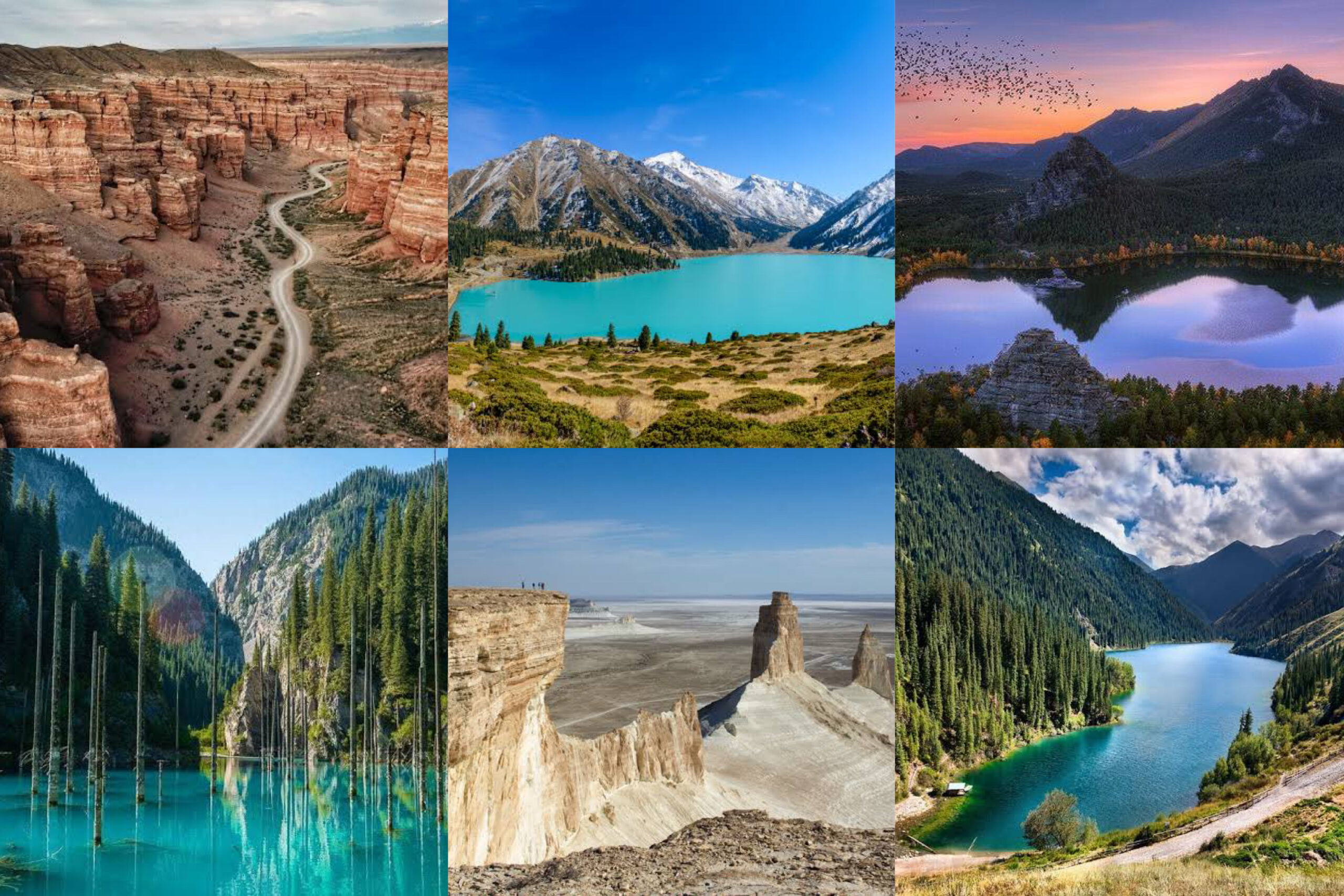
Collage is created by The Astana Times.
In the first seven months of 2025 alone, nearly 2 million people visited national parks across the country. The numbers point to more than just seasonal demand; they reflect a structural change in how Kazakhstan is being explored.
At the center of this shift is Burabai National Park, which drew over 600,000 visitors. Often dubbed the “Kazakh Switzerland,” it offers an accessible version of nature: lakes, forests, and dramatic rock formations within reach of short-term travelers. Its appeal is simple—high impact, low effort.
Close behind is Ile-Alatau National Park, close to Almaty, where more than half a million visitors sought out mountain routes and high-altitude scenery. Its proximity to the country’s largest city makes it a natural extension of urban life, less a destination, more a weekend reflex.
Further east, Kolsai Lakes National Park continues to build its reputation as one of Kazakhstan’s most photogenic locations. With over 350,000 visitors, its alpine lakes, particularly Kaindy, with its submerged forest, have become staples of travel feeds and visual storytelling.
The pattern holds across the rest of the top five: Charyn Canyon, often compared to a smaller Grand Canyon, and Bayanaul, the country’s oldest national park, known for its lakes and granite peaks.
This momentum is not limited to domestic travel. Kazakhstan is also attracting a growing number of international visitors, with over 12.2 million arrivals recorded in the first nine months of 2025. The increase is not dramatic but is consistent and increasingly diversified.
China stands out as the fastest-growing market, with arrivals up 42% year-on-year to more than 693,000 visitors. Visa-free travel, expanded air connections, and targeted promotion are clearly paying off. India, Turkey, Germany, and South Korea are also contributing to the upward trend, suggesting Kazakhstan is gradually expanding beyond its traditional tourist perimeter.
At home, the geography of travel is equally telling. The Almaty mountain cluster dominates, accounting for nearly half of all domestic flow. It combines what modern tourism increasingly demands: accessibility, infrastructure, and visual payoff.
Beyond Almaty, the Shchuchinsk-Burabai resort area continues to anchor northern tourism, while Mangystau offers something more unconventional: otherworldly landscapes, underground mosques, and the stark beauty of the Ustyurt Plateau.
Lakes such as Alakol and Balkhash, along with the Caspian coast, round out a map that is becoming more diverse and more competitive.
Behind this growth are several overlapping trends. Short trips are replacing longer stays, making proximity a key advantage. Global demand for eco-tourism is rising, and Kazakhstan’s geographic diversity, from mountains to deserts, positions it well to respond. At the same time, social media is doing what marketing campaigns often cannot: turning remote locations into recognizable destinations.
Infrastructure, slowly but steadily improving, is closing the gap between potential and accessibility. The question now is not whether Kazakhstan can attract tourists, but whether it can manage that growth without undermining the very landscapes that drive it. For now, the trajectory is clear: Kazakhstan is no longer just on the map. It is becoming the map for a specific kind of traveler, one looking not for cities, but for vast spaces.
