
ASTANA – Although nomadic society lacked formal statistical systems, Kazakhs developed their own methods to estimate population size. Instead of precise figures, they relied on social and administrative units such as ulus (state), ru (clan) and shanyrak (household), forming a system adapted to the realities of steppe life.
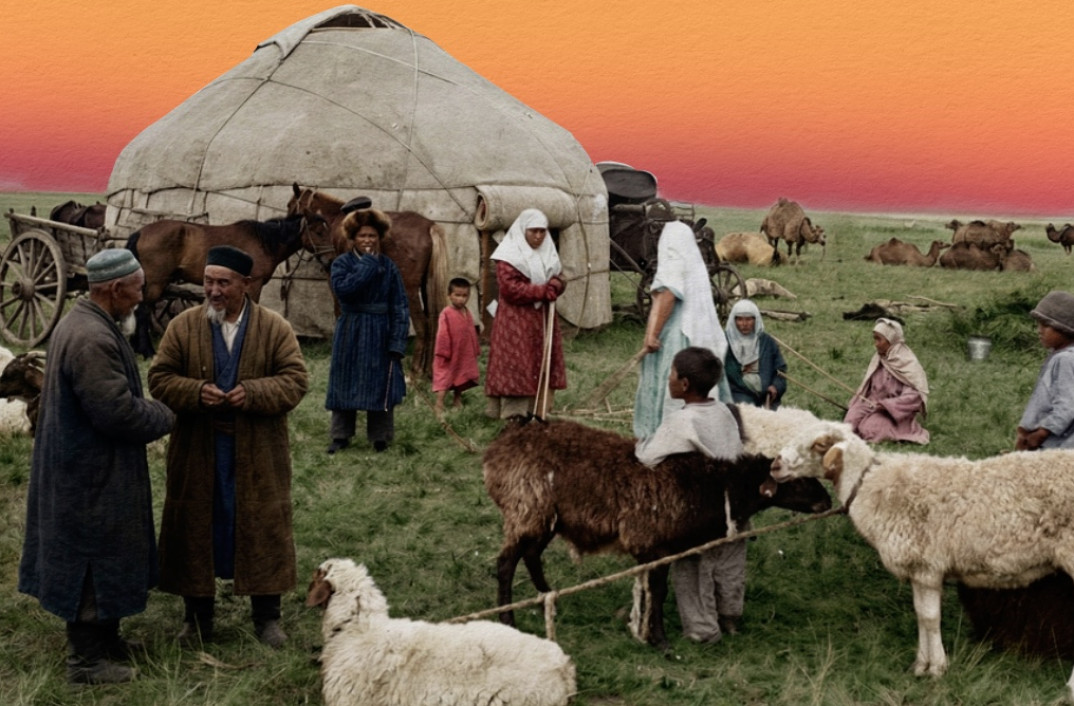
Photo credit: Qalam
According to Berikbai Karibayev, the Doctor of Historical Sciences and Professor at Al-Farabi Kazakh National University, there was no standardized methodology for counting the population during the Kazakh Khanate, but approximate calculations were widely used.
“In the 15th and 16th centuries, there was no precise system to determine population size. However, methods of approximate calculation existed,” he said.
The main unit of measurement was the ulus, which functioned both as a territorial entity and as an administrative structure with a defined population.
“Sources suggest that one ulus included nearly 10,000 shanyraks. On average, each household consisted of up to six people,” Karibayev said.
He added that, based on this estimate, the population of a single ulus ranged from around 50,000 to 80,000 people, roughly equivalent to a modern district.
First estimates: the era of Kasym Khan
One of the earliest references to the total population of the Kazakh people appears in Tarikh-i Rashidi by Muhammad Haydar Dughlat.
“The chronicle notes that the Kazakh population exceeded one million during the reign of Kasym Khan, a period of the Khanate’s peak, when its territory stretched from the Irtysh to the Volga and from Tobol to the Syr Darya,” Karibayev said.
He noted that this figure developed gradually.
“Before the formation of the Kazakh Khanate, three major uluses, Mangyt, Shiban and Orda-Ejen, existed in the region, with a combined population of around one million people,” he said.
When Kerey Khan and Janibek Khan broke away, not all groups followed them immediately.
“The Orda-Ejen ulus did not migrate in full, roughly one-third to half joined them. Even so, their numbers reached around 200,000 within a short period,” Karibayev said.
Counting households across the steppe
This method of estimation remained in use for centuries. Even in the 19th century, when the Russian Empire began studying the Kazakh steppe, population size was still calculated based on households.
“Orenburg Governor-General Volkovsky gathered information through traders, recording clans, their wintering sites, leadership and the number of households. However, this was not a formal census, but approximate data,” Karibayev said.
Among early researchers, Alexey Levshin estimated the Kazakh population at between 2 million and 3 million in his 1832 work.
The first full census in the Kazakh steppe was conducted in 1897.
“According to that census, the Kazakh population was around 4.5 million. However, even this figure is incomplete. One reason was the traditional belief ‘do not count people’ (adamdy sanama). Many families deliberately concealed their actual size, and some clans were not recorded at all,” Karibayev said.
Karibayev added that population estimates were not merely academic.
“Rulers needed to understand how many people were under their authority and how many warriors they could mobilize in times of war,” he said.
The article was originally published in Kazinform.
