
ALMATY – Tucked into the foothills of the Alatau mountains, an unusual home in Almaty looks more like a sculptural landscape than a place to live. Built from natural materials and shaped by hand, the house blends ancient construction techniques with modern ideas of sustainability and design.
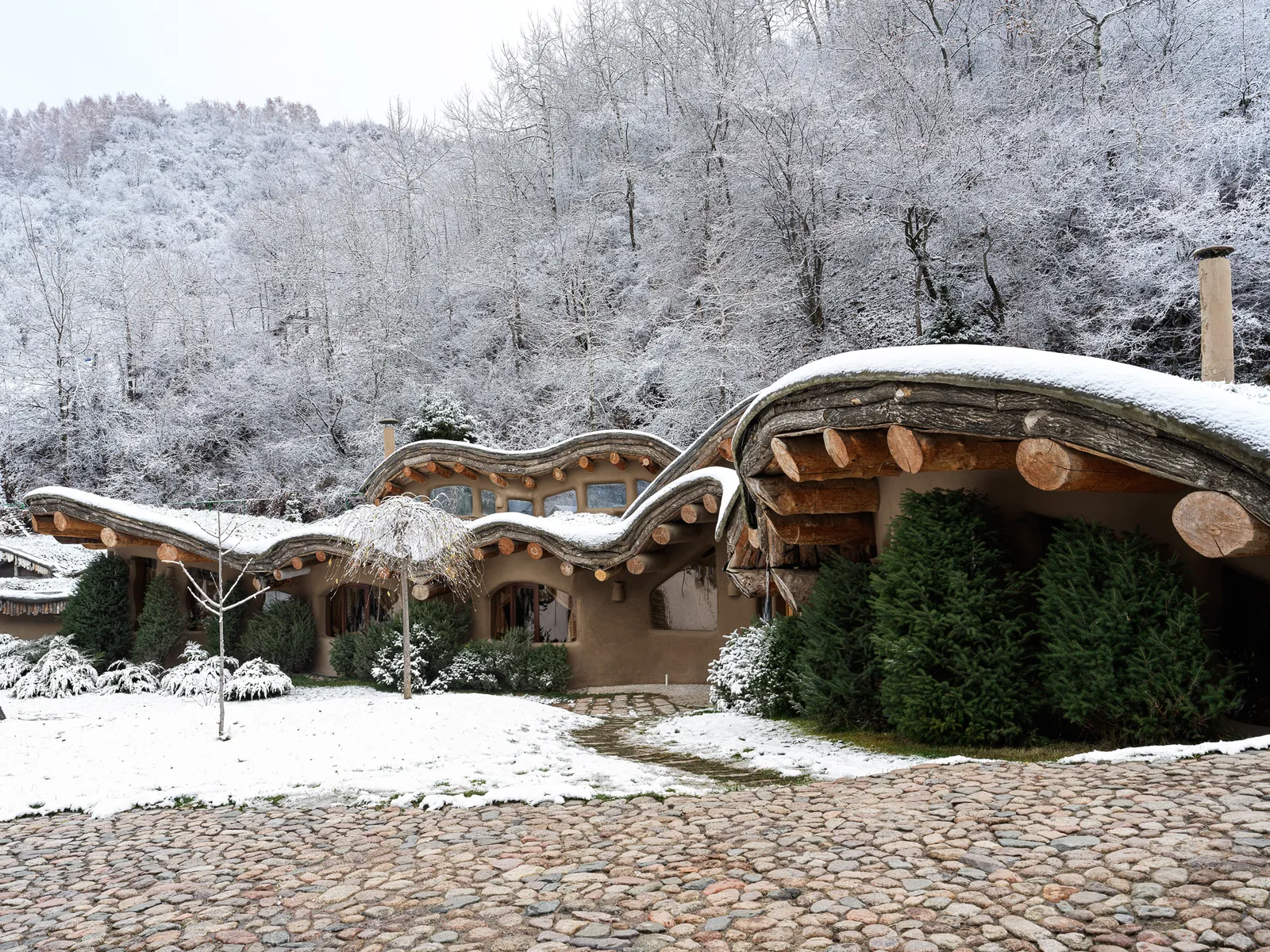
Tucked into the foothills of the Alatau mountains, an unusual home in Almaty looks more like a sculptural landscape than a place to live. Photo credit: Sergey Krasyuk.
For its creators, Dilyara Mazhitova and Vladimir Radostovets, the project began as an experiment but evolved into something far more ambitious – a living, breathing structure inspired by nature itself.
“When people first encounter our house, they struggle to believe it’s a residence. Most assume it’s a public space – a restaurant or a retreat. People simply don’t build homes like this,” Mazhitova said.
A home shaped by nature
The couple designed and built the house themselves using cob, a traditional building method made from clay, sand, straw and water. Known for its durability and natural insulation, cob has been used for centuries but is rarely seen in contemporary architecture at this scale.
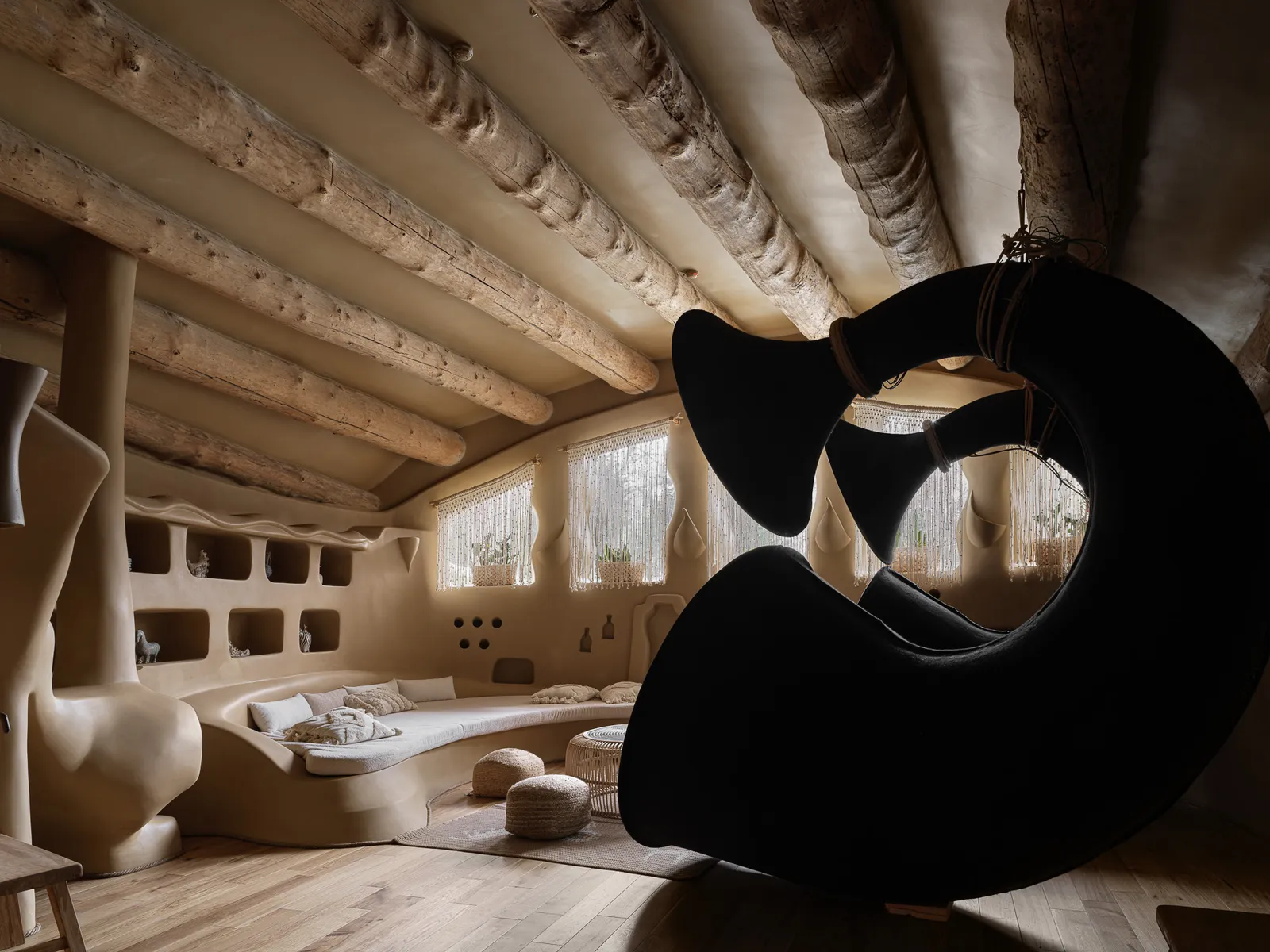
One of the home’s most distinctive features is a set of large acoustic horns, designed by Radostovets. Photo credit: Sergey Krasyuk.
Inspired by desert dunes and ocean waves, the house features flowing walls, curved ceilings and a rippling roofline. There are no sharp corners or conventional divisions between spaces. Instead, rooms transition seamlessly into one another.
“The space transitions organically from one room to another – there are no thresholds, no baseboards, no chandeliers. It functions as a single, cohesive organism,” said Mazhitova.
The layout centers around a communal living space, with private areas branching organically from it.
A decade-long transformation
Originally planned as a three-month build, the project ultimately took ten years to complete. Over time, the house became less of a construction project and more of an evolving artwork.
The design process began with simple sketches, which were then mapped onto the land using stones from a nearby river. While the structural frame rose quickly, shaping the interior required years of experimentation.
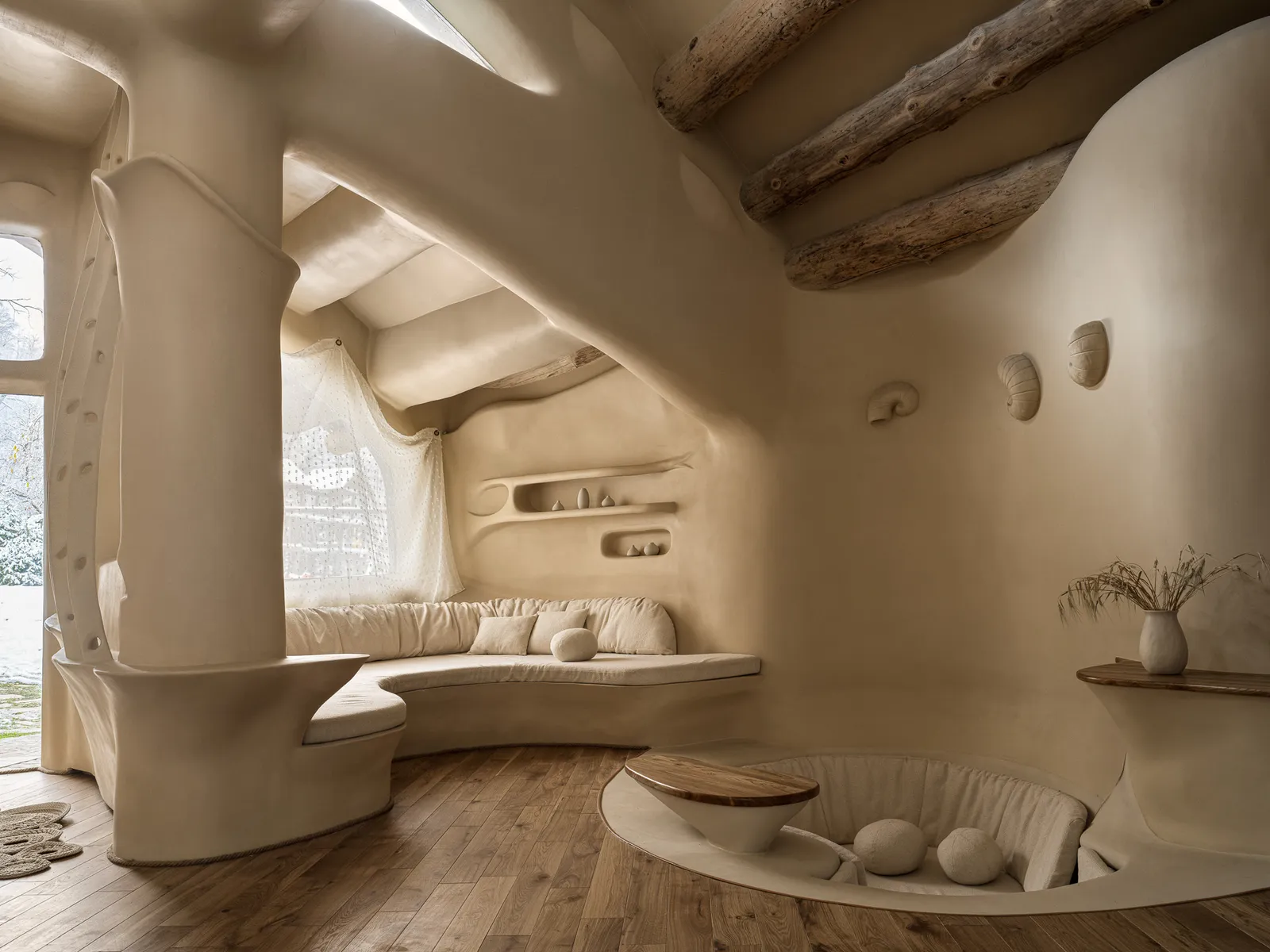
Inspired by desert dunes and ocean waves, the house features flowing walls, curved ceilings and a rippling roofline. Photo credit: Sergey Krasyuk.
One challenge was that part of the house is embedded into the mountainside, leaving one side without windows. To address this, the couple installed skylights and decorative recesses to create the illusion of natural light. A continuous row of windows beneath the roofline further brightens the interior.
“In the end, the project stretched over ten years, as the house transformed into an art piece that we sculpted, modified and perfected. We drew inspiration from nature’s organic forms, aiming to integrate the house seamlessly into the landscape rather than imposing an artificial structure upon it,” Mazhitova said.
Craft, sound and sensory design
Nearly every element of the house is handcrafted. Furniture is built directly into the structure, growing out of the walls, while textiles and decorative elements are sourced from local artisans.
Traditional solutions were adapted to fit the unconventional design. Since cob walls cannot support nails, the couple developed custom systems, including macramé curtains mounted on wooden branches.
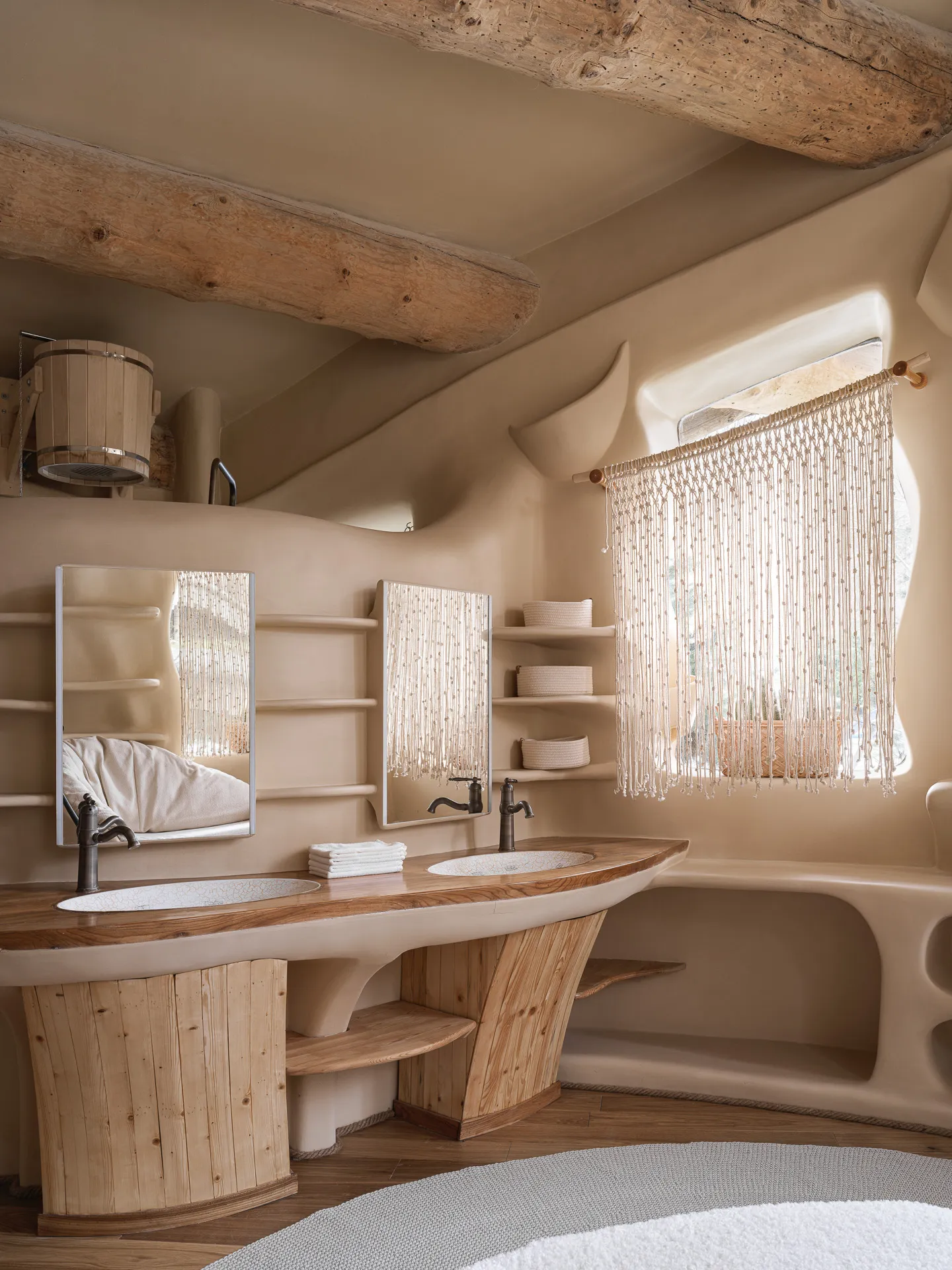
Since cob walls cannot support nails, the couple developed custom systems, including macramé curtains mounted on wooden branches. Photo credit: Sergey Krasyuk.
One of the home’s most distinctive features is a set of large acoustic horns, designed by Radostovets. Both sculptural and functional, they enhance sound within the space and serve as part of a home cinema setup.
“They produce extraordinary sound,” Mazhitova said. “It’s a completely different experience.”
Sustainable by design
Sustainability is central to the home’s concept. The roof combines a waterproof membrane made from recycled materials with layers of earth, allowing vegetation to grow, helping the structure blend into its surroundings, and preventing erosion.
Inside, a hydroponic wall near the kitchen supports the cultivation of herbs, reinforcing the home’s self-sustaining philosophy.
“The idea was to create a cycle — a system that supports itself,” she said.
A stroke of luck also contributed to the design as several fallen fir trees were repurposed into structural elements of the roof, now visible throughout the house like an organic spine.
Living with the elements
The house was designed to incorporate all four natural elements: earth, water, fire and air. It includes fireplaces, a pool, and natural ventilation systems, with greenery both inside and out, including a hydroponic wall for growing herbs.
The house continues to evolve alongside the family. The couple began building it in 2012 and has since raised three children. What started as an architectural experiment has become a deeply personal space shaped by time, creativity and shared experience.
“It’s a place where you can escape modern chaos. A house where conflict feels impossible,” Mazhitova said.
The article was originally published by Architectural Digest Middle East.
