
ALMATY — Archaeologists have begun a new excavation season at the medieval settlement of Zhankent in Kazakhstan’s Kyzylorda Region, continuing efforts to uncover the history of one of the most significant cities of the Oghuz state and a key site along the Silk Road, reported Kazinform.
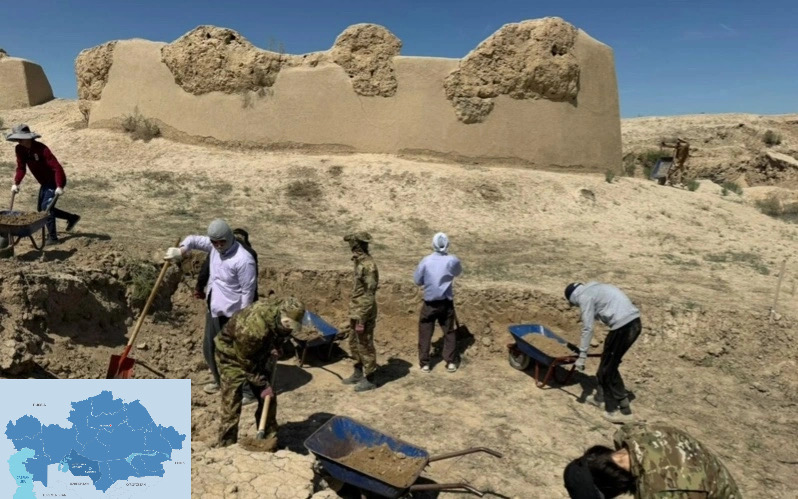
Archaeologists have begun a new excavation season at the medieval settlement of Zhankent in Kazakhstan’s Kyzylorda Region. Photo credit: Korkyt Ata Kyzylorda University. Click to see the map in full size. The map is designed by The Astana Times.
The archaeological works, supported by the regional administration, are taking place at the historic settlement in the Kazaly District. The project brings together researchers from the Archaeology and Ethnography Research Center of Korkyt Ata Kyzylorda University, archaeologists, students and specialists from the regional center for the protection of historical and cultural heritage.
According to Yerqazy Aldanazarov, head of the regional heritage center, archaeological research at Zhankent has been funded by the regional budget since 2014.
Decade of discoveries
Over the past decade, researchers have uncovered and preserved sections of the city’s defensive walls and towers, residential quarters, important public structures and ceramic kilns used for pottery production.
One of the excavated houses has been transformed into a historical display featuring figures that depict daily life and traditions of the Oghuz period, allowing visitors to visualize how residents once lived within the city walls.
Infrastructure around the site has also been upgraded. A road has been built to improve access for tourists and researchers, and the settlement has been fully enclosed within its protected zone.
In 2019–2020 and again in 2025, Kazakhstan’s Ministry of Culture restored portions of the eastern defensive wall and the citadel’s gates.
This year’s excavations will focus on the eastern gate complex and the shahristan, or central urban area, of the ancient city.
New finds emerge from residential quarter
Archaeologists have reported the discovery of several valuable artifacts during this year’s excavation campaign in the residential sector of the shahristan. While uncovering cultural layers of the ancient city, researchers found fragments of ceramic vessels, asyks (traditional knucklebones used in games) and animal bones.
According to the Kyzylorda Regional Center for the Protection of Historical and Cultural Heritage, the ceramic fragments will help specialists study the types and manufacturing techniques of everyday household items used by Zhankent residents. The animal remains are expected to provide insights into the population’s diet, livestock practices and broader economic activities.
All artifacts have been cataloged, measured and documented in accordance with scientific standards. The recovered materials will now undergo laboratory analysis and further scientific study.
UNESCO recognition and preservation
Historians believe Zhankent served as an important political center of the Oghuz state due to its strategic location between nomadic steppe territories and settled agricultural regions.
The city also occupied a critical position on trade routes linking Oghuz lands with the historic regions of Khorezm, Transoxiana and Khorasan, making it an important crossroads for commerce and cultural exchange.
Zhankent is included in the UNESCO World Heritage nomination Silk Roads: Fergana–Syr Darya Corridor and is also listed among Kazakhstan’s nationally significant sacred heritage sites.
A designated conservation zone protects the settlement. In 2019, the entire archaeological area was fenced, and a commemorative stele was installed.
Information about the site has also been incorporated into an interactive 3D map of historical and cultural monuments in the Kyzylorda Region. Visitors can access additional information via a QR code system installed on site.
Archaeologists hope the new excavation season will provide further insight into the development of the Oghuz civilization and the role Zhankent played as a political, economic and cultural center on the medieval Silk Road.
