
ALMATY – Kazakhstan is committed to the protection and promotion of human rights as a fundamental basis for freedom, justice, and sustainable peace, First Deputy Foreign Minister Yerzhan Ashikbayev said during the 61st session of the United Nations (UN) Human Rights Council and the Conference on Disarmament in Geneva on Feb. 25.
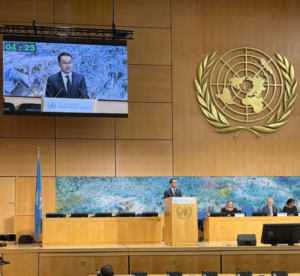
Speaking at the opening of the council’s 20th anniversary cycle, Ashikbayev informed the international community about the results of systemic reforms aimed at strengthening Kazakhstan’s national human rights architecture. Photo credit: Ministry of Foreign Affairs.
The session brought together more than 100 high-level representatives from states and international organizations, including UN Secretary-General António Guterres and UN High Commissioner for Human Rights Volker Türk.
Human rights reforms and constitutional changes
Speaking at the opening of the council’s 20th anniversary cycle, Ashikbayev informed the international community about the results of systemic reforms aimed at strengthening Kazakhstan’s national human rights architecture under the Just Kazakhstan policy course.
Particular attention was devoted to constitutional reform. Ashikbayev noted that the draft new Constitution proposed for a nationwide referendum seeks to establish a more human-centered model of governance, expand guarantees of rights and freedoms, including in the digital sphere.
Kazakhstan also reiterated its support for the multilateral system based on the UN Charter and international law. In this context, Ashikbayev presented several international initiatives advanced by Kazakhstan, including the Global Initiative to strengthen political commitment to international humanitarian law, and the Congress of Leaders of World and Traditional Religions.
He also highlighted the launch of a UN Regional Center for Sustainable Development Goals in Almaty, the upcoming Regional Ecological Summit, and the proposal to establish an International Water Organization under UN auspices.
Role in global nuclear disarmament
At the high-level segment of the Conference on Disarmament, the Kazakh delegation reaffirmed the forum’s indispensable role as the primary multilateral negotiating platform for disarmament, arms control, and non-proliferation.
Special emphasis was placed on key anniversaries in 2026, reflecting Kazakhstan’s contribution to nuclear disarmament efforts, including the 35th anniversary of the closure of the Semipalatinsk nuclear test site, the 30th anniversary of the opening for signature of the Comprehensive Nuclear-Test-Ban Treaty, and the 20th anniversary of the Semipalatinsk Treaty establishing Central Asia as a nuclear-weapon-free zone.
Ahead of the 2026 review conferences of the Treaty on the Non-Proliferation of Nuclear Weapons and the Treaty on the Prohibition of Nuclear Weapons, Kazakhstan confirmed its readiness to facilitate constructive dialogue among key stakeholders and reiterated its commitment to strengthening the global disarmament and non-proliferation regime.
Ashikbayev also underscored the importance of resuming strategic dialogue among nuclear-armed states to prevent a new arms race and reduce the risk of nuclear confrontation.
In addition, Kazakhstan called for further strengthening of the Biological Weapons Convention, including the development of verification mechanisms and institutional support through the creation of an International Biological Security Agency.
Concluding his remarks, Ashikbayev urged member states to demonstrate flexibility and a readiness to compromise to launch substantive negotiations aimed at reinforcing international security and enhancing the effectiveness of multilateral diplomacy.
