
ASTANA – National Bank Governor Timur Suleimenov outlined key economic priorities for 2026, focusing on fiscal consolidation, tighter control of consumer lending and coordinated anti-inflation measures, as he briefed the government’s expanded meeting on Feb. 10 in Astana.
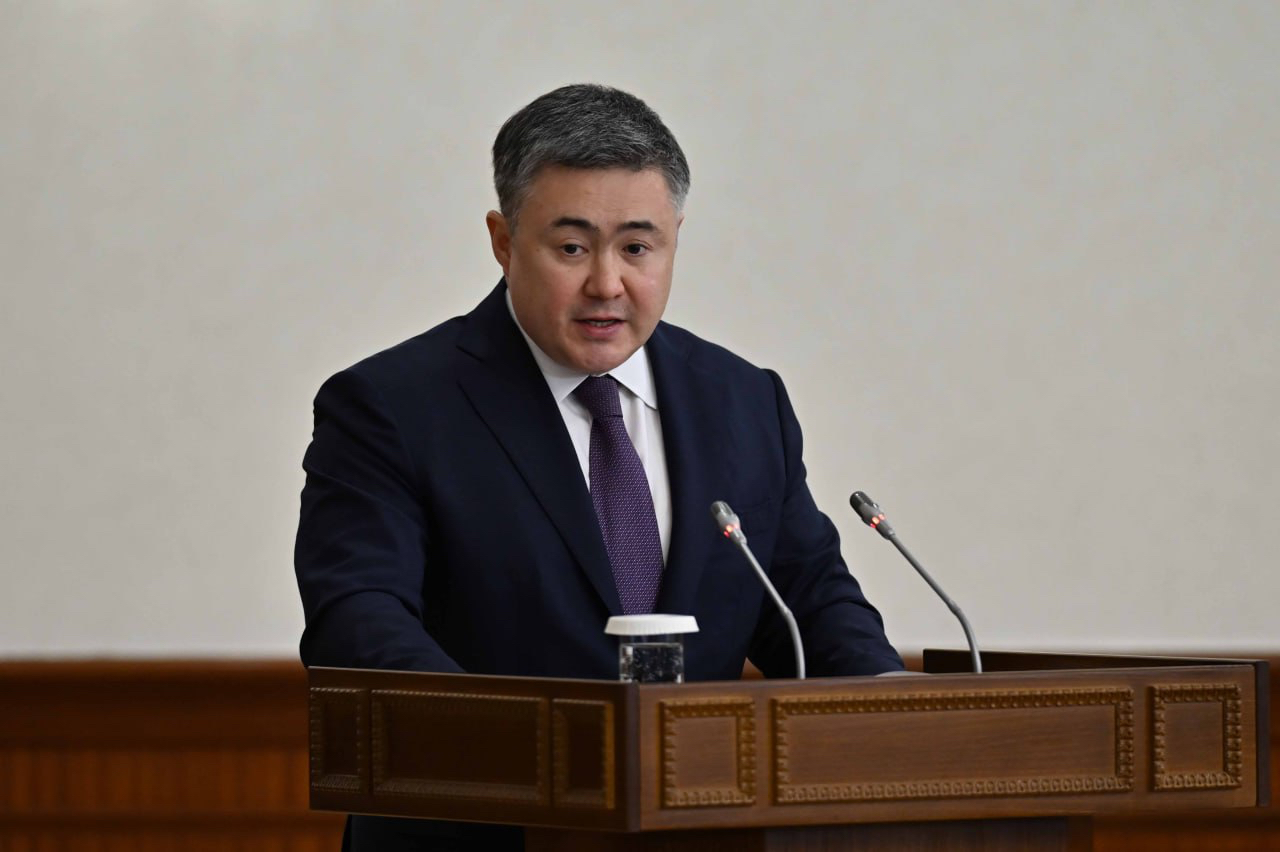
National Bank Governor Timur Suleimenov delivers his report during an expanded government meeting on Feb. 10 in Astana. Photo credit: Akorda press office
At an expanded government meeting, President Kassym-Jomart Tokayev delivered his assessment of where the country is heading, flagging critical areas where progress was lacking.
“2025 unfolded amid heightened external volatility, but the economy and the financial system adapted successfully. Inflation emerged as the economy’s key challenge. In September last year, price growth peaked at 12.9% before easing to 12.3% by the end of the year,” Suleimenov said.
External pressures included high global food prices, geopolitical uncertainty and inflation in imported goods, while domestically, inflationary pressures were driven by a significant budgetary and quasi-fiscal stimulus, as well as growth in consumer lending.
“These factors supported demand beyond the economy’s supply capacity. Inflation was also affected by higher utility tariffs and rising fuel prices. Inflation expectations increased as the value-added tax rate was raised,” he explained.
Key priorities going forward
Speaking about the central bank’s priorities for the year, Suleimenov stressed fiscal consolidation and a managed cooling of consumer lending.
“With the government, we are implementing a macroeconomic stabilization program for 2026–2028. It is important to adhere to key budget parameters, including keeping the budget deficit at 2.5% and transfers from the National Fund below 2.8 trillion tenge [US$5.7 billion],” he said.
He also noted that a coordinated set of anti-inflation measures will remain in place, with the central bank continuing to deploy its full range of monetary and macroprudential tools in cooperation with the government.
According to him, there is also the need to roll out a large-scale program of financial support for the economy through state-run Baiterek holding with what he described as a “minimal inflationary impact.”
Growing trust in the tenge
Suleimenov said the National Bank will continue maintaining a flexible exchange-rate regime this year, describing it as a “natural stabilizer against external shocks.”
“Despite volatility in global markets and increased demand for foreign currency, the tenge strengthened by 3.7% over the year. This largely reflects an ongoing monetary policy and growing confidence in the government’s overall macroeconomic framework,” he added.
This confidence is also evident in the growth of tenge-denominated assets.
“Deposits reached 48 trillion tenge [US$97.5 billion], up 16.3%, while dollarization fell to 21%, a historic low. The volume of term deposits increased more than 14-fold in 2025, while savings deposits rose 1.5 times. This provides commercial banks with a stable funding base for lending to the economy,” he said.
Suleimenov stressed the financial sector is gradually shifting toward greater support for the real economy, with bank lending to productive sectors growing faster than unsecured consumer lending.
“Fiscal measures will take effect this year, including higher corporate income tax rates for banks, the taxation of government securities and a one-off tax on banks’ income from government securities. Beyond their regulatory impact, these measures are expected to generate more than 500 billion tenge in budget revenue,” he explained.
Foreign reserves
Gold and foreign exchange reserves reached a historic high of $65.4 billion, with returns of 43% last year. The increase was supported in part by gold purchases on the domestic market, with the central bank buying 66 tons in 2025, the second-largest volume globally. By the end of the year, Kazakhstan’s gold holdings had risen to 345 tons.
“Despite sizable withdrawals, assets held in the National Fund also expanded over the year. A timely shift toward a more balanced asset allocation delivered a record return of $8.7 billion, or 15%,” he added.
In 2026, the National Bank will also launch an open investment partnership program, with up to $1 billion earmarked for high-technology projects.
“To diversify the country’s national reserves, a National Strategic Crypto Reserve has been established. Legislative amendments have been drafted for this purpose, and an investment portfolio of digital assets has been formed under the management of the National Bank,” Suleimenov said.
The sources of the crypto reserve will include investments from gold and foreign exchange reserves and the National Fund, as well as assets confiscated by government decision.
Ongoing digitization efforts
Suleimenov also reported on the efforts to make the financial system more digital.
“Kazakhstan became the first country in the region to launch a National Digital Financial Infrastructure, a unified system that integrates secure biometric identification, seamless interbank payments and transfers, the digital tenge, anti-fraud protections and modern digital services,” he said, adding that payment systems operated by the National Bank processed transactions totaling 1.6 quadrillion tenge (US$3.2 trillion) last year.
This year, the central bank plans to connect all banks to a unified QR payment system, introduce a digital consent service and expand the use of biometric identification in loans and large-value payments to help prevent fraud.
“The use of the digital tenge in the budget process is also set to expand this year,” he said.
In April, the government and the National Bank will adopt a comprehensive action plan to shift budget programs and projects to the digital tenge. The plan will cover road construction, housing and utilities, agricultural lending, support for small and medium-sized enterprises, as well as the social sector and health care.
