
ASTANA – For centuries, Kazakh ornaments told stories without words, woven into textiles, carved into wood, and engraved into metal. Today, those same symbols are being etched into skin, carrying ancient meanings into a modern context. Tattoo artist Saltanat Kuanova is among the pioneers redefining how Kazakhstan’s visual heritage lives on, turning national ornamentation into a contemporary language of identity.
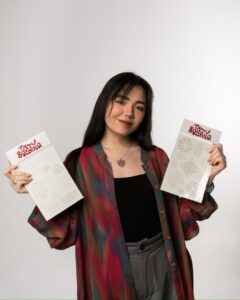
Saltanat Kuanova, a tattoo artist. Photo credit: Kuanova’s personal archieve
Kuanova became interested in tattoo art as a teenager and began working professionally at 16.
“By the age of 14, I knew for sure that this was what I wanted to do. I always loved drawing, even though I never attended art school. I took courses at 16 and have been working in the industry for nine years now,” Kuanova told The Astana Times.
Finding a voice in ink
She began working with Kazakh ornaments in 2017–2018, when such designs were still rare and usually requested by clients rather than initiated by artists.
“At the time, it felt very unusual. No one was really doing ornament tattoos then. However, you could feel a shift – creative people were beginning to rediscover Kazakh culture and realize how rich it is. I think I caught that moment,” she said.
Her interest deepened while working as a tattoo artist in the United States. Surrounded by international artists, she began searching for a style that would set her apart globally.
“Abroad, questions of identity always come up. I realized I didn’t stand out. When I returned to Kazakh ornaments and started studying their history and classification, I understood they are part of a broader Central Asian cultural system. I knew this was something unique,” she said.
Building a client base was initially difficult. Kuanova said she often had to persuade people to choose ornamental tattoos to develop a portfolio. Over time, demand increased as her work became more visible. In two years, she completed tattoos for more than 600 clients, ranging from simple inscriptions to complex ornamental compositions.
“The more people see how ornaments look on the body, the more interest grows,” she said.
Ornaments as a language
Kazakh ornaments are generally divided into cosmological, zoomorphic, plant-based and geometric patterns. Many carry symbolic meanings linked to protection, prosperity, balance or well-being.
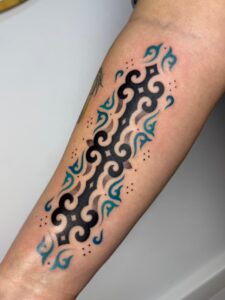
Among the most popular motifs are “arkhar-muiyz” (argali horns), a universal ornament symbolizing well-being, and “kuskanat,” a bird motif representing freedom, wisdom and forward movement. Photo credit: Kuanova’s personal archieve
“Ornaments are a language. They convey ideas, philosophy and metaphors. Some people insist that each ornament has only one fixed meaning. I disagree. As a form of expression, ornamentation evolves with us. I approach it respectfully, but I also allow room for exploration,” Kuanova said.
Kuanova noted ornament roots lie in ancient Turkic philosophy and Tengriism.
“For example, there is an ornament literally called ‘Women’s Happiness.’ It symbolizes fertility and the female body. This shows how open and natural our ancestors were in expressing life and meaning,” she said.
She views tattoos as a modern continuation of that tradition.
“Our ancestors loved to express themselves. You can see it in their clothing, jewelry and richly decorated garments. Everything was colorful and expressive, showing a clear desire to stand out. If they had lived in a different environment, such as the tropics, that same impulse might have taken the form of body decoration such as piercings, body adornments, or tattoos,” she said.
While stereotypes surrounding tattoos persist, including religious concerns, Kuanova believes attitudes will continue to change as the industry matures.
Ink as cultural preservation
Among the most popular motifs, she said, is arkhar-muiyz (argali horns), a universal ornament symbolizing well-being. Other frequently requested designs include kuskanat, a bird motif representing freedom, wisdom and forward movement, and koshkhar-muyiz (ram’s horns), associated with prosperity, though its use requires careful interpretation.
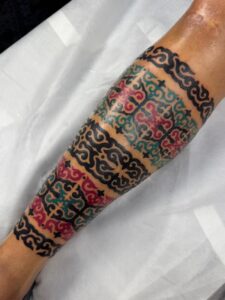
Photo credit: Kuanova’s personal archieve
Kuanova emphasized an individualized approach to each client, saying she creates a unique design for every tattoo. The process begins with discussing a client’s ideas, values and the meaning they want to express, while also considering traditional ornamental principles, including color symbolism, composition, scale and placement on the body.
“A tattoo should be personal. I never repeat my own work or copy other artists’ designs. Every sketch is created from scratch for each client,” she said.
She offers three approaches to design: strict adherence to traditional canons, a purely aesthetic composition without symbolic meaning, or a balanced combination of both. This, she said, allows clients to decide how closely they want to follow tradition or create something more interpretive.
Kuanova highlighted that tattoo art can also serve as a way of preserving cultural heritage.
“Interest in ornaments and Tengriism often leads people to study history and culture more deeply. Many artists in Kazakhstan, including musicians, filmmakers, and illustrators, already work with cultural codes such as ornaments, language and visual symbolism. In tattooing, this takes the form of ornaments and symbols that help preserve and promote cultural heritage,” she said.
