
ASTANA – Kazakh musicians, including a symphony orchestra, a chamber choir, and a ballet troupe, will perform at the 35th Lakshminarayana Global Music Festival (LGMF) 2026, one of the longest-running international music festivals, scheduled for Jan. 16-25 in India.
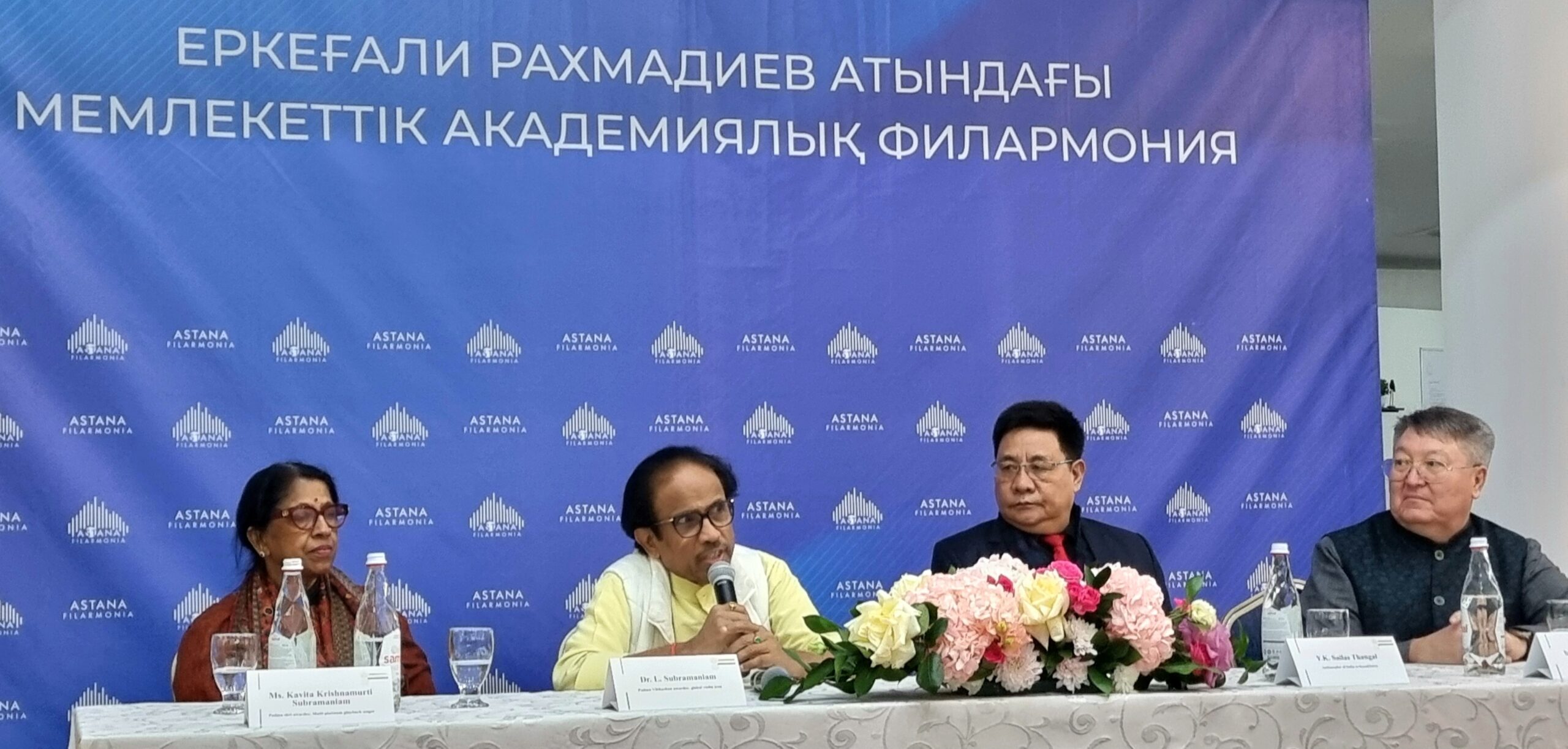
From left to right: Kavita Krishnamurti Subramaniam, Dr. L. Subramaniam, Y.K. Sailas Thangal and Abzal Mukhitdin during press briefing in Astana on Jan.12. Photo credit: The Astana Times
The festival tour will cover five major cities, including New Delhi, Chandigarh, Kolkata, Chennai and Bangalore, and aims to strengthen cultural ties between Kazakhstan and India through music and artistic exchange.
Speaking at a press briefing in Astana, Indian Ambassador to Kazakhstan Y.K. Sailas Thangal said the collaboration reflects deep historical links between the two countries rooted in the ancient Silk Road.
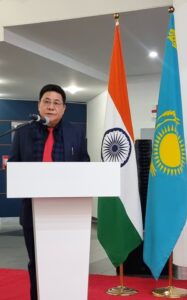
Indian Ambassador Y.K. Sailas Thangal said Kazakhstan and India share deep historical and cultural links dating back to the Silk Road.
“Today, this shared musical engagement revives that spirit of cultural dialogue in a modern and meaningful way. The festival creates a unique opportunity for Kazakh musicians to engage with Indian classical traditions, global orchestras and international audiences. At the same time, it allows Indian audiences to experience the depth and richness of Kazakhstan’s musical heritage,” he said.
He emphasized that such projects strengthen people-to-people contacts, inspire young artists, and build long-term cultural bridges beyond official diplomacy.
“Music, as a universal language, has long been a powerful instrument of diplomacy, capable of connecting hearts and minds across borders,” Thangal said.
A centerpiece of the program will be the Indian premiere of the “Navagraha Symphony,” a large-scale orchestral work by renowned Indian violinist and composer Dr. L. Subramaniam, founder and artistic director of LGMF. The symphony is inspired by the nine celestial planets and ancient Sanskrit shlokas.
“In India, we believe the nine planets strongly influence human destiny. Some, like Saturn, Neptune and Uranus, are considered the most complex. Their periods bring many ups and downs, leading to maturity and self-realization. The music reflects these ideas and is based on ancient Sanskrit shlokas,” Subramaniam said.
Abzal Mukhitdin, the Kazakh conductor and maestro leading the Astana Philharmonic Symphony Orchestra, noted that the composition consists of nine parts, each representing a planet, including the Sun and the Moon.
“The most complex and extensive sections belong to Saturn, Neptune and Uranus. Indian music uses far more tonal variations than Western classical music, which makes these parts especially challenging and rich,” Mukhitdin said.
He highlighted that the concert program will open with a Kazakh musical block featuring works by Kurmangazy, Tattimbet and Brusilovsky. In addition to the Astana Philharmonic Symphony Orchestra, performers will include a choir from the Aktobe Region, musicians from the Kokshetau and Petropavl Philharmonics, and, for the first time, the Gakku dance ballet.
“The concert will last about two hours. Our goal was to represent Kazakhstan as broadly as possible, bringing together musicians from various regions. During rehearsals, we already see how harmoniously all these elements come together,” he said.
The performances will blend Indian and Kazakh musical traditions through symphonic music, choral works and ballet, offering audiences a rare cross-cultural artistic experience.
