
ASTANA – Within the framework of the 32nd Ministerial Council of the Organization for Security and Cooperation in Europe (OSCE), Kazakh Foreign Minister Yermek Kosherbayev held bilateral meetings with heads of key OSCE institutions on Dec. 4 in Vienna.
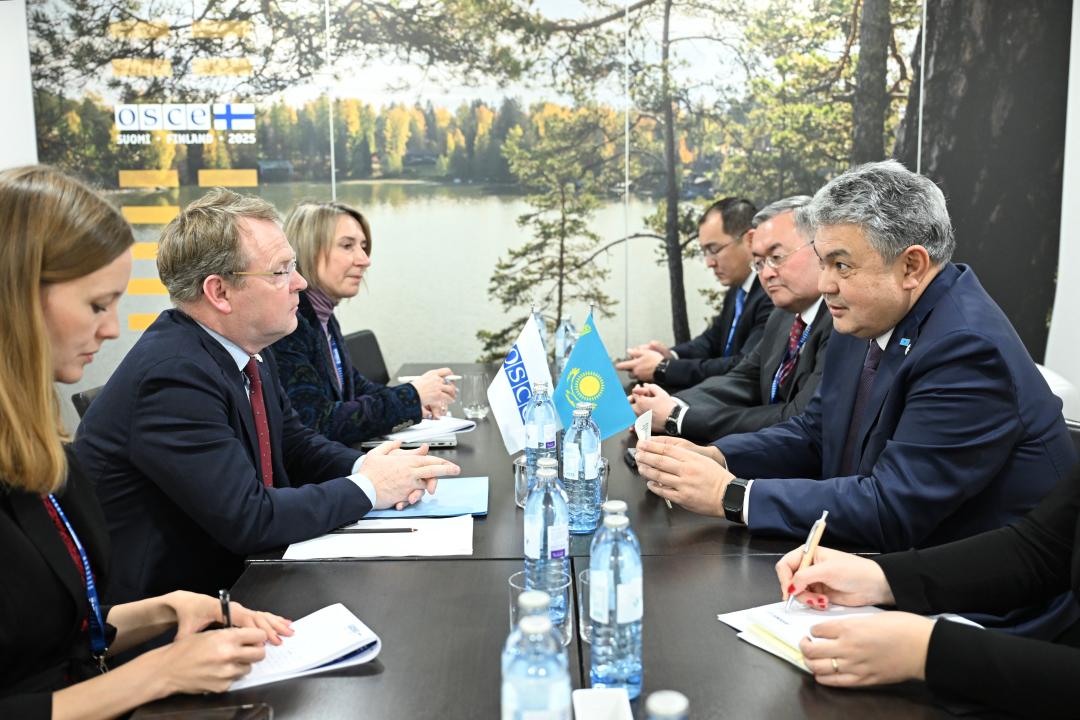
Photo credit: gov.kz
Kosherbayev met with OSCE Secretary General Feridun Sinirlioglu, Director of OSCE Office for Democratic Institutions and Human Rights (ODIHR) Maria Telalian, OSCE Representative on Freedom of the Media Jan Braathu, and OSCE High Commissioner on National Minorities Christophe Kamp, reported the ministry’s press service.
During the meeting with Sinirlioglu, Kosherbayev emphasized the strategic nature of Kazakhstan’s cooperation with the OSCE and the importance of developing comprehensive interaction across the politico-military, economic-environmental, and human dimensions.
With Kamp, he highlighted Kazakhstan’s experience in promoting interethnic harmony, calling diversity a national asset and strategic advantage. Talks with Telalian and Braathu focused on democratic development, rule of law, media freedom, human rights, and strengthening civil society.
Bilateral meetings on the margins of the OSCE ministerial council
On the sidelines of the council, Kosherbayev met with foreign ministers from Austria, Cyprus, Germany, Greece, Georgia and the Netherlands. Discussions focused on political dialogue, trade and investment partnerships, and engagement within the OSCE and other multilateral platforms.
With the Netherlands’ David van Weel, they reviewed priority sectors and new areas for trade and investment. Talks with Cyprus’ Constantinos Kombos reaffirmed commitment to strengthening bilateral cooperation. With Austria’s Beate Meinl-Reisinger, they discussed Kazakh-Austrian relations and economic cooperation via the Intergovernmental Commission and Business Council.
Meetings with Germany’s Johann Wadephul emphasized maintaining regular contacts and deepening ties in all priority sectors. With Greece’s Georgios Gerapetritis, attention was on political, trade, economic, investment, and cultural-humanitarian cooperation. Discussions with Georgia’s Maka Bochorishvili focused on political dialogue, trade and economic cooperation, transport and logistics, and cultural and humanitarian cooperation, including the Trans-Caspian International Transport Route.
The foreign ministers expressed their intention to further advance comprehensive partnerships, strengthen inter-agency ties, and promote common approaches to key international and regional matters.
