
ASTANA —Every country eventually discovers what its first generation raised in freedom will do with that freedom. In Kazakhstan, part of the answer has been playing in cinemas and festival halls for more than a decade. Gulnara Abikeeva, a film scholar, Doctor of Art History and author of 12 books on cinema, calls these filmmakers “Children of Independence.” They were born in the final years of the Soviet Union but came of age in a country learning to define itself anew. They did something that still surprises those who study their work. They looked directly at their own country, without borrowed slogans and without waiting for permission. And international festivals from Berlin to Venice took notice.
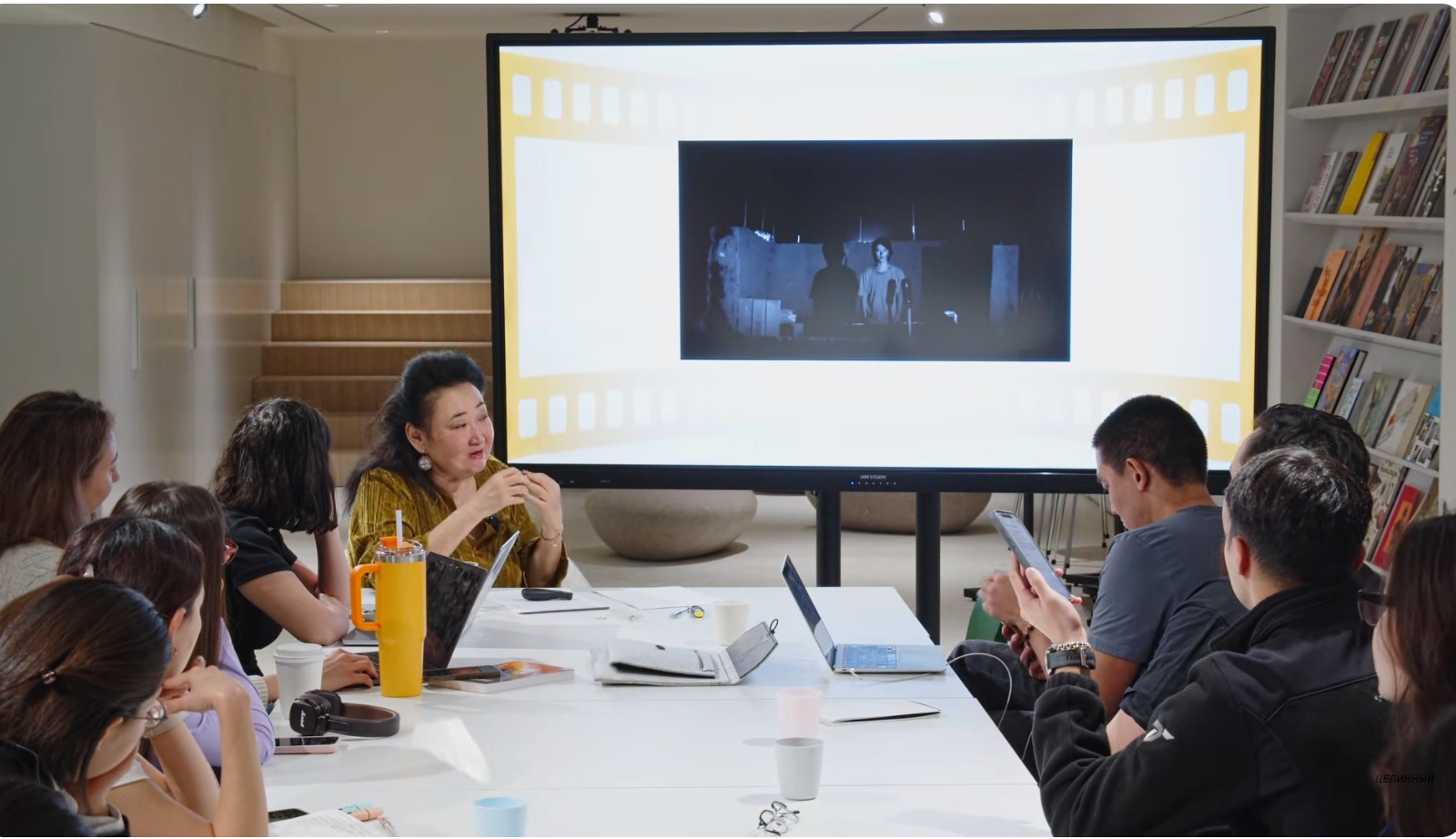
Photo credit:
Abikeeva’s recent lecture at the Tselinny Center of Contemporary Culture in Almaty on Nov. 9 explored how this independent cinematic language emerged. Her explanation began, unexpectedly, with fear.

Gulnara Abikeeva, a film scholar, Doctor of Art History and author of 12 books on cinema. Photo credit: voicesoncentralasia.org
A critic’s cold shiver
“When the films of Emir Baigazin and Adilkhan Yerzhanov began appearing, I felt a chill. I wondered, my God, how could they do this? How could they speak out against the police? How could they talk about corruption and bullying?” she recalled.
She said that her fear had two sources. She belonged to another generation, and she thought the films might be banned. They were not. That, too, became part of the story.
“Children of Independence, as the name of a generation, a priori do not know that censorship exists. Their spirit of freedom already flows in their blood, so their films criticize our reality,” Abikeeva said.
She also pointed to the environment that shaped them: the atmosphere in schools, the way history was taught and the greater openness of historical information in the 1990s and 2000s. According to her, these experiences helped form a generation less inclined to accept established explanations.
A generation finds its audience
The international festival circuit soon provided a remarkable stage for this new voice. Baigazin’s debut feature “Harmony Lessons” premiered in competition at the 2013 Berlin International Film Festival. Set in a rural school, it follows 13-year-old Aslan, a boy drawn into a brutal environment of bullying, extortion and violence. The film won the Silver Bear for Outstanding Artistic Contribution, awarded to cinematographer Aziz Zhambakiyev. Its young lead, Timur Aidarbekov, also won Best Actor at the Amiens International Film Festival.
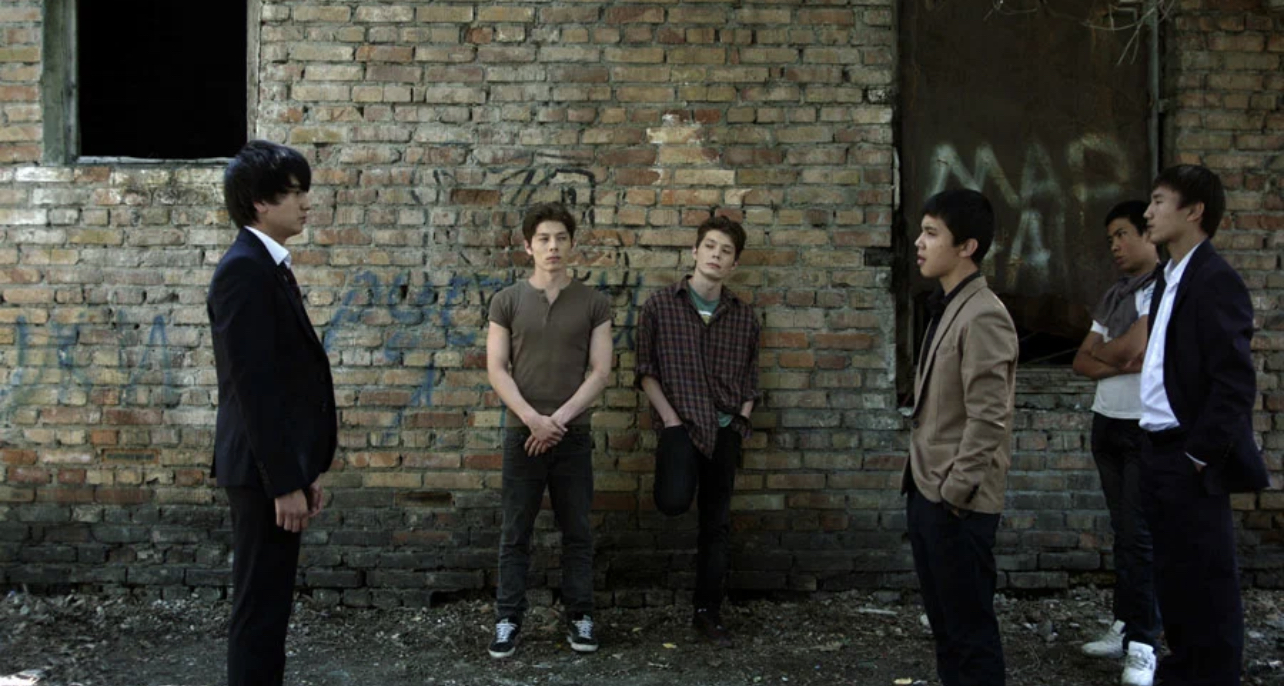
In 2013, Baigazin became the first Kazakh director to participate in the main competition of the International Berlin Film Festival with his film “Harmony Lessons.” Photo credit: Kinopoisk.
Baigazin continued exploring isolation, family and the fragile relationships between individuals and their surroundings in “The Wounded Angel” (2016) and “The River” (2018). The latter won the Orizzonti Award for Best Director at the Venice International Film Festival in 2018.
Adilkhan Yerzhanov, born in 1982 in Zhezkazgan, developed a different but equally distinctive language, combining social criticism, dark humor, absurdism and striking visual metaphors. His “The Owners” was selected for Cannes in 2014, followed by
Adilkhan Yerzhanov. Photo credit: esquire.kz
“The Gentle Indifference of the World,” which screened in the Un Certain Regard section in 2018. “Yellow Cat” entered Venice’s Orizzonti competition in 2020, while “Goliath” was selected for Orizzonti Extra in 2022. Its lead actors, Berik Aitzhanov and Daniyar Alshinov, received the independent Bisato d’Oro award for Best Actors. In 2019, Yerzhanov received the Asia Pacific Screen Award for Achievement in Directing for “A Dark, Dark Man.”
Together, these achievements marked an extraordinary period of international visibility for Kazakh auteur cinema. But for Abikeeva, the more interesting question was not how many awards the filmmakers collected. It was what made their cinema so different.
The end of grand narratives
To explain this shift, Abikeeva turned to French philosopher Jean-François Lyotard and his concept of the end of “grand narratives.” Lyotard used the term to describe universal explanations of history and human existence: faith in progress, liberation through ideology and the historical mission of a state or class. The Soviet project was a classic example. It offered a coherent picture of the world in which past, present and future were connected by the promise of a brighter tomorrow. Soviet cinema, including Kazakh cinema, existed within this framework.

Emir Baigazin. Photo credit: Baizagin’s Facebook page.
The generation that preceded the Children of Independence, which Abikeeva calls the “post-wave” generation, was roughly a decade older. Its members experienced the collapse of the Soviet Union as a personal trauma. They remembered shortages, hunger, long queues and parents struggling to find their footing in a transformed society.
She noted that the younger filmmakers did not experience the collapse as the loss of an existing world. They grew up in a reality where the old system had already disappeared.
“They are not fighting, which is why they can criticise,” she observed.
In her interpretation, their cinema belongs to a world of smaller, fragmented narratives: private stories that do not claim to explain society as a whole. Rather than offering a universal moral lesson or a reassuring resolution, these films leave the audience to interpret what it sees.
According to her, Kazakhstan, in this cinema, “ceases to be an idea or a symbol.” It becomes an everyday environment in which people live without access to either utopia or heroism. The result can seem harsh and pessimistic, but Abikeeva sees it as an honest record of a post-ideological society.
When a house becomes a country
The plots help explain her argument. In “Realtor” (2011), Yerzhanov follows a young urban man who wants to sell his parents’ village house to Chinese buyers. One visitor notices a balbal, an ancient stone monument, and the protagonist casually offers to remove it. But as he climbs toward the monument, he enters an imagined historical world where Kazakhs fight to defend their land. Returning to the present, he begins to understand what he was prepared to sell.
In “Constructors” (2013), Yerzhanov explored the social tensions surrounding housing and property, touching on broader issues of housing insecurity and bureaucracy in post-Soviet Kazakhstan, while portraying the characters’ existential struggle to find a sense of belonging.
Abikeeva sees these early films as attempts to create an image of Kazakhstan and engage with larger questions of national identity. She identifies two qualities in Yerzhanov’s work: acute social awareness and an ability to communicate through original visual metaphors.
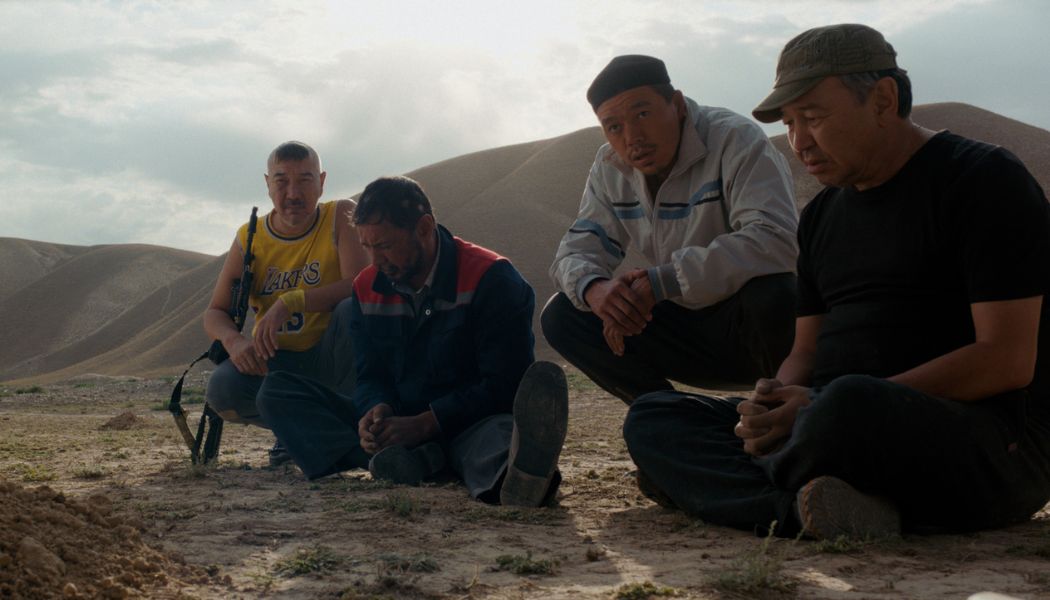
Berik Aitzhanov and Daniar Alshinov play the lead roles in the movie “Goliath.” The film “Goliath” by Adilkhan Yerzhanov was presented at the 79th Venice International Film Festival on Lido Island from Aug. 31 to Sept. 10. Photo credit: the Kazakhfilm
“The question of having a home is not only the question of one family. It is a metaphor for whether the current generation feels at home in its country, whether the state cares about its youth,” she said.
As Yerzhanov’s cinema evolved, however, its messages became less explicit and its worlds more unsettling. Abikeeva openly admitted that she sometimes felt distant from this work. But she also turned that discomfort into a question about herself: perhaps she was simply from another generation, while younger audiences saw this cinema as normal.
A dialogue that society barely hears
For Abikeeva, what ultimately defines the “children of Independence” is their willingness to maintain an open dialogue with society. Yerzhanov’s films, for example, address violence against women and men, corruption, abuse of power and, increasingly, the shadow of war.
“Their task as an artist is to create. Distributors, promoters and film scholars — it is our task to promote it,” Abikeeva said,
She is particularly enthusiastic about Baigazin, whom she describes as a remarkable artist deserving of producers’ attention and investment. Yerzhanov, she noted, has been more active in securing opportunities and financing from Kazakh, Russian and international producers.
According to her, the significance of the filmmakers of the 2010s goes beyond their festival successes. They represent a generation of filmmakers who entered the profession without inheriting the Soviet censorship system or the expectation that cinema must serve as an ideological instrument. They came of age amid greater freedom, international competition and the absence of ready-made answers. Perhaps that is what made their cinema radically new. These filmmakers were not trying to replace one grand narrative with another. They were recording a country as they encountered it: complicated, contradictory and unresolved.
There is something worth considering in that. A cinema that refuses to tell audiences what to think is asking them to look more closely at the world around them. Its images may be uncomfortable, its stories unresolved and its characters far from heroic. But perhaps a country’s ability to produce artists unafraid to look at it honestly, and audiences willing to confront what they see, says more about the country’s independence than any official narrative could.
