
ASTANA – Uzbekistan’s strong economic growth is creating opportunities to strengthen its position as a regional trade and logistics hub, but sustaining the momentum will require deeper structural reforms, greater private sector participation and closer economic integration across Central Asia, International Monetary Fund (IMF) officials said Nov. 13 at a roundtable at the Central Bank of Uzbekistan in Tashkent.
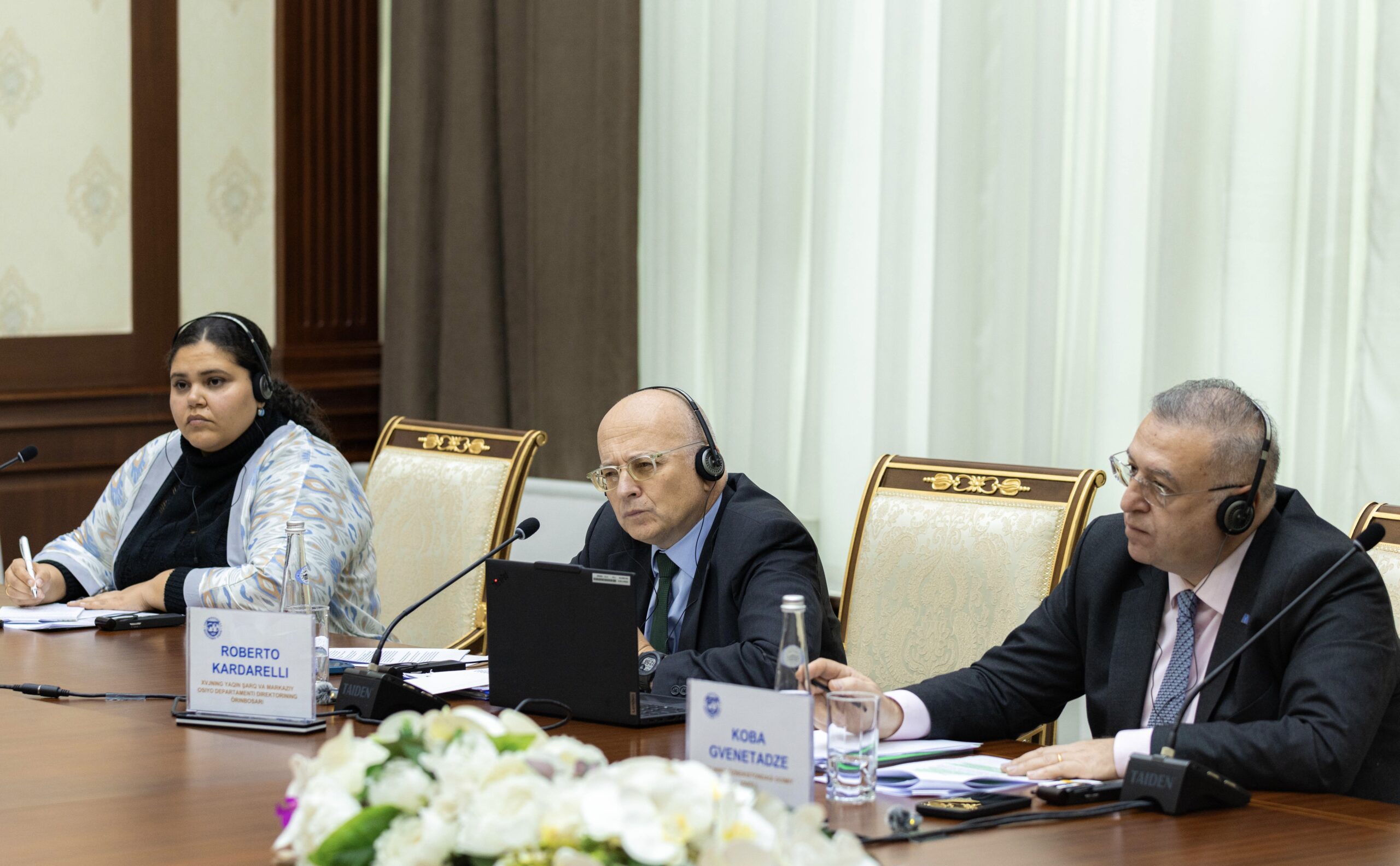
Photo credit: Central Bank of Uzbekistan
Roberto Cardarelli, assistant director of the IMF’s Middle East and Central Asia Department, and Koba Gvenetadze, the fund’s resident representative in Uzbekistan, discussed the country’s growth prospects, inflation risks and structural reform priorities, highlighting the need to translate strong economic performance into higher productivity and sustainable job creation.
Koba Gvenetadze, the fund’s resident representative in Uzbekistan. Photo credit: Central Bank of Uzbekistan
Uzbekistan’s economy has expanded strongly over the past five to six years, supported by domestic demand and continued structural reforms. However, the strength of domestic consumption also creates potential overheating pressures, making the coordination of fiscal and monetary policies increasingly important, Gvenetadze said. He cautioned against treating a particular growth rate as the ultimate measure of economic success. Instead, the priority should be to ensure that growth is sustainable, increasingly productivity-driven and supported by private businesses rather than the state.
“It’s a very important moment for Uzbekistan to make sure that all this performance and very impressive performance in terms of growth is translated into higher productivity,” Gvenetadze said.
The IMF’s October 2026 World Economic Outlook projects Uzbekistan’s economy to grow by 7.8% in 2026, up from its previous forecast of 6.8%. Growth is expected to moderate to 6.5% in 2027, compared with the earlier projection of 6%. The revised outlook reflects the country’s strong economic performance and places Uzbekistan among the region’s fastest-growing economies. The improved forecast comes as the country seeks to accelerate annual economic growth toward 9%-10%. Achieving such ambitions without intensifying inflationary pressures will depend on the country’s ability to strengthen its economic foundations and improve productivity.
Moving beyond first-generation reforms
The next phase of Uzbekistan’s economic transformation will require moving beyond the initial wave of liberalization toward more difficult institutional and structural changes. Cardarelli described this as a broader challenge facing economies across the region. Having implemented many first-generation reforms, including market liberalization, countries now need to address more complex issues related to private sector development, state-owned enterprises, financial markets and human capital.
For Uzbekistan, reducing the state’s economic footprint remains a central priority. Gvenetadze identified stronger corporate governance, stricter budget constraints for state-owned enterprises, transparent privatization and stronger competition as key areas for reform.
The financial sector also requires further modernization. The IMF sees a need to phase out directed and preferential lending, strengthen banking supervision and improve the regulatory framework, alongside advancing the long-discussed capital markets law.
These reforms are closely connected. A more competitive banking system and deeper capital markets could improve access to financing for private businesses, reduce reliance on state-directed credit and create conditions for more efficient investment.
Governance improvements will also matter. Gvenetadze noted that Uzbekistan had already adopted a conflict-of-interest law, while legislation on whistleblower protection and asset declarations would further strengthen institutional accountability.
The IMF also highlighted the importance of expanding women’s and young people’s participation in the labor market. For an economy with a growing young population, creating jobs will depend not only on investment and infrastructure but also on developing the skills required by a more diversified economy. Cardarelli stressed that human capital would be particularly important as countries seek to move toward services and higher-value economic activities. Diversification into these sectors is difficult without a workforce equipped with the necessary skills.
Growth, inflation and fiscal discipline
Maintaining macroeconomic stability will be another test for Uzbekistan as economic activity remains strong. The IMF identified inflation as a major macroeconomic stability challenge across the region, driven by domestic demand pressures and external shocks. Cardarelli noted that bringing inflation down from double-digit levels is generally easier than achieving further reductions, requiring monetary policy to remain appropriately tight.
In Uzbekistan, strong domestic demand and higher-than-budgeted gold revenues have created additional fiscal policy considerations. Higher commodity revenues can encourage governments to increase spending, potentially reinforcing demand-driven inflation.
Gvenetadze said Uzbekistan had so far demonstrated fiscal discipline. He noted that the budget deficit was set at 3% of GDP for this year and said he expected the actual figure to come in below that level. He also referred to discussions with the authorities on analyzing the non-mineral budget deficit. Such an indicator would help assess how much public finances depend on gold revenues and provide a clearer picture of the underlying fiscal position. Gvenetadze clarified that the IMF had not recommended establishing a separate sovereign wealth or stabilization fund for Uzbekistan. The broader challenge is to prevent temporary revenue gains from translating into permanent spending commitments while maintaining sufficient fiscal space to respond to future shocks.
Uzbekistan’s regional role and the Middle Corridor
Beyond domestic reforms, Uzbekistan’s geographical position gives it an opportunity to become an increasingly important link in regional and international trade, Gvenetadze said. Stronger economic links with neighboring countries could generate positive spillovers across the region by expanding trade, investment and market opportunities.
The China-Kyrgyzstan-Uzbekistan railway, currently under construction, illustrates the potential of improved regional connectivity. The project could open new trade routes and strengthen Central Asia’s links with global markets.
However, the benefits extend beyond transit. Better transport connections can lower trade costs, attract investment and give businesses access to larger markets. Cardarelli also pointed to the changing geography of global trade as an opportunity for the region. Disruptions linked to conflicts in the north and south have pushed businesses to explore alternative routes, increasing Central Asia’s strategic importance. The Middle Corridor is part of this wider shift.
Yet infrastructure alone will not determine whether the region can capitalize on changing trade patterns. The IMF’s analysis highlights the importance of improving logistics and governance, lowering trade and regulatory barriers, streamlining customs procedures, digitalizing trade processes and harmonizing standards across countries. These measures are essential to turn transport connectivity into deeper economic integration.
