
ASTANA – Kazakhstan marks the 33rd anniversary of its national currency, the tenge, commemorating a milestone in the country’s economic independence. Introduced in 1993, the tenge has evolved from the first nationally designed banknotes into a modern currency incorporating advanced security technologies and a digital payment infrastructure.
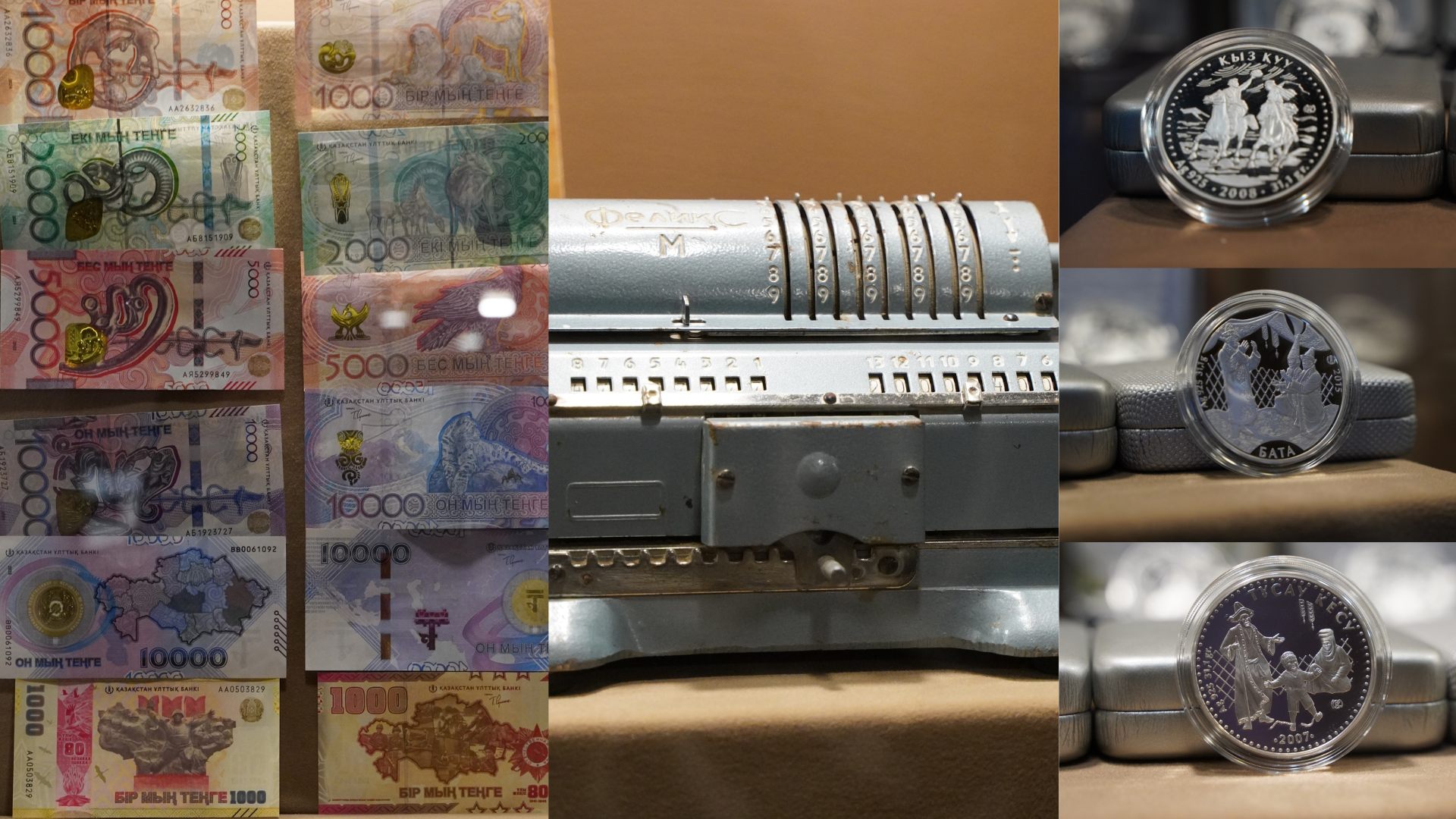
Photo credit: Fatima Kemelova/ The Astana Times
The tenge’s introduction followed a series of institutional changes in 1993. On April 13, the National Bank of the Kazakh Soviet Socialist Republic became the National Bank of Kazakhstan. The following day, the government adopted a law on banking activities, establishing the central bank’s independence and accountability to the Supreme Council and the president.
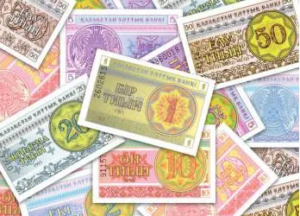
The currency also initially included a smaller denomination called the tiyn. Photo credit: nationalbank.kz
On Nov. 15, the tenge officially entered circulation, becoming the national currency of independent Kazakhstan.
Prominent Kazakh artists and designers, including Timur Suleimenov, Mendybai Alin, Agimsaly Duzelkhanov, Dosbol Kasymov and Khairulla Gabzhalilov, developed the design of the first tenge banknotes. Their work began with research into archival documents on the history of money production and currency circulation in Kazakhstan during the earliest periods of its history.
The name was chosen based on historical research into the region’s monetary traditions. At the suggestion of academician Sauyk Takazhanov, the designers adopted tenge, an old Kazakh term for money, as the name of the new national currency.
The currency also initially included a smaller denomination called the tiyn. However, inflation gradually eroded its purchasing power, eventually taking it out of circulation.
From the first banknotes to modern security features
Since 1993, Kazakhstan has issued five main banknote series, each with its own theme and distinctive design elements: Portraits, Al-Farabi, Baiterek, Qazaq Eli and Saka Style.
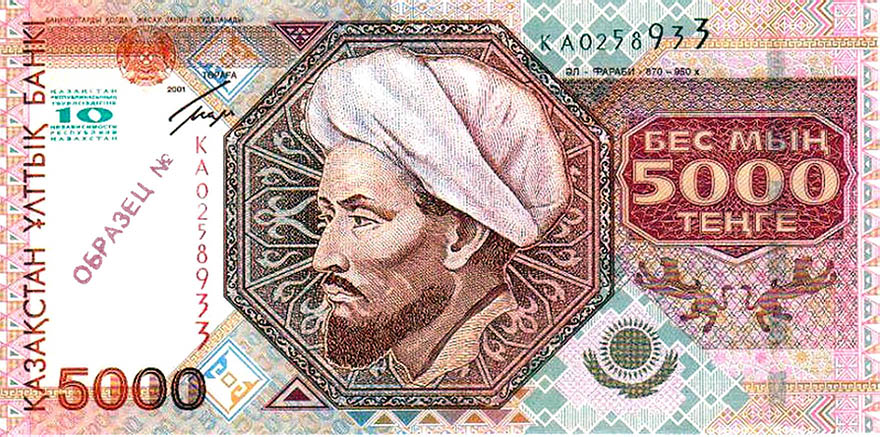
5,000-tenge banknote commemorating the 10th anniversary of Kazakhstan’s independence. Photo credit: nationalbank.kz
The first banknotes featured portraits of prominent figures who made significant contributions to science, art, culture and education. Their reverse sides depicted Kazakhstan’s natural landscapes, including Burabai, the Ile Alatau mountains and Lake Balkhash, as well as notable mosques and mausoleums.
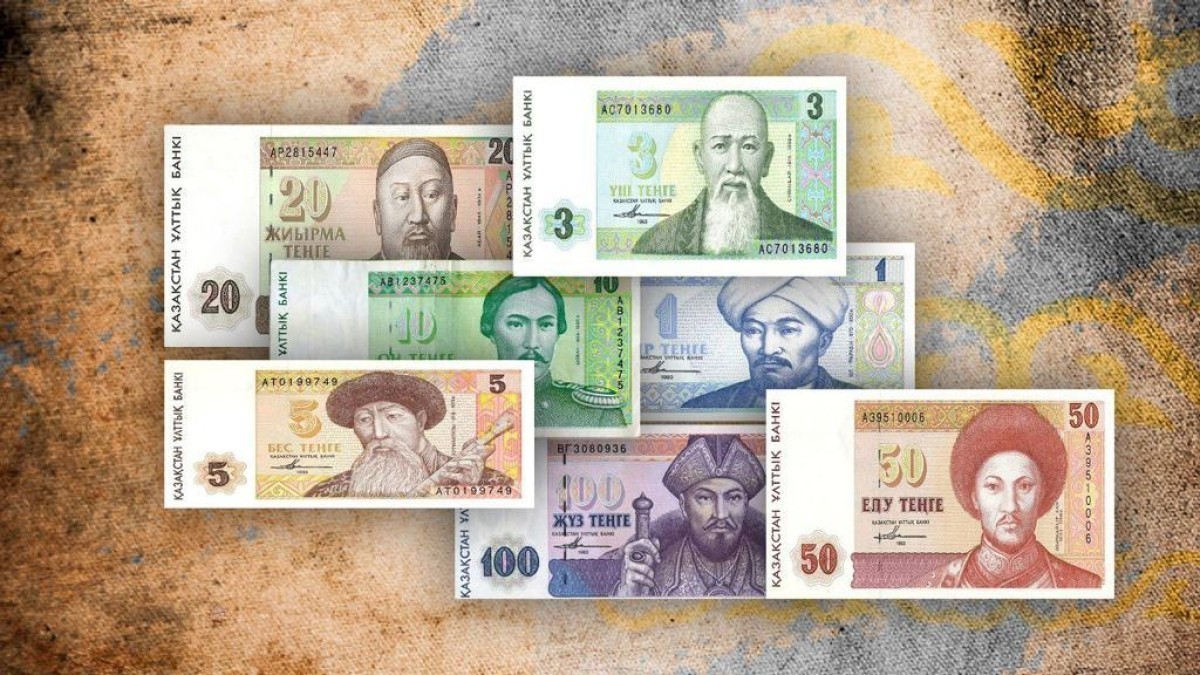
The first banknotes featured portraits of prominent figures who made significant contributions to science, art, culture and education. Photo credit: e-history.kz
In 1994, Kazakhstan began preparations to establish its own banknote production facility. A turnkey contract was signed in early 1994, with design and construction proceeding simultaneously because of tight deadlines. Installation of production equipment began while finishing work was still underway.
The National Bank’s Banknote Factory officially opened in 1995. It produced more than 83 million banknotes that year. Output exceeded 104 million banknotes in 1996, bringing the facility close to its designed production capacity.
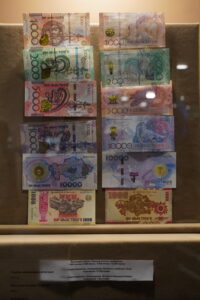
Photo credit: Fatima Kemelova/ The Astana Times
The tenge’s design underwent a major update in 2006, when a new banknote series featuring the Baiterek monument entered circulation. In 2011, the country introduced another series featuring the Qazaq Eli monument.
Alongside regular banknotes intended for everyday transactions, Kazakhstan also issues commemorative banknotes in limited quantities to mark significant national and international events.
These banknotes are legal tender and circulate alongside regular currency, although they are also popular among collectors. They often feature distinctive designs depicting historical figures, monuments, cultural symbols and natural landmarks.
Commemorative banknotes are common in many countries. They also provide an opportunity to test new security technologies before incorporating them into regular banknote series.
Since the introduction of the tenge, Kazakhstan has issued several commemorative banknotes in different denominations to mark important milestones. These include 1,000-tenge banknotes dedicated to the country’s chairmanship of the Organization for Security and Cooperation in Europe in 2010, its chairmanship of the Organization of the Islamic Conference, the Kultegin monument dedicated to ancient Turkic writing, and the 80th anniversary of Victory in the Second World War. Commemorative issues also mark the 2011 Asian Winter Games and anniversaries of the tenge and Kazakhstan’s independence.
In addition to issuing commemorative banknotes, the National Bank mints commemorative and collectible coins that help preserve the country’s cultural heritage. The coins feature a wide range of themes, including historical events, national achievements and cultural symbols. They celebrate Kazakhstan’s history and traditions while raising awareness of its heritage at home and abroad.
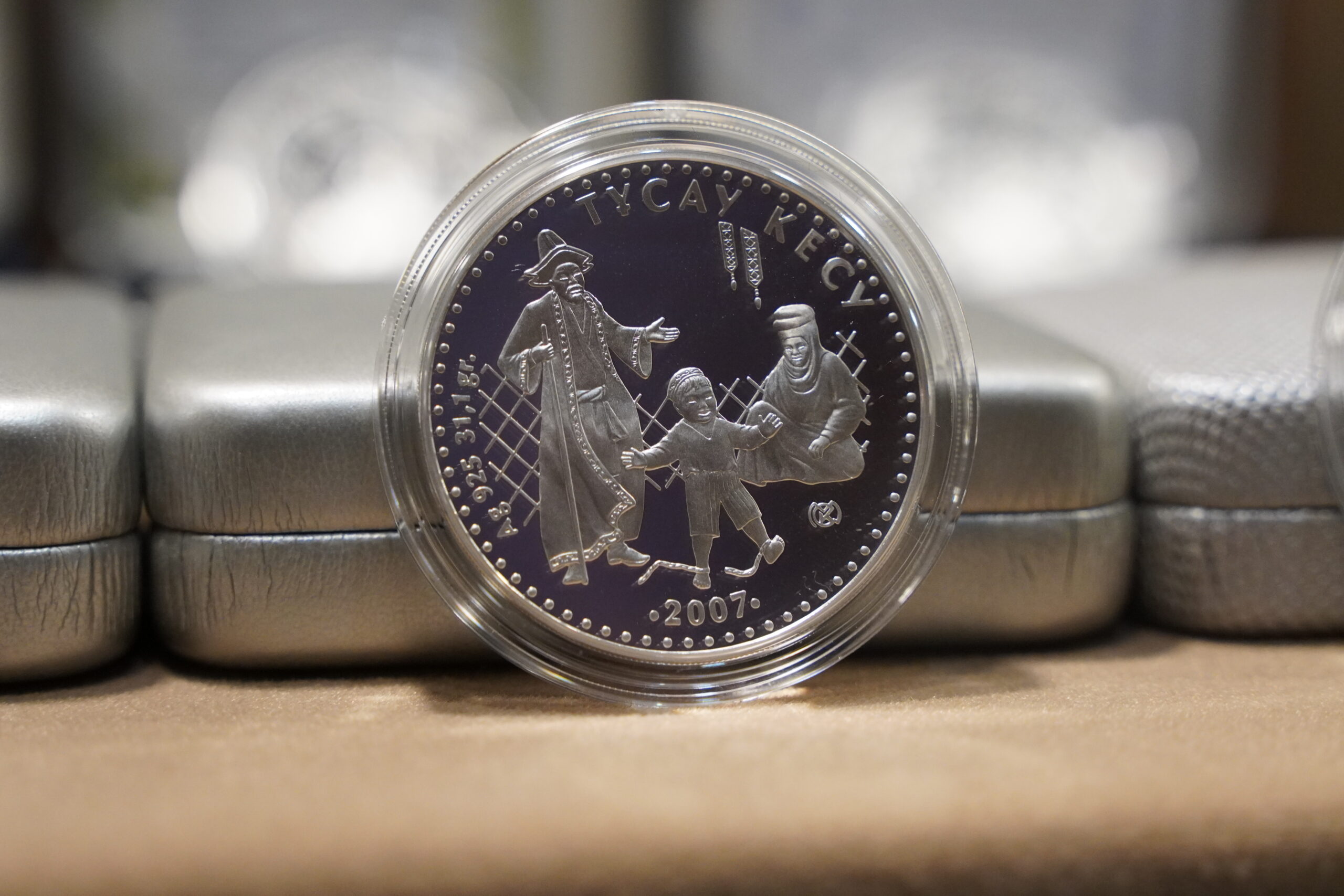
A commemorative coin featuring Tusau Kesu, a traditional Kazakh ceremony celebrating a child’s first steps. Photo credit: Fatima Kemelova/ The Astana Times
Security has remained a central priority in the tenge’s development. Kazakh banknotes feature multiple layers of protection, many of which can be verified without specialized equipment. These include distinctive paper texture and sound, watermarks and security threads visible when held against the light. Hidden images appear when the banknote is tilted, while color-shifting ink changes its appearance at different angles. Tactile printing creates raised elements that can be felt on both sides of the banknote.
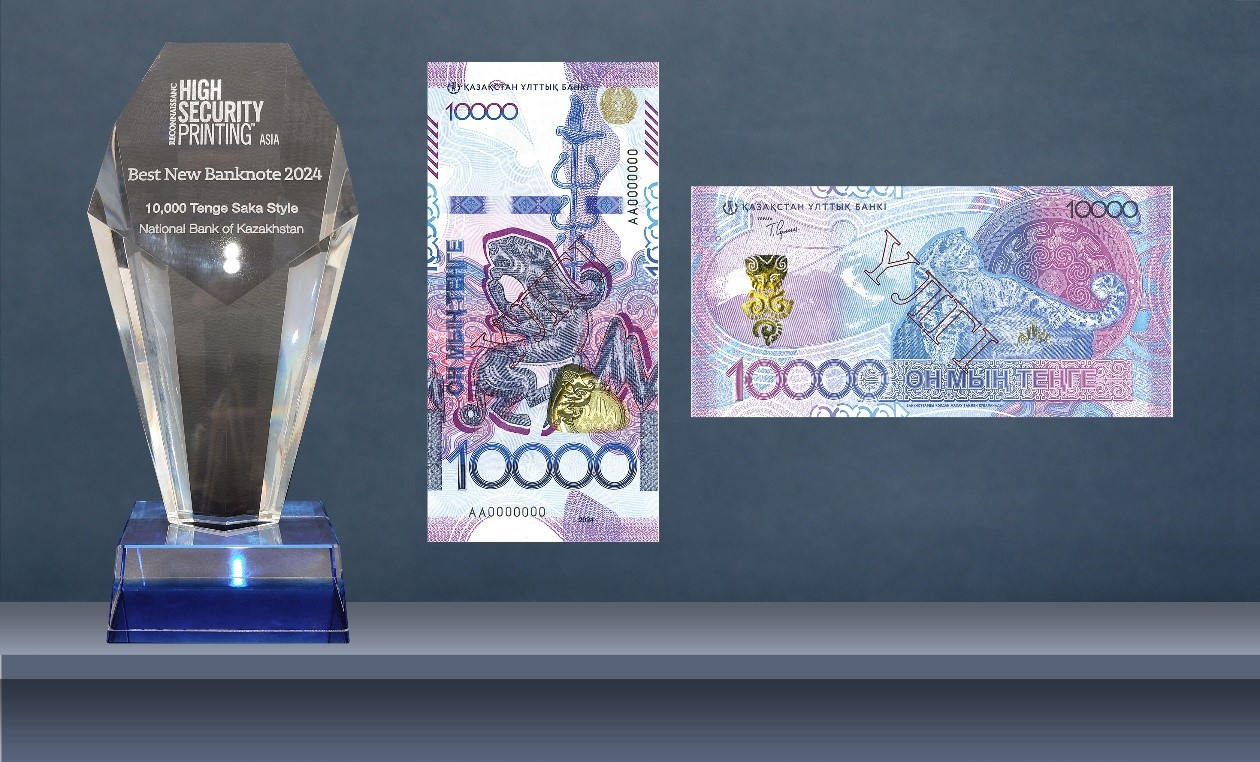
The 10,000-tenge banknote from the Saka Style series won Best New Banknote 2024 award at the High-Security Printing competition. Photo credit: nationalbank.kz
Kazakhstan has also introduced several advanced security technologies. The National Bank was the first in the world to introduce Rapid Vision micro-optical, two-color security threads featuring a dynamic motion effect. RollingStar diffraction patches, which produce vivid three-dimensional visual effects, have also been incorporated into the Saka Style series.
For example, the 20,000-tenge banknote issued in 2022 contains 25 security features.
The next stage: the digital tenge
More than three decades after the introduction of the physical currency, Kazakhstan is moving toward another stage in its monetary development: the digital tenge.
In 2022, President Kassym-Jomart Tokayev approved the concept for the digital tenge’s development. Pilot projects to improve the traceability of public funds using the digital currency began in 2024.
On March 17, 2025, Kazakhstan introduced the Uki investment coin and its digital equivalent, the Gold Coin. On Jan. 16, 2026, the legal status of the digital tenge was formally established. The digital currency was officially launched in Kazakhstan on July 18.
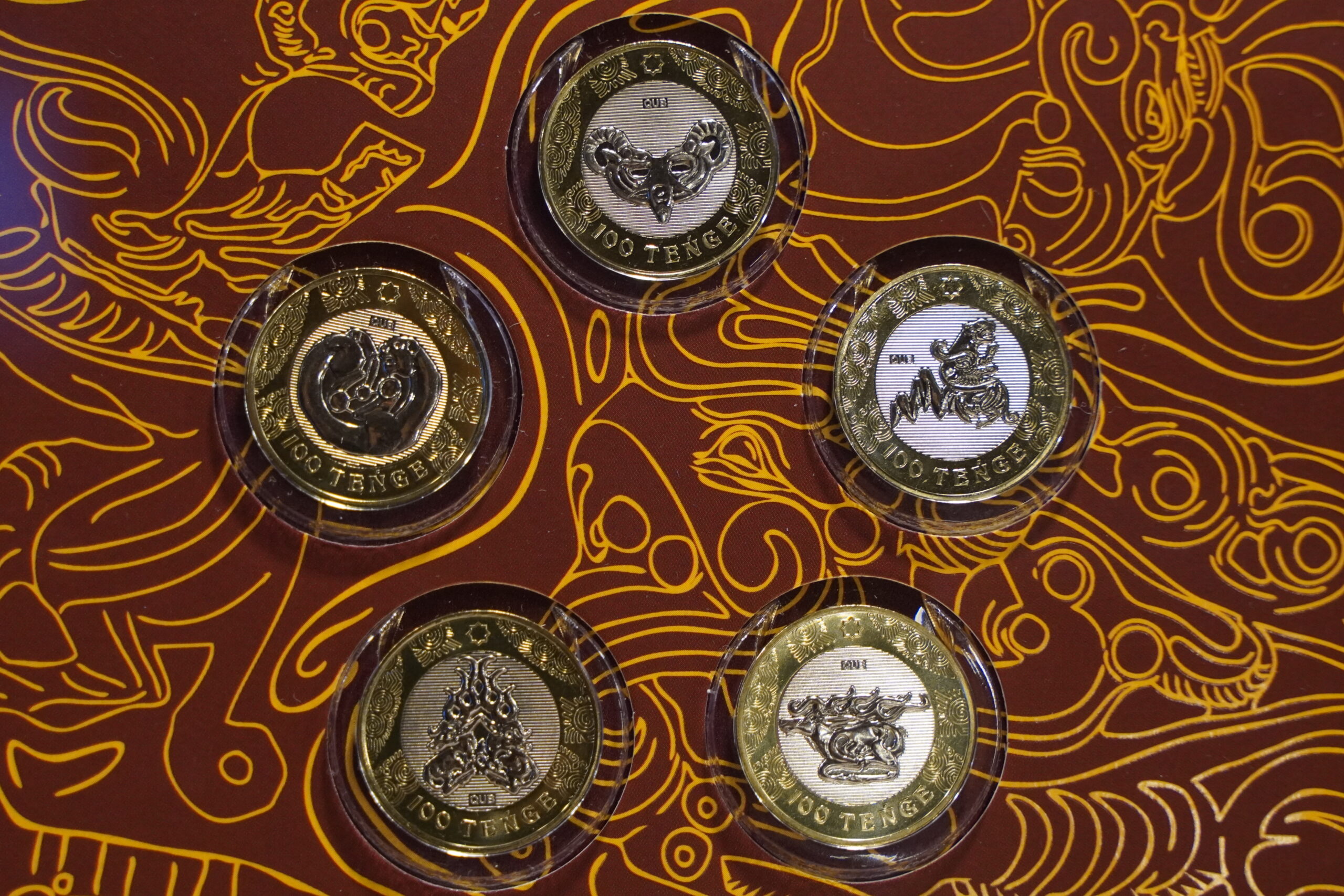
Photo credit: Fatima Kemelova/ The Astana Times
Under the rules governing the digital tenge, a digital account can be funded with cash or noncash money. Transfers from other digital accounts are also permitted. When digital tenge are transferred to a regular bank account or withdrawn in cash, they are exchanged for an equivalent amount of conventional tenge.
The regulations also allow for international payments, although these will require agreements between Kazakhstan’s digital currency platform and the national digital currency systems of other countries.
The platform includes additional functions designed to improve the traceability and management of funds. Digital tenge can be assigned unique identifiers to track their subsequent use. Smart contracts can automatically execute transactions once predefined conditions are met. For transactions between individuals, the execution period of such contracts must not exceed 10 business days.
The most extensive application of the digital tenge so far has been in public finance, particularly the management and monitoring of budget spending.
In June, the Ministry of Finance approved the rules for a pilot project introducing the digital currency into the execution of the national and local budgets. The experiment is scheduled to run through the end of the year. The pilot covers a wide range of public expenditures, including construction and reconstruction projects, road repairs, purchases of medicines, medical equipment, fuel, vehicles and specialized uniforms. It also includes budget lending and grants for scientific projects.
The digital tenge will also be used to finance projects supported by the Special State Fund. Its use has been made mandatory for certain categories of public expenditure, including eight categories of budget spending on projects valued at more than 100 million tenge (US$221,582).
According to the Ministry of Finance, 340 billion digital tenge (US$753 million) have been issued to date. Twenty pilot projects have been completed on the new platform, another 10 are underway, and approximately 50 are being prepared for launch.
The main difference between the digital tenge and conventional cashless payments lies not simply in the form in which money is held, but in the ability to track how funds are used.
One of the platform’s key advantages is its ability to link a specific budget commitment to the subsequent movement of funds. At the planning stage, each transaction is assigned a unique identifier that is intended to remain attached to the payment as it passes through different stages of financing. This makes it possible for the government to trace allocated funds not only to the immediate recipient but also to the specific obligation and purpose for which the money was intended.
The system could be particularly important for projects involving long chains of contractors between the public procurement authority and the final service provider, helping authorities monitor how public funds move through each stage of implementation.
