
ASTANA – Two years ago, Sandugash Beisenbekova hung a woven copy of one of the world’s oldest known carpets in one of Astana’s gallery to make a point: Kazakh carpet weaving did not begin in the 20th century. Now the founder of ShyraQ has taken her project south to Shymkent and changed the question. The second edition, SHE RUG 02 – Alone Together, asks less about where Kazakh rugs come from and more about what they once held together.
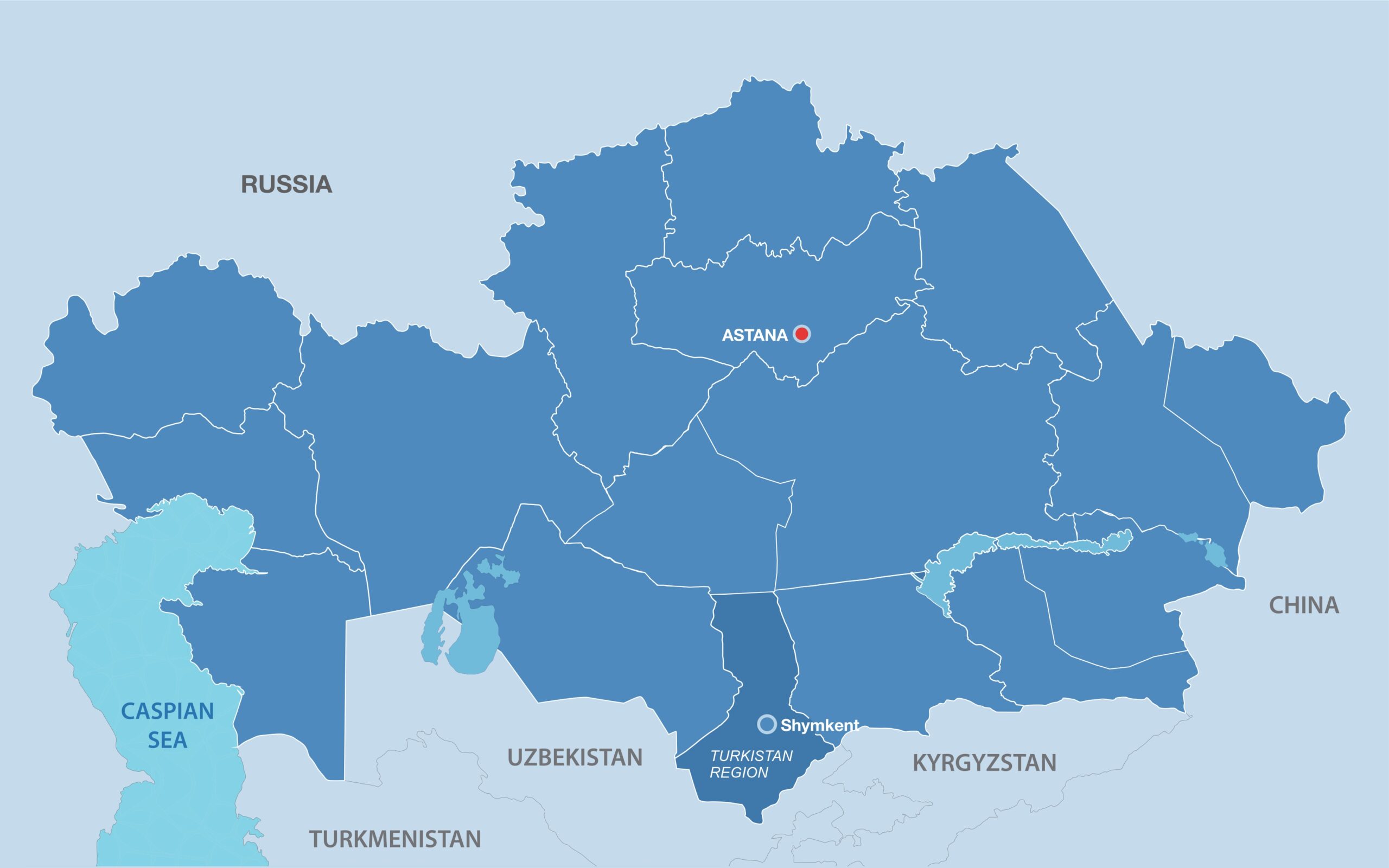
Photo credit: Exhibition’s press service. Click to see the map in full size. The map is designed by The Astana Times.
The exhibition opened on Nov. 5 at the Orbis Auto/Zeekr space on Tamerlan Highway and runs through Dec. 12.
From Astana to Shymkent
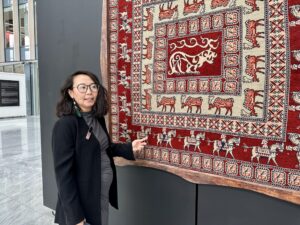
The exhibition curator Sandugash Beisenbekova. Photo credit: The Astana Times
When the first SHE RUG opened at the Forte Kulanshi art space in Astana in October 2024, The Astana Times described it as a tribute to generations of carpet weavers. The show traced Kazakh weaving back to the Saka civilization and placed a recreation of the Pazyryk carpet at its center; the original is kept in the Hermitage in St. Petersburg.
“Everyone knows about Turkmen carpets, about Azerbaijani or Afghan carpets, but no one really knows about Kazakh carpets,” Beisenbekova said at the time, adding that she hoped to bring the project to Almaty and Shymkent.
Shymkent is a fitting second stop. ShyraQ’s weavers live in the neighboring Turkistan Region, where the studio employs about 15 women and provides small looms so they can work from home. In a sense, the craft has returned to the region where it is made.
The venue is less expected. Instead of a gallery, the works are displayed in a car showroom provided by Orbis Auto Shymkent. Daniyar Nakisbekov, head of Orbis Auto Shymkent, said the company wanted “to open our space to art, culture and dialogue” and give residents a chance to see art in an unfamiliar setting.
A question for a hyperconnected age
Alone Together starts from a simple question: are people truly connected, or simply always in contact? The answer the exhibition offers comes from nomadic life, where belonging was something people practiced rather than discussed. Doors were left open to guests, meals were shared with neighbors, work was done together, and skills passed from grandmothers to granddaughters. The curatorial notes also list artificial intelligence among the exhibition’s themes, alongside women’s labor and rural livelihoods, which shows how far the project has moved from the historical survey of 2024.
“Alone Together is not about loneliness. It is about rediscovering the value of being together,” Beisenbekova said.
Several artists return from the first edition, including Natalia Karagoz, whose 2024 painting “Carpet Flowers” drew on the carpet ornaments of her native Gagauz people, as well as Alibai Bapanov, Botagoz Tolesh and Natalia Bazhenova. They are joined by Almagul Menlibayeva, one of Central Asia’s best-known contemporary artists, who divides her time between Berlin and Almaty, and Seoul-based Ayanat Abayqyzy. Aigul Qyryqbayeva, Bauyrzhan Doszhan, Gulzhakhan Ongarova, Malik Flober, Beisenbekova and ShyraQ Studio also take part. Rugs from five private collectors complete the display.
Women’s work and its value
Beneath the conceptual framing, SHE RUG remains a project about women’s work. Carpet weaving was once a skill nearly every Kazakh woman had, as The Astana Times noted in a 2023 look at the tradition, but few practice it today. Most Kazakhs know felt carpets such as the syrmak better, because they are quicker to make. A single woven carpet can take a year, Beisenbekova said in 2024.

Sandugash Beisenbekova speaks about handmade Kazakh rugs as a valuable investment and part of Kazakhstan’s growing creative industries on The Astana Times Unplugged podcast in 2025. Photo credit: The Astana Times
Beisenbekova, a former banker at the European Bank for Reconstruction and Development who holds a PhD, founded ShyraQ in 2023 as a social enterprise. Her argument is economic as much as cultural: if women’s knowledge is valued, it can bring income and independence to women in villages with few other options. She made a similar case on The Astana Times Unplugged podcast in 2025, describing handmade Kazakh rugs as a serious investment and part of Kazakhstan’s growing creative industries.
“For me, preserving heritage does not mean looking backwards. It means giving traditional knowledge a meaningful place in contemporary life and creating opportunities for it to evolve,” she said.
The exhibition’s academic partner is the Shymkent-based Ozbekali Zhanibekov University. Its president, Kairat Balabiyev, said preserving heritage “requires more than documenting traditions” and stressed the need for “a new generation of culturally conscious and creatively confident professionals.”
Beisenbekova has said she hopes one day to take SHE RUG to the United Kingdom and France.
