
ASTANA – Kazakhstan is targeting 2027 to begin construction of its first nuclear power plant and is assessing several potential locations for a third facility as part of its long-term nuclear energy strategy, Chairman of the Agency for Atomic Energy Almasadam Satkaliyev said at the World Atomic Week conference on Nov. 13 in Antalya, Türkiye.
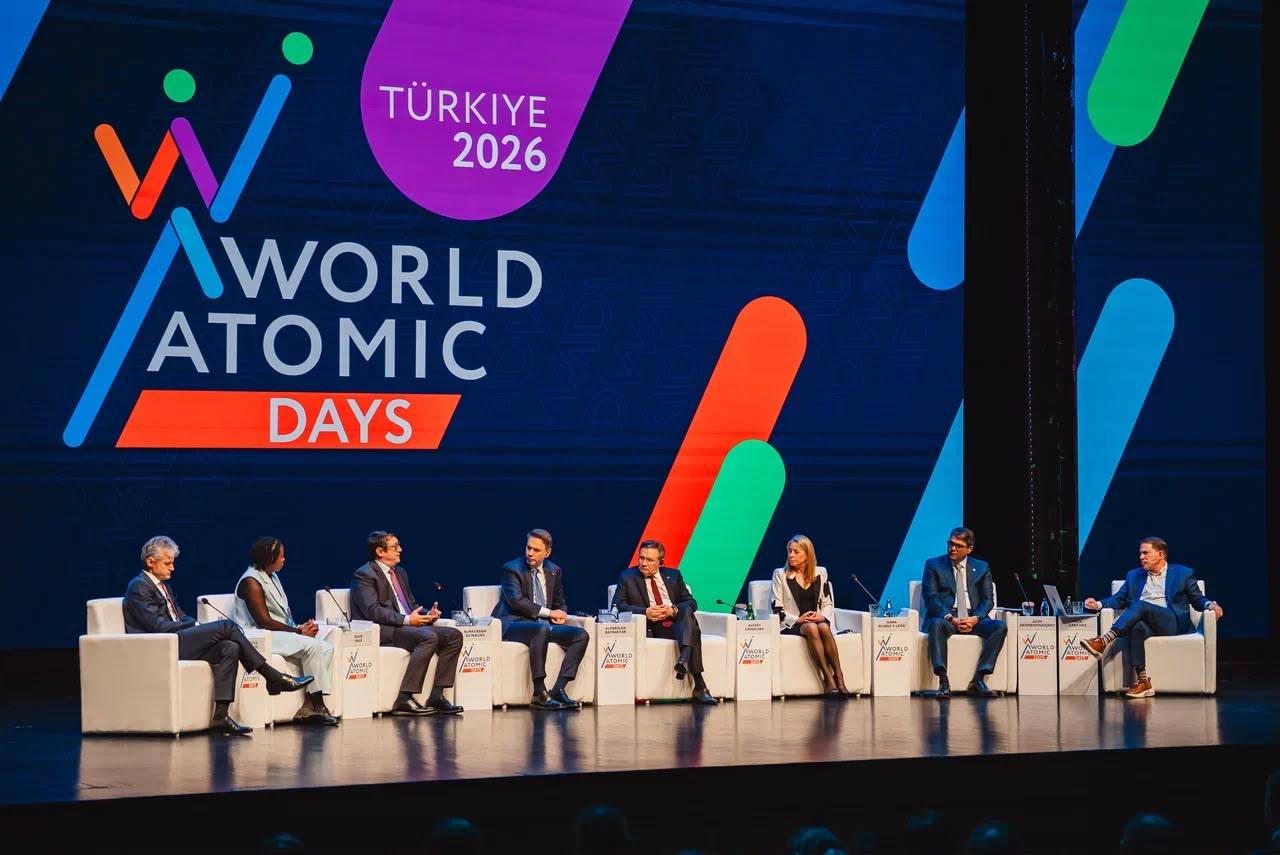
Almasadam Satkaliyev addresses the World Atomic Days conference alongside international nuclear industry leaders in Antalya, Türkiye. Photo credit: Atomic Energy Agency
Speaking at the Nov. 13 plenary session titled Nuclear Energy for People and the Planet, Satkaliyev outlined plans to expand nuclear power generation, develop domestic fuel production and establish strategic uranium reserves, the agency reported.
Preparations for the first plant have advanced following the signing of an intergovernmental agreement with Russia and an engineering, procurement and construction (EPC) contract with Rosatom. Negotiations are underway on the contract’s technical annexes.
“Objectively, we understand that in 2027, Rosatom, together with its Kazakh partners and domestic enterprises, could begin construction, provided all requirements of Kazakhstan’s legislation are met,” Satkaliyev told journalists.
Negotiations on the second nuclear power plant are ongoing, alongside geological and engineering surveys. Satkaliyev said it was too early to announce implementation timelines.
Third plant sites under review
Kazakhstan is considering several locations for a third nuclear power plant, including Kurchatov in East Kazakhstan, the Caspian Sea coast in the west and northern regions along the Tobol River. The northern site is being considered on the recommendation of electricity grid operator KEGOC.
The selection will depend on regional electricity demand, geological and hydrological conditions, and access to cooling water. Satkaliyev also noted that medium-capacity reactors could provide not only electricity but also heat and, in some cases, support water desalination.
The first two plants are preliminarily planned for the Zhambyl District of Almaty Region.
Domestic fuel production and uranium reserves
Kazakhstan aims to supply its future nuclear power plants with domestically produced fuel. The country already has capabilities ranging from uranium extraction to fuel pellet and fuel assembly production.
It has obtained a license from French company Framatome to manufacture fuel for French-designed reactors, with its current output purchased by Chinese partners.
“We understand that nuclear power plants in Kazakhstan must be supplied with fuel that can be produced in Kazakhstan,” Satkaliyev said, adding that the agency was exploring production expansion with Russian and Chinese partners.
The country also plans to establish a multi-level strategic uranium reserve to secure domestic supplies for at least 100 years. Kazakhstan ranks second globally in uranium reserves and accounts for approximately 40% of worldwide production.
“We consider uranium not only an export commodity, but also a strategic resource for developing our own energy sector and economy,” Satkaliyev said.
The reserve system will include deposits preserved for future generations, stocks of processed uranium and fuel assembly inventories at individual nuclear power plants. Kazakhstan is also considering low-enriched uranium storage mechanisms, drawing on the experience of the International Atomic Energy Agency (IAEA) Low Enriched Uranium Bank based in the country.
Beyond nuclear power generation
Satkaliyev said nuclear energy development would support broader technological and industrial growth, including applications in medicine, agriculture, scientific research and industrial diagnostics.
Kazakhstan plans to strengthen its research capabilities, train qualified specialists and expand the use of nuclear technologies through its existing scientific infrastructure, including research reactors.
He also highlighted the country’s cooperation with the IAEA, noting its participation in programs promoting the peaceful use of nuclear energy and regular expert assessment missions.
Satkaliyev pointed to Kazakhstan’s decision to renounce the world’s fourth-largest nuclear arsenal following independence as an important foundation of its international standing in nuclear non-proliferation.
