
ASTANA – Kazakhstan plans to tokenize up to $60 million in real estate and logistics projects by the end of 2026, launching its first major test of digital assets as a new source of financing for the economy, National Bank Governor Timur Suleimenov said at a Sept. 15 government meeting.

Photo credit: shutterstock
The plans include up to $50 million for the Iconic Tower complex and $10 million for the Birlik logistics center in Alatau City in the Almaty Region. Both are expected to be issued through the Kazakhstan Stock Exchange’s digital infrastructure.
Kazakhstan also plans to link its nationwide regulatory framework with the separate regimes of the Astana International Financial Centre and Alatau City, creating what officials describe as a single digital asset market.
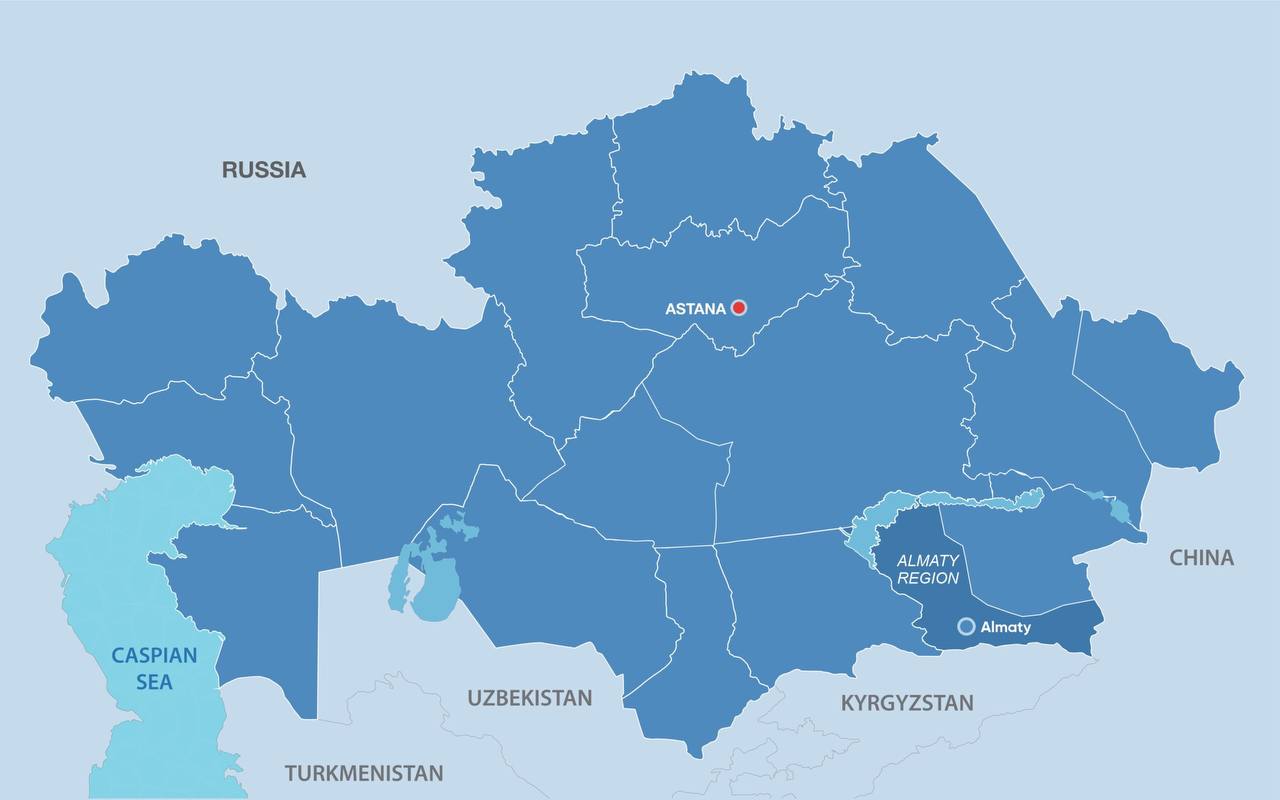
The Alatau City model. Photo credit: Akorda. Click to see the map in full size. The map is designed by The Astana Times.
Under that model, authorities are considering a regional payments and settlement hub with Binance. Suleiemenov said the project would involve establishing a Binance legal entity in Kazakhstan and obtaining a top-tier payment organization license, potentially allowing the hub to serve clients across the Commonwealth of Independent States, Eastern Europe and Asia, Suleimenov said.
The projects are part of a 65-measure plan approved by the government on Sept. 15 to expand Kazakhstan’s regulated digital asset market.
Kazakhstan plans to tokenize major infrastructure projects, real estate and commodity assets to attract investment. Prime Minister Olzhas Bektenov instructed the National Bank to compile a priority list of assets for tokenization and establish rules intended to protect investors.
“The digital assets sector is a completely new area of Kazakhstan’s economy. The basic conditions for the development of the digital assets market have already been established. We are now in the process of forming a comprehensive ecosystem,” Bektenov said.
“We have major infrastructure projects, real estate, commodities and other assets. Tokenization can be used to attract additional financing for these projects,” he added.
The government seeks to attract investment and bring more cryptocurrency activity into the regulated economy under the new plan. It also calls for expanding the use of the digital tenge, exploring digital instruments for cross-border payments and developing a more tightly regulated cryptocurrency-mining industry.
The National Bank expects the initial pool of tokenized assets to include government securities, corporate bonds, real estate, infrastructure projects and mineral deposits. Suleimenov called on the Finance Ministry, Samruk Kazyna Sovereign Wealth Fund, Baiterek Holding, KASE and the Central Securities Depository to prepare the first large-scale issuances.
What is tokenization
Tokenization records rights to an asset on a digital ledger. It can divide assets such as real estate, infrastructure or corporate debt into smaller digital units that investors can buy and trade. Supporters say the technology could accelerate transactions, reduce administrative costs and make investments previously dominated by large institutions accessible to a wider range of investors.
Larry Fink and Rob Goldstein of BlackRock have compared tokenization’s current development to that of the internet in 1996, noting that the technology could advance more quickly than many expect. They do not expect it to replace conventional finance soon, but envision the two systems gradually converging.
They portrayed that transition as a bridge being built from two sides: traditional financial institutions on one side and stablecoin issuers, fintech companies and blockchain networks on the other.
Global trends
The World Economic Forum describes 2026 as a “defining moment for digital assets.” It said clearer regulation, wider institutional adoption and greater interoperability are moving blockchain beyond experimentation and into the infrastructure supporting digital financial markets.
Tokenized real-world assets remain a small part of the global digital asset market. Boston Consulting Group estimates that around $30 billion in such assets are publicly visible, compared with roughly $3 trillion in cryptocurrencies and $300 billion in stablecoins. Under the firm’s more expansive scenarios, tokenized assets could represent nearly 16% of global investable assets by 2035, although the outcome would vary considerably by asset class.
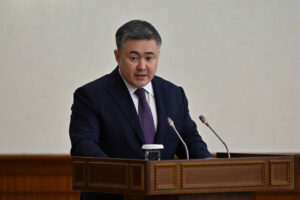
National Bank Governor Timur Suleimenov. Photo credit: Akorda press office
According to Suleimenov, the digital assets market now has approximately 750 million users worldwide. Stablecoin transaction volume reached $50 trillion in 2025, while the market for tokenized assets expanded 12-fold over the past three years.
“Three major trends have emerged globally. The first is a shift from prohibition and observation toward licensing, supervision and common international standards. The second is the integration of digital assets with banks, payment infrastructure and capital markets. The third is a move toward practical applications,” Suleimenov explained.
Digital assets are increasingly used for cross-border payments, custody services and the tokenization of real and financial assets.
“Kazakhstan’s objective is to create a competitive, regulated market, with transactions, liquidity and capital concentrated within the country,” he added.
Steady progress
Suleimenov said Kazakhstan began building a regulated digital asset market in 2022. Then, it allowed cryptocurrency exchanges licensed by the Astana International Financial Centre to work with local banks. The parliament followed with a digital assets law in 2023.
By the end of 2025, AIFC-based providers had processed $10.6 billion in transactions and attracted approximately 215,000 users, according to figures cited by Suleimenov. The framework, however, remained limited to the financial center and did not cover the wider domestic market.
The National Bank expanded its approach in July 2025 by launching a regulatory sandbox where companies could test digital asset products under its supervision.
“The sandbox now includes 34 projects across 14 areas. Among them are stablecoins, tokenization, cryptocurrency exchanges, custody and services connecting cryptocurrencies with conventional currencies,” Suleimenov said.
Legislation that took effect on May 1 extended regulation nationwide and formally recognized digital financial assets, including stablecoins and tokenized real and financial assets. It also introduced licensing requirements for tokenization platforms, cryptocurrency exchanges and exchange services. Suleimenov described it as Central Asia’s first comprehensive nationwide regulatory framework for digital assets.
A presidential decree in July expanded the effort by seeking to establish a fully-fledged digital assets industry, encouraging the transition of digital asset transactions to the country’s regulated ecosystem and launching the tokenization of the economy and diversifying sources of financing for the economy.
Key figures
The National Bank has authorized the Kazakhstan Stock Exchange to operate platforms for issuing and trading digital assets. Its digital platform has recorded 34,000 transactions worth 20.5 billion tenge (US45.9 million) in an exchange-traded fund linked to bitcoin futures.
Three newly introduced cryptoasset ETFs have generated 650 transactions worth one billion tenge (US$2.2 million), according to Suleimenov.
Three licensed cryptocurrency exchange operators have also processed around two billion tenge (US$4.5 million) during their first two months of operation, while five more companies are seeking licenses.
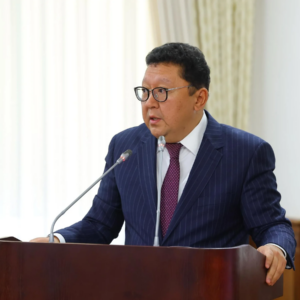
Yerkegali Yedenbayev, chief authorization and fintech officer at AIFC’s Astana Financial Services Authority. Photo credit: kapital.kz
Yerkegali Yedenbayev, chief authorization and fintech officer at AIFC’s Astana Financial Services Authority, said Kazakhstan’s citizens are estimated to hold around one million cryptocurrency wallets worldwide, suggesting that much of their trading still takes place through foreign platforms.
He said the center’s regulated digital asset providers currently serve nearly 270,000 clients, up from 53,000 in 2023.
“Today, there are 35 providers operating in the AIFC that offer services in the digital assets sector. Among them are 11 digital asset exchanges, including Binance, the world’s largest crypto exchange, and Bybit, the fourth-largest crypto exchange. In addition, there are 16 investment service providers and eight payment organizations, including three stablecoin issuers,” Yedenbayev said.
“While the volume of transactions in the licensed market reached $320 million in 2023, this figure reached $10.5 billion by the end of last year. In the first half of this year, the volume of transactions reached $5.5 billion. Thus, in a short period of time, the regulated market has grown more than 30-fold,” he said.
Digital tenge
The newly adopted plan also calls for wider use of the digital tenge, the central bank’s digital currency. Unlike cryptocurrencies, it is issued by the National Bank.
Bektenov instructed the Finance Ministry and the National Bank to examine its use in government procurement, corporate transactions and programmable contracts, which could automate payments when predetermined conditions are met.
“Unlike cryptocurrencies, the digital tenge is a centralized digital currency issued by the National Bank and is therefore legal tender. Its use should improve the efficiency of public spending and support the development of digital financial services. Digital contracts could help automate payments in government procurement and corporate transactions,” he said.
In an earlier interview with The Astana Times, Binur Zhalenov, deputy governor of the National Bank of Kazakhstan (NBK), said the digital tenge has the potential to transform how money moves. Most of the real-world use cases of digital tenge will be related to government spending, including public procurement and social spending.
What needs to be done
Suleimenov said the plan’s success would depend on competitive tax rules, more targeted compliance controls by banks and a sufficient supply of high-quality assets for tokenization. He said concerns involving an individual transaction or customer should not result in banks freezing all accounts held by a licensed digital asset provider.
The concern echoes findings reported earlier. Ainur Zhanturina, founder of RISE Research, said limited access to banking services was the principal barrier identified in the organization’s survey and interviews with Kazakhstan’s digital asset companies.
“Many banks are unwilling to work with companies in this sector, viewing them as higher-risk clients, which complicates transfers and account management,” Zhanturina said.
Сryptocurrency mining
While the digital tenge and tokenization are intended to expand Kazakhstan’s financial infrastructure, the plan also addresses a more established and energy-intensive part of the digital asset industry: cryptocurrency mining.
Kazakhstan has 76 licensed cryptocurrency miners and five accredited mining pools, with around 470,000 pieces of mining equipment registered with the government, said Vice Minister of Artificial Intelligence and Digital Development Gizzat Baitursynov.
The country’s mining pools reported producing approximately 3,600 bitcoins in 2025, four times the volume recorded in 2023. According to Baitursynov, tax revenue from the industry rose to 22.4 billion tenge (US$50.1 million) in 2025 from nine billion tenge (US$20.1 million) two years earlier.
Bektenov said Kazakhstan should focus on regulating energy consumption and taxation rather than simply expanding mining capacity. He instructed officials to examine the use of gas- and coal-fired generation to supply mining centers.
“According to international studies, by the end of 2025, our country had entered the world’s top 10 in terms of its share of global Bitcoin mining. Now, our priority should no longer be focused on the quantitative growth of mining capacity,” said Bektenov.
He emphasized that the policy should focus on creating a more effective operational model that ensures control over energy consumption, transparent taxation, and the industry’s integration into the global digital economy.
“It is necessary to establish a fully-fledged digital mining industry comprising exchanges, digital instruments, tokenization, asset storage, and payment solutions,” he added.
