
ASTANA – The emerging AI order may look bipolar from a distance, with the United States (U.S.) and China dominating the most advanced models, chips and computing infrastructure. But the discussion at Digital Bridge 2026 in Astana on Oct. 2 suggested a more complex picture: the technology may be concentrated, while its applications, standards and economic benefits are likely to spread far more widely.

Ian Slater, Executive Vice President at Mastercard. Photo credit: Digital Bridge 2026.
Olaf J. Groth, founder and CEO of Cambrian Futures, described the emerging system as a “G2 plus X” order.
“The G2 with regard to AI and cognitive technology is dominated by the U.S. and China,” Groth said during the New AI World Order panel moderated by Financial Times China Technology Correspondent Eleanor Olcott.
But the question, in his view, is who the “X” will be.
“There’s lots of room for smaller economies, including, of course, middle powers, as well as some larger economies like India, Europe, to be the X,” he said, pointing to countries such as Kazakhstan, Singapore, Vietnam and Malaysia as economies that could play differentiated roles.
That distinction is important. The countries outside the two AI superpowers may not need to reproduce the entire technological stack to have a meaningful place in the new economy.
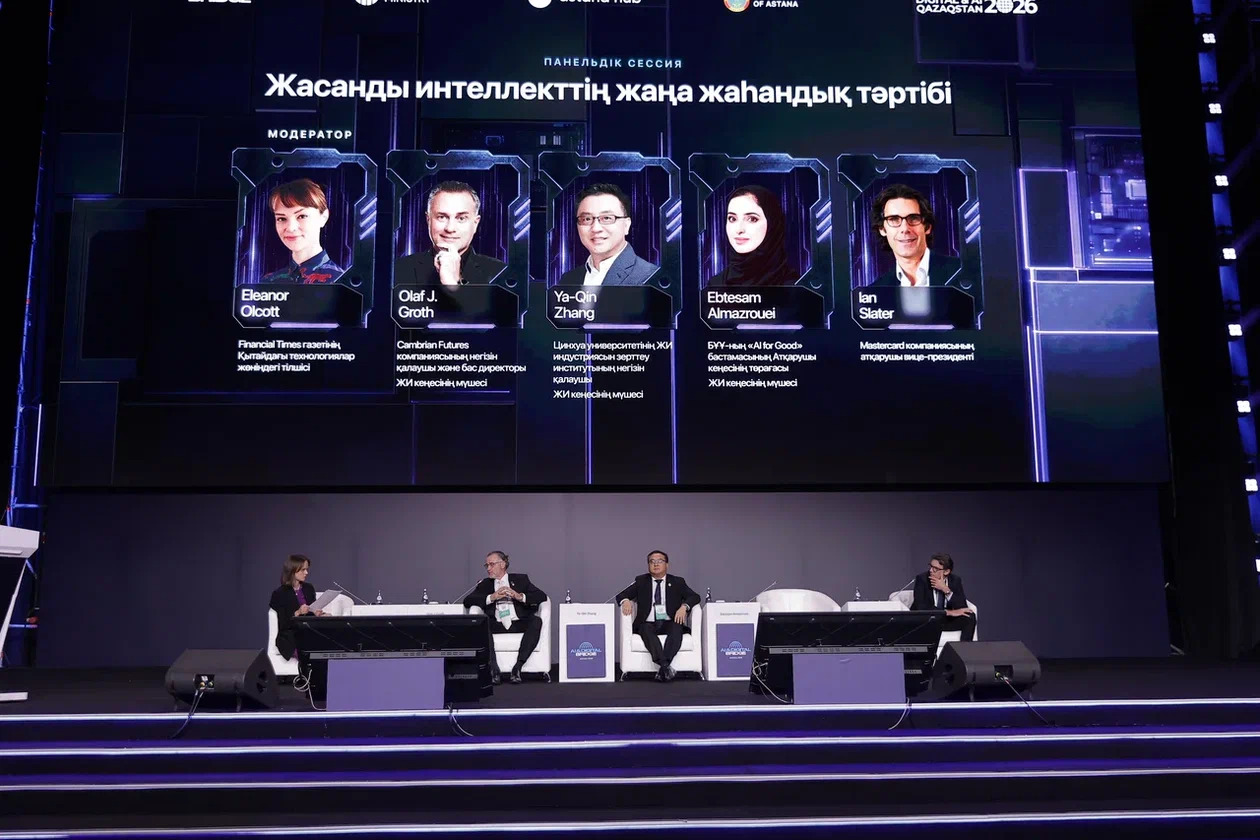
Photo credit: Digital Bridge 2026.
Ya-Qin Zhang, founder of the Institute for AI Industry Research at Tsinghua University, noted that most countries should not try to build frontier models entirely on their own.
“I wouldn’t say it’s a good idea to develop a trillion-parameter super frontier model for every country, probably not for Kazakhstan,” Zhang said.
Instead, he suggested countries focus on areas where they can build their own strengths while selectively using frontier models developed elsewhere.
His “TAP” model, including token, agent or application, and people, offered one way of looking at that division. Applications and people can be developed locally, while countries make choices around the infrastructure behind the models, including electricity, chips and access to frontier systems.
The emphasis on choice is important. Zhang said that countries should avoid becoming locked into a small number of technology providers and retain the ability to combine different models, infrastructure and applications. That also shifts the discussion away from the race to build the biggest model and toward the less visible infrastructure that lets AI function across economies.
Data, security and the limits of doing it alone
For financial networks in particular, AI’s value is closely linked to the breadth of data available to it. Ian Slater, Executive Vice President at Mastercard, made that point when the discussion turned to fraud and cybersecurity. According to him, global payment systems can benefit from drawing on patterns across markets rather than operating on data from a single country.

Photo credit: Digital Bridge 2026.
“A single country data set from a fraud and risk management perspective doesn’t work very well,” Slater said.
His argument was not simply that more data is always better. Fraud itself is increasingly cross-border, meaning that systems designed to detect it can be disadvantaged if they see only a fraction of the picture. That same logic applies to the wider question of access to technology.
Slater said that AI could create new opportunities for financial inclusion, but those opportunities depend on whether markets can connect to the technology and standards already developing globally.
“It is not efficient nor is it possible for every market in the world to develop its own capability,” he said.
The point fits into a broader tension running through the discussion: how to develop domestic capability without turning technological sovereignty into technological isolation.
Groth said that open-weight models could help widen access, while Zhang pointed to the cost-effectiveness of open models and the possibility for countries to combine them with their own data centers, electricity and applications.
“Open models can be an equalizer to democratize AI,” Zhang added.
But greater accessibility introduces another problem. The more models spread, the harder they may become to monitor. Groth warned that a world full of customized open models could also become “very unwieldy” from a governance perspective, raising questions about how governments would monitor systems operating outside traditional institutional structures. That makes the emerging AI architecture not only a technological and economic question, but a regulatory one.
The panel also returned repeatedly to the issue of trust, particularly as AI moves into financial services, digital identity and autonomous systems. Zhang said that increasingly capable AI systems will require clear boundaries, testing and mechanisms that allow potentially dangerous systems to be monitored or shut down. Slater approached the same issue from the consumer side, noting that people are still trying to understand what AI actually means for them. The challenge, then, is no longer simply whether AI works. It is whether the systems built around it are understandable, secure and governed well enough to become part of everyday economic life.
What comes after the technology?
In a separate conversation with The Astana Times after the panel, Slater returned to a question that came up several times during the discussion: what actually makes AI useful to an economy? His answer was not about building ever-larger models.
“I think the government needs a plan. They need to know what they’re doing it for,” he said.
He said there is a risk that AI becomes a target in itself, much as happened with other technology cycles.
“The danger with anything like AI … is that the term itself becomes the end. People talk about AI for the sake of AI,” he said.
For Slater, governments should start with a use case and work backward, building the institutions and partnerships around it. He pointed to Singapore and the United Arab Emirates as examples of countries that approached digital transformation with a relatively clear sense of what they wanted to achieve.
The same practical approach, he said, will be needed as AI agents begin to enter commerce. Slater sees agents as an extension of how people already interact with the internet rather than a replacement for existing commerce. Someone could eventually ask an agent to search for a flight, compare options and make a purchase according to permissions given in advance. But the technology is moving faster than consumer familiarity with it.
“We talk about these things, but we’re not at the end of the point where a consumer actually knows how to do it,” he said.
That gap matters because giving an agent the ability to act on someone’s behalf raises questions as much about behavior and responsibility as about software.
Slater also sees a similar challenge around biometrics and digital identity. He said he prefers biometrics to passwords, but as AI agents become more sophisticated, systems will still need to distinguish the real individual from the digital representation acting on that person’s behalf.
“We have some work to do to figure that piece out,” he said.
For a panel framed around a contest between the world’s biggest AI powers, that may have been one of the more telling conclusions. The next chapter will certainly be shaped by who controls frontier models, computers and chips. But it will also depend on what countries do with technologies they did not necessarily invent themselves and whether people are willing to let those technologies make increasingly consequential decisions for them.
