
ASTANA – Eleven years after Kazakhstan joined the World Trade Organization, the country trades across a far wider global market under internationally agreed rules. However, one of the central challenges that preceded accession remains: reducing its dependence on commodity exports.
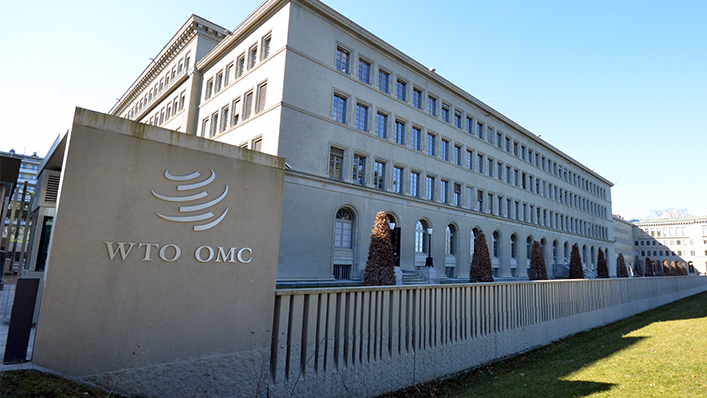
The World Trade Organization sets and oversees the rules governing international trade, with the aim of making trade between countries more open, predictable and efficient. Photo credit: WTO
Kazakhstan became the WTO’s 162nd member in 2015 after nearly two decades of negotiations. Its experience since then offers a measure of how deeply the economy has integrated into global trade and whether greater market access has translated into a more diversified export base.
“It is important to understand that today, 98% of Kazakhstan’s trade is conducted with WTO member countries. The organization remains a key element of the global trade architecture,” said Minister of Trade and Integration Arman Shakkaliyev during a briefing in September.
Sagyndyk Kosherbayev, director of the Center for Trade and Investment Policy at the Astana-based Economic Research Institute, describes Kazakhstan’s accession to the WTO as one of the key stages in the country’s integration into the global economy.
According to him, by the end of 2025, Kazakhstan’s foreign trade turnover had reached $144.7 billion, up 89% from 2015. Over the same period, exports increased by 72%, while imports more than doubled. During Kazakhstan’s first WTO Trade Policy Review in 2024, WTO members also noted that the country’s trade volumes had roughly doubled since accession.

Sagyndyk Kosherbayev (in the center). Photo credit: Economic Research Institute
Kosherbayev cautioned against attributing all of that growth directly to WTO membership. A more useful measure, he said, is how membership has changed the conditions under which Kazakhstan trades with the rest of the world.
“Kazakhstan remains a major exporter of commodities, meaning the value of its foreign trade is heavily influenced by global prices for oil, metals and uranium. Trade dynamics have also been shaped by the development of the Eurasian Economic Union, geopolitical shifts, exchange-rate fluctuations, transport and logistics constraints, and changes in the geography of trade flows,” Kosherbayev told The Astana Times.
What WTO membership changed
According to Kosherbayev, some of the clearest gains from WTO membership have come through more predictable market access, lower tariffs and simpler customs procedures.
“As part of its commitments, Kazakhstan bound tariffs across all product lines, while its average applied most-favored-nation tariff fell from 7.8% in 2015 to 5.6% in 2025. A more open tariff regime lowered barriers to imports of equipment and production inputs, while binding maximum tariff levels made foreign trade conditions more predictable for businesses and investors,” Kosherbayev said.
The expert also pointed to the progress in simplifying trade procedures, including introducing electronic customs declarations, a single-window system for export and import operations, and a customs risk-management system.
“This is where one of the more underestimated benefits of membership lies. The WTO is not so much a mechanism for increasing exports in itself as it is a system of rules that makes international trade more predictable,” he said.
This predictability also matters for investors, particularly companies considering export-oriented production, because it allows them to better assess the cost of importing equipment and components and the conditions for exporting finished goods.
WTO membership also provides a rules-based forum to challenge trade measures that might otherwise be difficult to contest through bilateral pressure alone.
Kosherbayev said that in April, Kazakhstan used the WTO dispute settlement system as a complainant for the first time, requesting consultations with Indonesia over additional import duties on hot-rolled steel coils from Kazakhstan.
“Kazakhstan argued that the measures may be inconsistent with provisions of the General Agreement on Tariffs and Trade 1994, the Anti-Dumping Agreement and the Marrakesh Agreement Establishing the WTO. The case illustrates one of the practical advantages of membership, particularly for economies with less negotiating weight,” he explained.
Diversification challenge
However, more predictable trade rules did not fundamentally transform the structure of Kazakhstan’s exports.
“In 2025, crude oil accounted for around 50.5% of Kazakhstan’s merchandise exports. Other major export categories included radioactive elements and isotopes, refined copper, copper ores and concentrates and ferroalloys. This is a crucial point when assessing the results of WTO membership,” said the expert.
A highly concentrated export structure doesn’t necessarily mean the WTO membership has been ineffective. Rather, as Kosherbayev said, it shows the limits of what trade policy alone can achieve.
“Export diversification is shaped primarily within the domestic economy. It requires competitive businesses, technological development, higher labor productivity, access to financing, transport connectivity, compliance with international standards and the ability of companies to integrate into global value chains,” he explained.
“International trade rules can provide access to markets, but it is the domestic economy that must produce goods and services capable of competing in those markets,” he added.
WTO under pressure
The predictability may matter even more today, as protectionism, wars and geopolitical rivalry increasingly reshape global trade. WTO itself describes the current period as the “most serious and sustained disruptions since the multilateral trading system was created 80 years ago.”
The shift has been especially visible in U.S. trade policy, with the Trump administration expanding the use of reciprocal, country-specific and sectoral tariffs in pursuit of what it describes as fairer trade.
“Trade conflicts among the world’s largest economies, industrial policies, subsidies for strategic sectors, sanctions-related restrictions and efforts by governments to reduce dependence on individual suppliers are accelerating the fragmentation of global trade,” said Kosherbayev.
At the same time, WTO’s World Trade Report indicated that around 72% of global merchandise trade still takes place under the WTO’s most-favored-nation terms. The organization says decades of trade cooperation have supported economic growth, helped narrow income gaps between developing and advanced economies, and contributed to greater stability among its members.
The WTO said it now faces a paradox partly of its own making. The more open and integrated trading system it helped build has also become more complex, multipolar and difficult to govern. Its challenge is no longer simply to preserve that system, but to adapt to the world it helped create.
So the next phase will depend on whether Kazakh companies can use that access to expand beyond commodities and compete in higher-value segments of global trade at a time when the multilateral trading system itself is becoming more fragmented.
As Kosherbayev said, Kazakhstan’s trade policy should increasingly be judged not by the number of markets formally open to the country, but by how effectively its businesses can compete in them.
