
ASTANA – Kazakhstan is moving its cross-border trade hubs from planning to implementation, with new production facilities, logistics infrastructure and cargo flows emerging along the country’s borders and Caspian coast.
The five priority hubs are designed to strengthen trade with the Kyrgyz Republic, Uzbekistan, Russia, China and the Caspian region, attract investment and support the government’s goal of raising non-resource exports to 30%, the Ministry of Trade and Integration reported on Sept. 6.
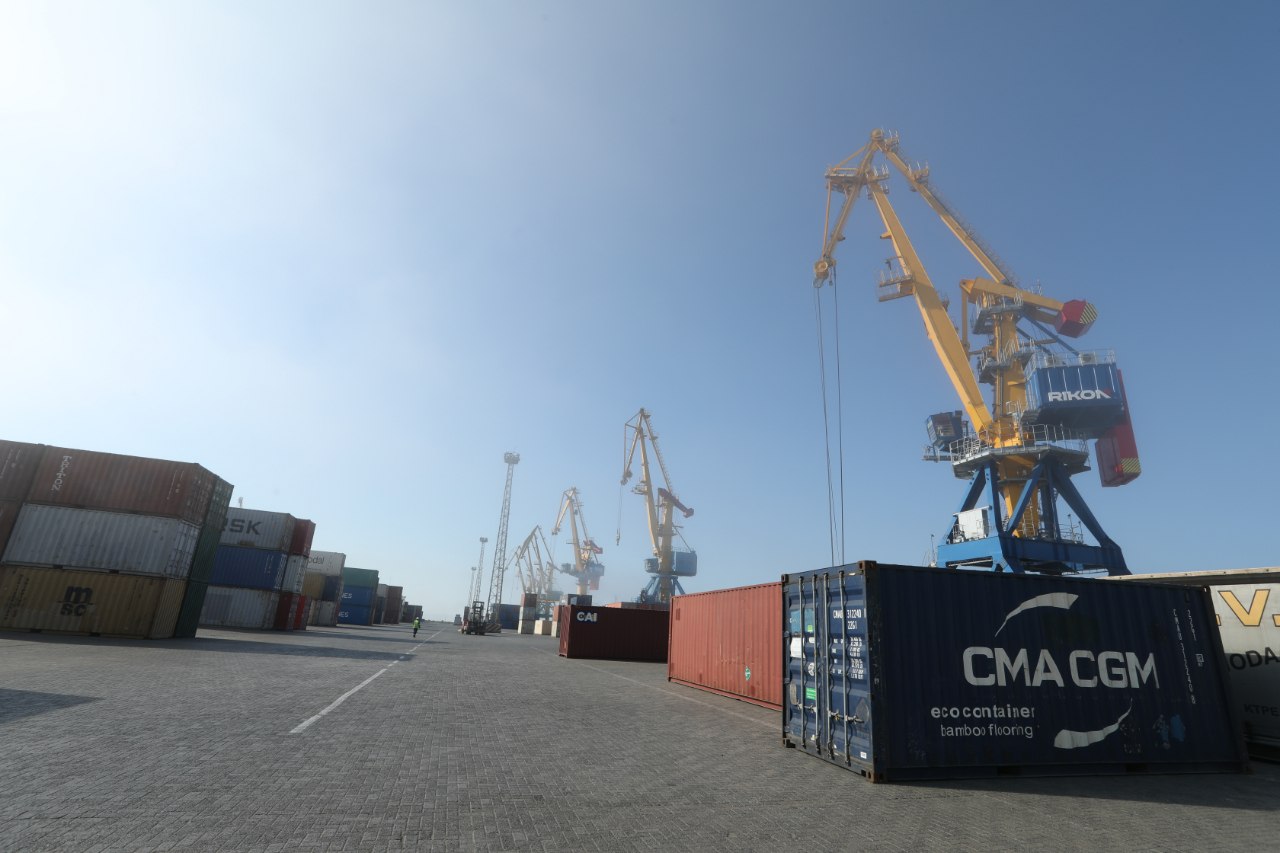
Containers at a cross-border logistics hub in Kazakhstan. Photo credit: Ministry of Trade and Integration.
Khorgos emerges as major eastern gateway
The strongest growth is at the Khorgos-Eastern Gate Special Economic Zone (SEZ), where the number of projects rose from 14 in 2022 to 69, while investment grew from 340 billion tenge (US$755.1 million) to 652.8 billion tenge (US$1.5 billion).
Currently, 40 projects worth 75 billion tenge (US$166.6 million) are under implementation, creating 864 jobs. In January-June, nine new participants registered projects totaling 9.3 billion tenge (US$20.7 million), creating 230 jobs. Production reached 12.7 billion tenge (US$28.2 million), up 74% year on year.
The SEZ already hosts a dry port with an annual capacity of 540,000 containers and a 25,000-square-meter Class A warehouse. Two additional major logistics projects are being designed.
By 2028, 28 projects worth 577.7 billion tenge (US$1.3 billion) are planned, with nearly 2,800 jobs. Key projects include the Kazakhstan-China International Industrial City, valued at 330 billion tenge (US$733 million), and an international cargo and passenger airport worth 250 billion tenge (US$555.2 million).
Central Asia hub advances
On the southern border, the Central Asia International Industrial Cooperation Center is moving into the construction and commissioning phase.
External construction and installation work is complete, and commissioning is underway. Internal engineering infrastructure is 55% complete and is expected to be finished by December.
Eight production buildings have already been constructed, while the center’s investment project portfolio totals 89.4 billion tenge (US$199 million). Construction has started on a 75.3-billion-tenge (US$167.2 million) industrial park, one of the center’s largest projects.
In the Zhambyl Region, the Industrial Trade and Logistics Complex received SEZ status in April. The 165-hectare site is being prepared for development, with infrastructure connections planned. Construction of the first-stage substation began this year, with around 4 billion tenge (US$8.8 million) allocated this year from a total planned 12 billion tenge (US$26.7 million).
Western hub targets production and trade
The Eurasia Cross-Border Trade Center in the West Kazakhstan Region covers 281 hectares. Part of its external infrastructure, including gas, electricity, water supply and wastewater systems, has already been completed.
The industrial zone is attracting projects ranging from asphalt production and tire recycling to aerated concrete manufacturing and a gas-turbine power plant.
Authorities are also considering creating the Eurasia SEZ, which would provide additional incentives for investment and local production.
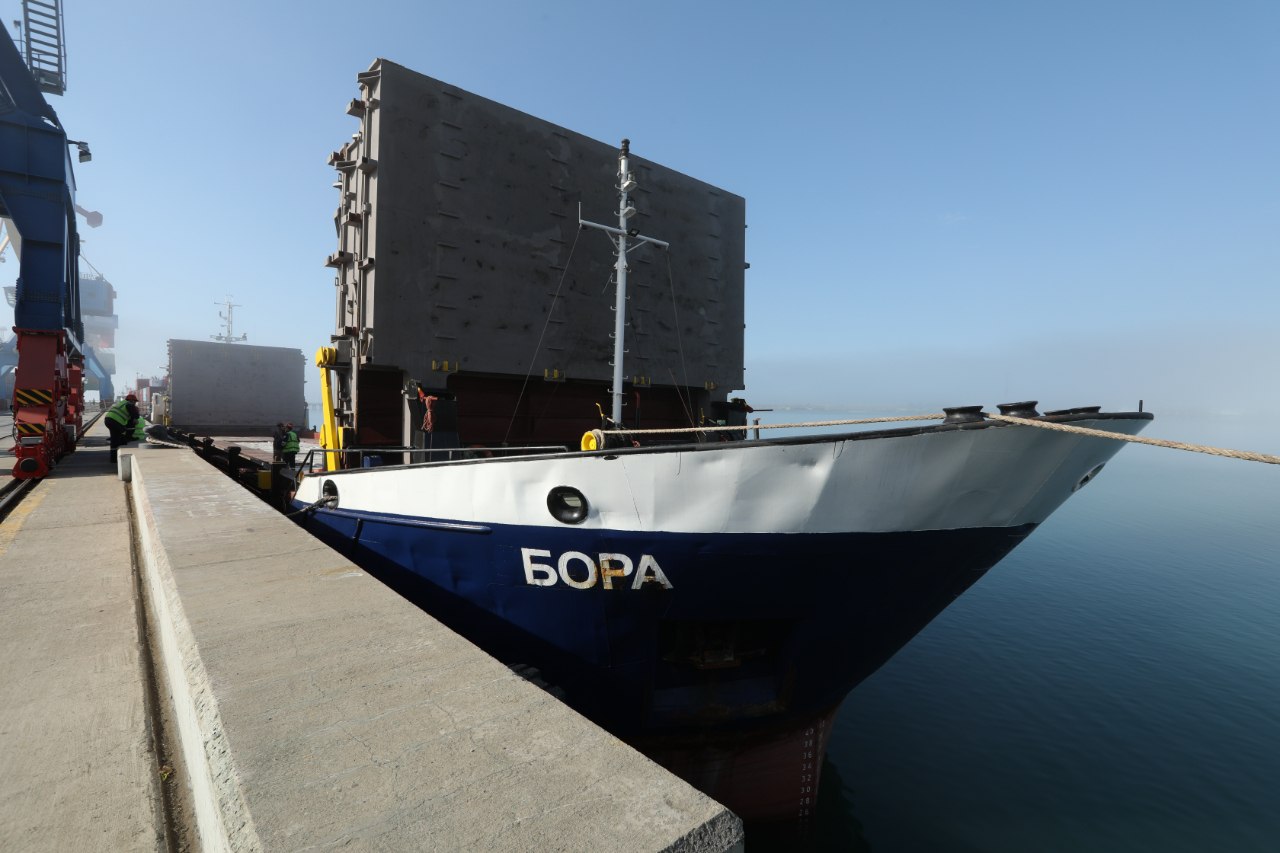
Cargo operations at a Kazakhstan port on the Caspian Sea. Photo credit: Ministry of Trade and Integration.
Caspian corridor gains container capacity
The Caspian leg is already generating tangible cargo flows. The Aktau International Container Hub received its first container train on July 14. Since then, it has handled 233 containers, or 444 TEUs.
The project is being developed in stages and is expected to raise the port’s container-handling capacity from 70,000 TEUs to 240,000 TEUs annually.
Another major project is the Ersai container terminal at the Industrial Port. Construction is nearly 85% complete. Ten kilometers of internal railway tracks have been built, while the container yard and crane tracks are nearing completion.
The terminal is scheduled to open on Oct. 1. At full capacity, it will handle up to 120,000 TEUs annually and accommodate up to 300 vessels a year. Private investment in the project exceeds 15 billion tenge (US$33.3 million).
From border infrastructure to trade network
The five hubs are gradually becoming part of a broader trade and logistics network connecting Kazakhstan with neighboring markets and international transport routes.
The emerging model goes beyond border checkpoints and warehouses. Industrial production, logistics services, investment projects and container infrastructure are developing alongside one another, creating new points of economic activity across the country.
The next priority is to bring the facilities to full capacity, attract more investors and increase trade and transit volumes through Kazakhstan’s border corridors.
