
SAMARKAND – The development of capital markets ultimately reflects the maturity of a country’s financial system, with trust emerging as the decisive factor, said Nurzhan Tursunkhanov, deputy chairperson of Kazakhstan’s Agency for Regulation and Development of the Financial Market.
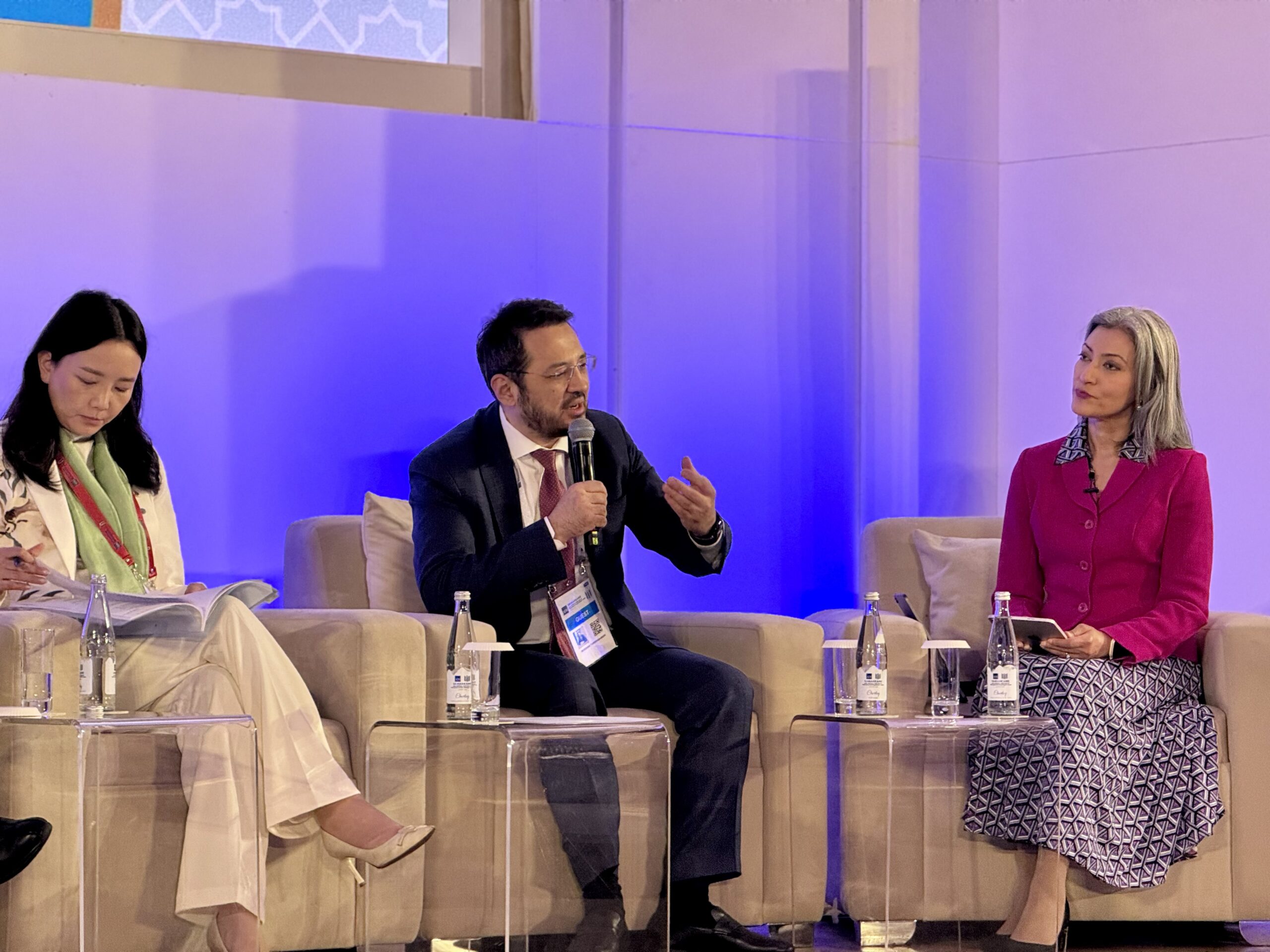
Khulan Bat-Erdene, Nurzhan Tursunkhanov and moderator Sharanjit Leyl. Photo credit: Assel Satubaldina/ The Astana Times
Tursunkhanov addressed a panel session at the Asian Development Bank’s (ADB) 59th Annual Meeting of the Board of Governors that is taking place in Samarkand on May 3-6. Bringing together finance ministers, central bank governors, industry leaders, civil society representatives and media, the gathering is held each year and serves as the bank’s flagship platform to discuss regional economic trends, policy priorities, and development challenges.
Speaking at a panel session, Tursunkhanov pointed to rapid rise of the non-resident participation in Kazakhstan’s local currency government bond market. This, he noted, signals growing investor confidence in policy and institutions.
“Strong policy maker, very credible and where the markets can actually see you, hear you, and predict your action, this is very important. This is one of the cornerstones, one of the fundamentals of the well-functioning capital market,” Tursunkhanov said.
Foreign holdings in Kazakhstan’s domestic bond market have surged substantially from levels that Tursunkhanov said were once seen as aspirational.
“Five years ago, we have been dreaming about $1 billion or $2 billion. Last year, we reached $2 billion of non-resident investments in the local currency government bond market,” he said. The momentum retained, as the figure climbed to nearly $5 billion in recent months, he added.
Capital markets unlock opportunities for growth
Countries across the region and beyond are pushing to deepen capital markets and reduce reliance on bank-based financing. That shift is driving a stronger focus on regional coordination, with financial cooperation gaining renewed urgency under the Central Asia Regional Economic Cooperation (CAREC) 2030 strategy, said Yingming Yang, ADB Vice President for South, Central and West Asia. CAREC is a partnership of 11 countries, including Kazakhstan.
“The strategy recognizes that deeper and more resilient financial markets are essential to support economic diversification, regional connectivity, and the transition toward low-carbon and climate-resilient economies. Across the region, financial sectors are at different stages of development, yet they share common structural factors. As a result, banking systems dominate while non-bank financial sectors, particularly capital markets, remain underdeveloped,” he said.
Robust capital markets, Yang noted, are critical to mobilizing domestic savings, attracting foreign investment, and allocating resources efficiently, including toward green and resilient infrastructure. “This is precisely why a regional approach is critical,” he said, adding that regional cooperation and integration is one of ADB’s five strategic focus areas.
Mongolia’s Deputy Finance Minister Khulan Bat-Erdene also underscored why developing capital markets is critical for the region’s long-term growth. She explained that the banking system is mostly built on short-term deposits. That works well for short-term lending, but it creates problems when it comes to financing long-term projects such as infrastructure or large-scale investments.
“In order to move away from a more loan-based and bank-independent system to a more market-based and capital, what we need is a fresh, clean, and healthy ecosystem,” Bat-Erdene said.
That’s where capital markets come in. They can offer longer-term financing and a wider range of instruments. But the challenge is that in many emerging regions, including Central Asia, while there has been progress in developing financial products and issuing securities, there aren’t enough long-term investors to buy them.
“What we need is a buy-side ecosystem where institutional investors, such as pension fund, public pension fund, long-term insurance companies, those type of institutions can come and be the buyer and the participant of the capital markets,” she explained.
Another important point that the deputy minister highlighted is that banks should not be seen as competitors to capital markets, as they can play a key supporting role.
“They have the necessary infrastructure. They have the distribution channel. They have a huge client base. Instead of saying, the banks are the bad guys, we need to leverage on their competence and maybe use their distribution channel for a lot of investment fund infrastructure,” she said.
At the same time, Bat-Erdene also cautioned against hurrying with the reforms.
“We need to sequence the reforms, not trying to do everything at once,” she added. If reforms are rushed or poorly sequenced, they can fail and damage trust in the system, making future progress even harder.
Advancing regional cooperation
ADB welcomed the institutionalization of the CAREC Capital Markets Development Forum (CMDF), a platform designed to bring together policymakers and market participants to share knowledge and develop common frameworks.
Yang pointed to the experience of Southeast Asia as a model, noting that the ASEAN Capital Markets Forum has helped develop common standards and mobilize more than $100 billion in sustainable bonds. Similar cooperation in Central Asia, he said, could help accelerate reforms, build investor confidence, and attract long-term capital.
Tursunkhanov voiced strong support for the creation of the regional platform. He stressed that the timing is critical, as several countries in the region are pursuing reforms independently.
“We need to build coordination,” he said, emphasizing that aligning reform efforts across countries would deliver a far greater impact than acting alone.
