
ASTANA – Kazakhstan plans to transform Alatau into a regional technology and investment hub under a newly adopted special legal regime that will give the city broader economic powers, AI-focused regulation and special conditions for foreign investors.
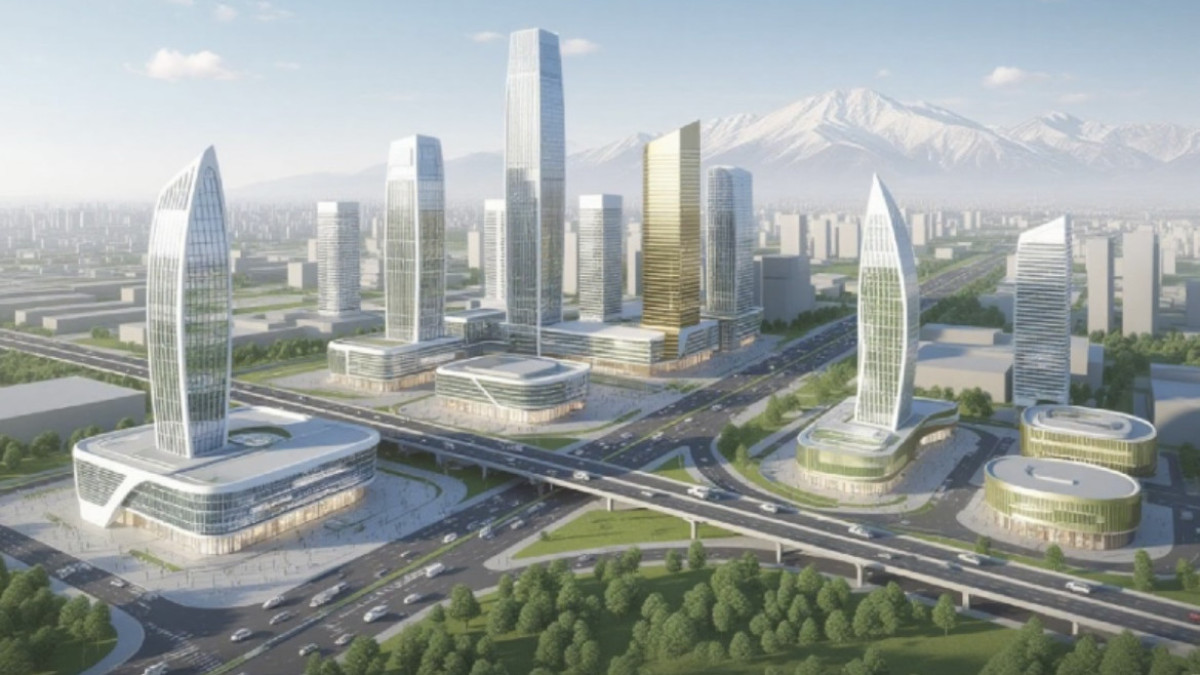
Photo credit: Grok
The constitutional law, presented during a government briefing on May 21, is part of the country’s broader effort to diversify its economy and attract international technology companies and investors. The framework will take effect in stages beginning July 1.
Under the new regime, Alatau, located in the Almaty Region, will receive expanded authority over taxation, investment policy and business regulation. Officials say the city will operate under a streamlined governance model featuring a one-stop service system for investors and businesses modeled in part on international financial and innovation centers such as Dubai and Singapore.
A key element of the initiative is a special investment regime designed to increase confidence among international companies. Investors will be able to resolve disputes through the jurisdiction of the Astana International Financial Centre or international arbitration mechanisms. Regulatory acts in Alatau will also be based on principles and precedents of the law of England and Wales, which officials say will make the system more predictable for foreign businesses.
“As a result, Alatau will become a modern, regulated platform for the implementation of new governance and technological solutions. Successful mechanisms tested in Alatau will subsequently be scaled up and applied in other regions of Kazakhstan,” Deputy Prime Minister Kanat Bozumbayev at a May 21 government briefing.
“In international practice, such projects are commonly referred to as ‘charter cities.’ A comprehensive ecosystem in Alatau is planned to be created that extends beyond tax incentives to include business regulation frameworks, investment attraction mechanisms and systems for resolving commercial disputes,” he explained.
The government is also positioning Alatau as an AI-driven smart city. The city will operate through a unified digital platform and may introduce experimental legal regimes for artificial intelligence, robotics, autonomous transport and digital assets, including cryptocurrency-related activities.
Bozumbayev said the legislation was developed with input from leading international experts and drew on lessons from both successful and unsuccessful special economic and administrative zones around the world.
Over the past decade, more than 1,000 such zones have been established globally to attract investment, innovation and technology, reflecting growing competition among jurisdictions for capital and talent, he said. Yet roughly 60% failed to achieve their objectives.
“Examples, including Shenzhen and Hainan in China, Sejong and Songdo in South Korea, as well as Singapore, Dubai and Doha, have been studied. International experience shows that granting a city a special status alone is not sufficient. The decisive factor is the quality of the institutional environment,” said Bozumbayev.
Under a constitutional law establishing a special legal regime for Alatau, the Alatau City Authority, created last year as a state fund by presidential decree, will be transformed into a government body effective July 1.
The authority will be tasked with driving the accelerated development of Alatau. Its strategic direction will be overseen by a council chaired by the Prime Minister, which will be responsible for making key policy decisions and approving regulatory acts.
Local authorities, including the city’s maslikhat and akimat, will continue to manage day-to-day social services, municipal infrastructure and other public affairs.
According to Alisher Abdykadyrov, chief executive officer of the Alatau City Authority, a pool of 53 investment projects worth more than two trillion tenge (US$4.2 billion) has been formed, with plans to create more than 51,000 jobs.
“Among the key partners and flagship projects are companies and institutions including Iconic Complex, Joby, AutoFlight, Mars, PepsiCo, KAIST University, Hyundai Green Food, and Khan Tengri Biopharma,” said Abdykadyrov.
One of the most high-profile projects involves urban air mobility. The first aerotaxi test flights were carried out in Alatau on May 19 in partnership with the U.S.-based Joby and Chinese company AutoFlight.
