
ASTANA – The Eurasian Development Bank has released the Waves of Investment Megahype report on April 7, outlining the most likely directions for the next global surge in investment in emerging technologies, according to the bank’s press service.
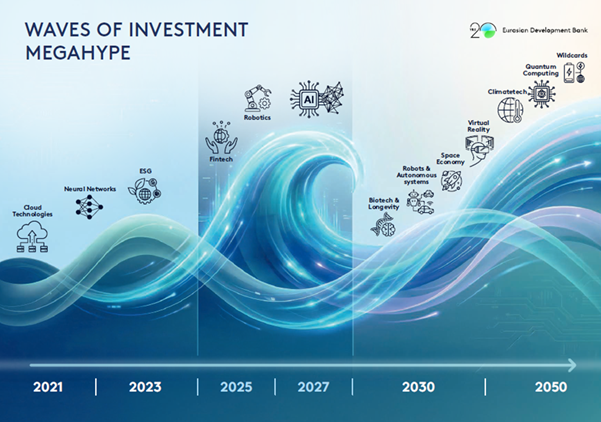
In its recent report the EDB outlined the most likely directions for the next global surge in investment in emerging technologies. Photo credit: EDB
The report identifies seven areas expected to attract major capital flows in the coming years, including biotechnology and longevity, robotics and autonomous systems, quantum computing, virtual reality, energy storage and grids, climate technologies, and the space economy.
In recent years, the global economy has experienced several powerful investment waves. The digital boom peaked in 2021, followed by heightened interest in ESG in 2023 and artificial intelligence in 2025. Each wave builds on the previous one, as earlier technologies create the infrastructure, data and demand for subsequent innovations.
The report highlights that, in the near term, biotechnology, robotics and virtual reality will be the strongest candidates for the next investment cycle.
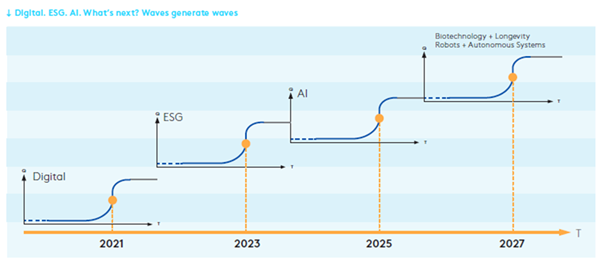
Photo credit: EDB
Biotechnology receives particular attention, driven not only by its market size but also by its potential to address long-term labor shortages. As populations age, extending healthy and productive lifespans is becoming an increasingly important economic factor.
According to the bank’s estimates, the global biotechnology market totaled around $1.9 trillion to $2.2 trillion in 2024-2025 and could reach nearly $5.9 trillion by 2034. The robotics market is projected to grow from $64.8 billion in 2025 to $376 billion by 2035, while virtual reality could expand from around $75 billion to $693 billion over the same period.
The report also assesses the macroeconomic impact of increased longevity in major economies. One additional year of healthy, productive life could generate significant cumulative GDP gains over 20 years, including around $18.2 trillion for China, $15.1 trillion for the United States, and $2.8-$3.4 trillion for Russia. This suggests that investment in healthcare, aging prevention and biotechnology may become both a social priority and a major economic strategy.
At the same time, the report warns that each technological wave carries risks alongside opportunities. It highlights the concept of creative self-deception, in which expectations about a technology outpace its actual level of development. For investors and policymakers, the key challenge is not only identifying promising sectors but also accurately assessing their maturity.
In the new technological environment, the key resource is the ability to rapidly absorb and scale promising solutions. For developing economies, competition will extend beyond capital to include speed of market entry, skills development and institutional readiness for the next phase of growth.
