
ASTANA – With shifting global supply chains shift and geopolitical tensions on the rise, Japan is looking to Kazakhstan as a strategic partner not only for critical minerals and transport routes, but for a broader relationship built on trust, education and shared global priorities, said Japan’s Ambassador to Kazakhstan Yasumasa Iijima in an interview with The Astana Times.
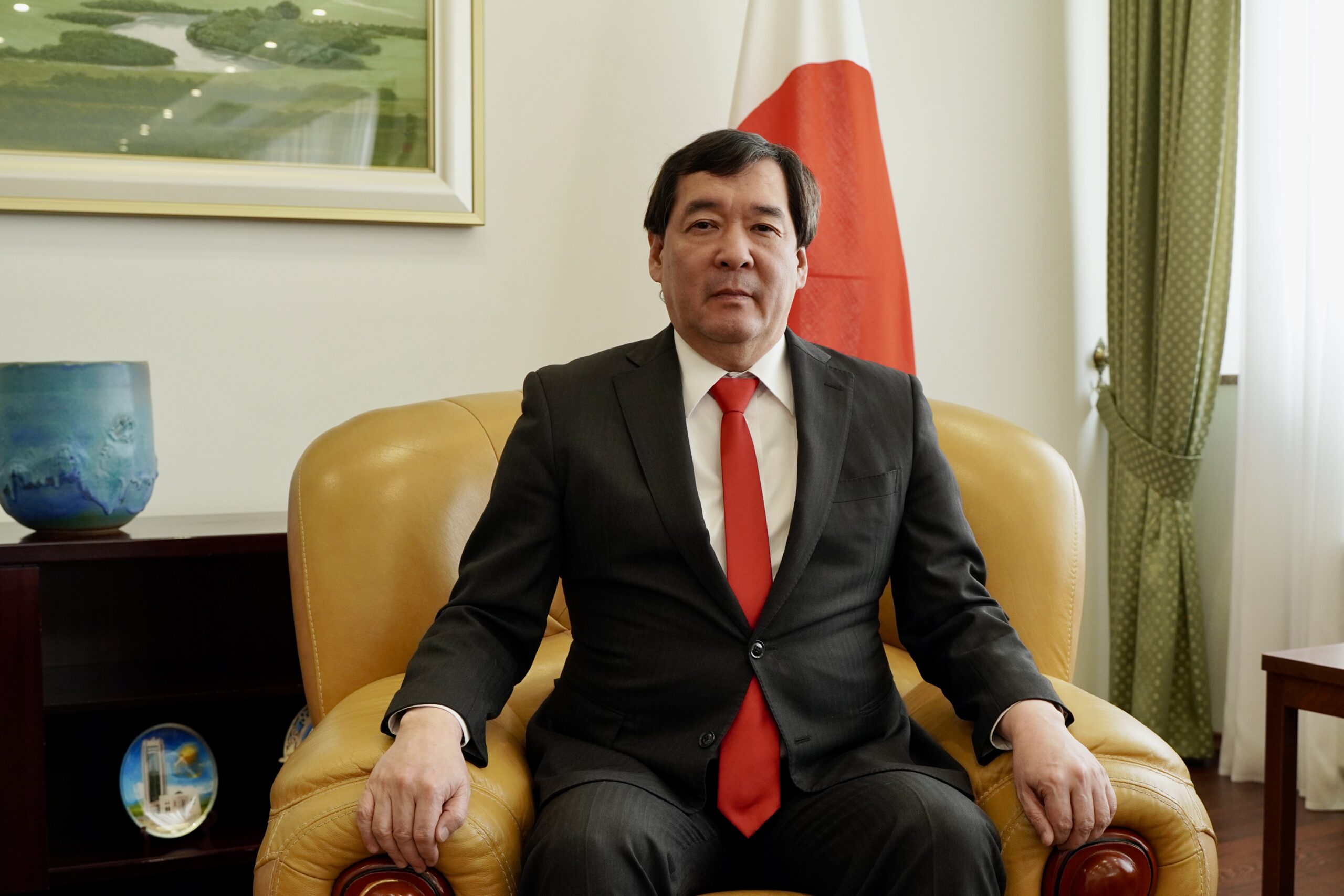
Japan’s Ambassador to Kazakhstan Yasumasa Iijima. Photo credit: Fatima Kemelova/ The Astana Times
That momentum was especially visible over the past year, which saw an active stretch of high-level engagement, including then–Japanese Foreign Minister Takeshi Iwaya’s visit to Astana and President Kassym-Jomart Tokayev’s visit to Japan in December, which coincided with the Central Asia–Japan summit in Tokyo.
As part of the visit, Tokayev met with Emperor Naruhito of Japan. Bilateral ties were also at the focus of Tokayev’s meeting with Japanese Prime Minister Sanae Takaichi.
In his meetings with top management of Japanese companies, Tokayev highlighted opportunities in critical minerals, industrial manufacturing, smart technologies, and workforce development. “Bilateral cooperation includes engagement in critical minerals, including rare metals and rare earth elements. Particular attention is also being paid to cooperation on the Middle Corridor, which Kazakhstan considers a priority,” Iijima said.
“The country is positioned to leverage its strategic location at the center of the Eurasian continent to become a key transport and logistics hub linking East Asia, Europe and South Asia. Japan has expressed its intention to provide comprehensive support for the project to facilitate the flow of people, goods and information,” he said.
The ambassador flagged the declining water level of the Caspian Sea as another major concern that could pose risks to the development of the country’s transport and logistics potential.
“If the trend continues, it could lead not only to one of the world’s most significant environmental crises but also affect the Caspian route, a vital component of the Middle Corridor,” he explained.
An important part of the visit was the Central Asia–Japan summit, bringing together leaders from across Central Asia. As part of the summit, more than 150 documents were signed by both government institutions and private sector representatives, including 53 agreements between Kazakhstan and Japan, said the ambassador.
“The summit reaffirmed the countries’ intention to cooperate in transport and logistics, including the Trans-Caspian International Transport Route linking the countries of Central Asia. The parties also agreed to strengthen cooperation on environmental protection, including the green transition through digitalization and artificial intelligence, and to prioritize human capital development through scholarship programs,” the ambassador explained.
21 years of regional format
Japan was the first country to initiate the diplomatic platform with Central Asia, which was later followed by the region’s other major partners. The ambassador praised the dialogue built upon this framework, saying it played a crucial role in “maintaining and strengthening partnership and cooperation based on friendship and mutual trust.”
“Notably, Kazakhstan’s delegation at the first foreign ministers’ meeting under the Central Asia+Japan format was led by current President Kassym-Jomart Tokayev, who at the time served as foreign minister,” said Iijima.
“As such, President Tokayev has a deep understanding of the format’s goals and concept and has consistently supported Japan’s initiatives. He has made a significant contribution to the development of this framework, for which Japan expresses its strong appreciation,” he added.
Trade momentum
Tokayev’s December visit alone concluded with more than 60 bilateral documents worth more than $3.7 billion.
“Both countries recognize the importance of diversifying sources of critical minerals. At the December summit, they also discussed opportunities to expand supplies of key minerals and Kazakhstan’s role in ensuring the security of global supply chains,” said the ambassador. According to official statistics, bilateral trade reached $1.78 billion in 2025, with Kazakhstan exporting $435 million and importing $1.35 billion, mainly machinery and vehicles from Japan. Kazakhstan’s exports are dominated by metals, particularly ferroalloys, as well as energy resources and chemicals.
Japan is among the top ten foreign investors in Kazakhstan, with over $8 billion in total investments. More than 60 Japanese companies operate in Kazakhstan across sectors including energy, mining, finance, logistics and healthcare.
According to Iijima, for Japan, Kazakhstan plays an important role as a promising source of rare metals and rare earth elements.
“These valuable resources are essential for the production of semiconductors, defense systems and high-precision automotive components. Demand for them is expected to grow substantially in the coming years, alongside a stronger presence of Kazakhstan in international markets,” he said.
Japanese companies are also active in Kazakhstan’s mining sector, particularly uranium and chromium extraction. According to the ambassador, the mining boom in the country has increased demand for reliable construction equipment, bolstering the standing of Japanese manufacturers such as Hitachi Construction Machinery and Komatsu.
“Japanese equipment makers are distinguished by strong after-sales service systems and a commitment to training highly qualified specialists. In addition, Japanese automobiles continue to post steady sales and enjoy a high level of trust and popularity in the Kazakh market,” said the ambassador.
What matters most to Japanese investors
Iijima said Japanese companies prioritize predictable business environment when making investment decisions, emphasizing the importance of timely and reliable contract payments.
“This is especially important for resource and infrastructure projects involving long-term investments, where the business environment must remain stable, and any disputes must be resolved through fair and transparent legal procedures,” said the ambassador.
Japanese companies, he noted, are bound by rigorous compliance standards and cannot operate in environments where corruption distorts business practices, competition is not fair, or international norms are not upheld.
“In addition, Kazakhstan’s companies often expect investments to yield returns quickly,” Iijima added. “Kazakhstan is making consistent efforts to improve its investment climate that are helping draw greater interest from Japanese investors.”
Nuclear disarmament efforts
Alongside deepening economic ties, the two countries are aligned on broader global challenges, and priority among them is nuclear disarmament.
The ambassador pointed to shared devastating experience from the nuclear weapons. Japan is the country to have experienced the atomic bombings of Hiroshima and Nagasaki, while Kazakhstan has the legacy of more than 450 nuclear tests at the Semipalatinsk site.
“As a country that closed the Semipalatinsk nuclear test site and voluntarily renounced nuclear weapons, Kazakhstan, in my view, shares the same feelings as Japan,” he added.
“Each country follows its own path, but they share a common goal: a world free of nuclear weapons. Even amid today’s complex security environment, we believe our shared responsibility is to continue strengthening the nuclear disarmament and nonproliferation regime through dialogue and confidence-building measures,” said Iijima.
For more than three decades, Japan has partnered with Kazakhstan to mitigate the legacy of nuclear weapons, supplying monitoring and medical equipment as well as physical protection systems. Iijima noted that the assistance has been delivered through programs such as Measures Against Radioactive Contamination in the Semipalatinsk Nuclear Test Site Area and the Equipment Development Plan for Nuclear Safety.
“In addition, Japan used the opportunity of a meeting between the foreign ministers of Japan and Kazakhstan last August to sign an agreement providing new medical equipment to Kazakhstan under a grant aid program,” said the ambassador.
Growing academic exchanges
The bilateral relationship extends beyond trade and investment, with both countries placing increasing emphasis on education and the exchange of knowledge.
According to Iijima, academic exchange programs for Kazakh professionals, including opportunities to study abroad, are organized not only by universities and research institutes but also by the Japanese government. In particular, the Ministry of Education, Culture, Sports, Science and Technology (MEXT) offers a range of annual scholarship programs for Kazakh citizens.
“Among them is the MEXT Research Student Program, which enables researchers to conduct academic work in Japan. The MEXT Teachers Training Program allows practicing educators to study teaching methods and enhance their professional qualifications at Japanese universities. The Young Leaders’ Program provides opportunities for overseas study aimed at preparing future leaders from among promising public sector professionals in Kazakhstan,” the ambassador explained.
He also pointed to the growing number of people in Kazakhstan learning Japanese.
“Last year, participation in the Japanese Language Proficiency Test, held in Astana and Almaty, reached a record high. This reflects growing interest in Japan among Kazakh citizens and shows that academic and educational opportunities are increasingly available not only in Europe and the United States, but also in Japan,” he said.
Likewise, Japanese culture is gaining a growing following in Kazakhstan, with anime and manga emerging as particularly popular entry points for a new generation of enthusiasts.
