
ASTANA – Ahead of its 15th Five-Year Plan, China has completed a structural shift in its financial system, moving from rapid expansion of banking assets to a strategy aimed at becoming a financial power. Analysts say the transition could reshape China’s economy and create new opportunities for Kazakhstan, strengthening its role as a bridge between Chinese capital and Eurasian markets.
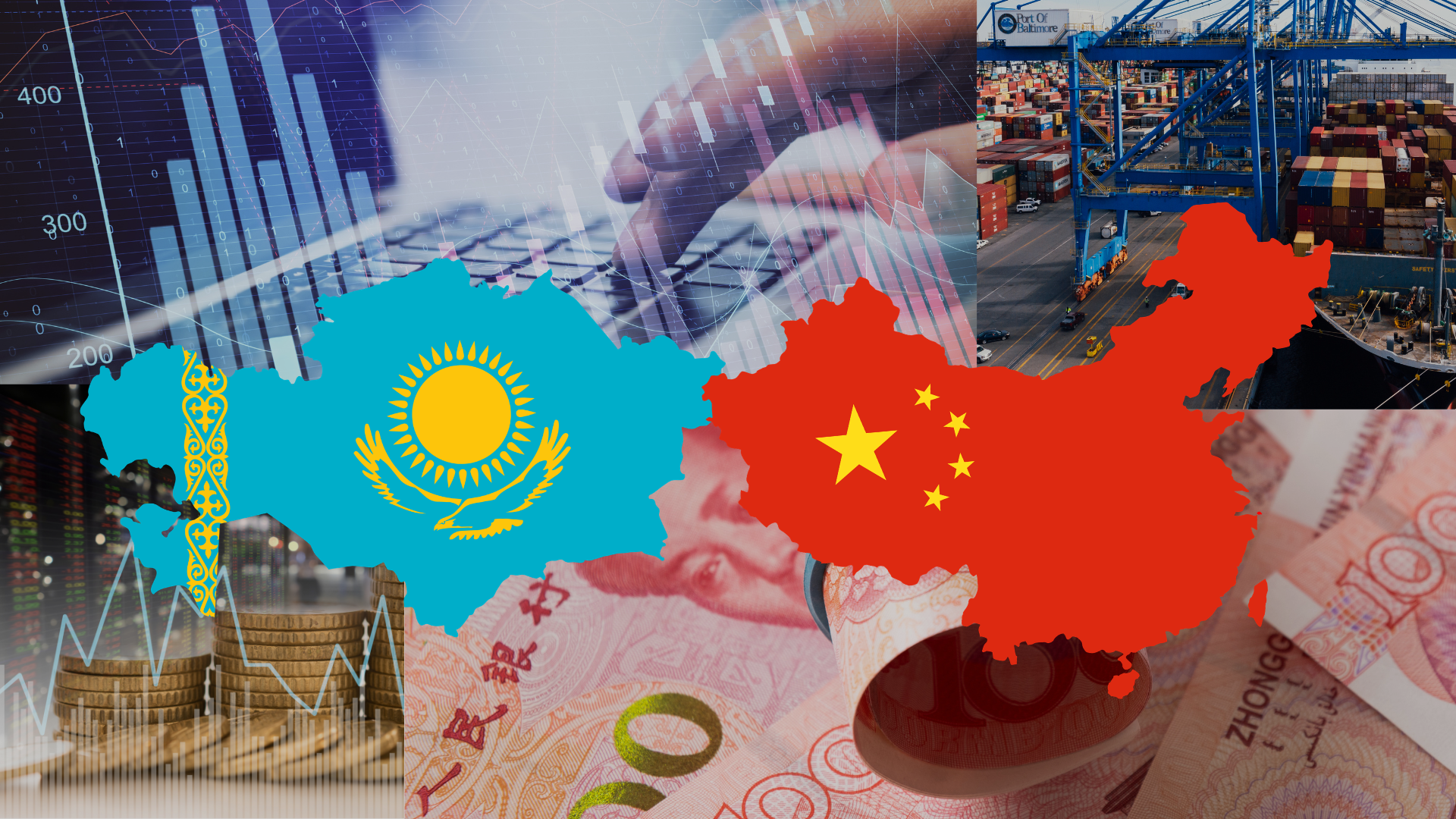
Collage is created by The Astana Times/ Fatima Kemelova.
China’s new financial doctrine
China is one of the world’s largest financial centers, with the biggest banking assets and foreign-exchange reserves, the second-largest stock and bond markets, and a major insurance sector.
As of February, the country had 21 systemically important banks, around 1,500 insurance companies and more than 4,000 financial institutions. The market remains highly connected internationally, with 24 global banks and nearly half of the world’s 40 largest foreign insurers operating in China.
To achieve the status of financial power, Beijing identified several priorities, including strengthening the national currency, reinforcing the central bank, building competitive financial institutions, developing international financial centers, improving supervision, and expanding professional expertise.
Chinese President Xi Jinping said China’s financial system differs from Western models, emphasizing that finance should serve the real economy and public welfare rather than the interests of a narrow group of investors.
Under the new policy, bank capital is expected to be more closely tied to the real sector, limiting speculative bubbles in services and real estate. Financial resources are to support technological sovereignty, industrial modernization and the development of critical infrastructure.
The strategy also calls for reducing reliance on complex derivatives and other speculative instruments seen as sources of systemic risk.
According to a March 9 report by the Standing Committee of the National People’s Congress, China plans to speed up the transition by drafting new laws on finance and financial stability.
CIPS, yuan settlements and global ambitions
Amid a weaker U.S. dollar and policy uncertainty in Washington, China is seeking to strengthen the global role of the yuan in trade, investment and currency markets.
Ding Zhijie, head of the Financial Research Institute at the People’s Bank of China, said the yuan should become a global instrument for pricing, payments, investment, financing and reserves.
A key priority is expanding the global clearing network for yuan transactions and increasing the attractiveness of yuan-denominated assets. China is also developing the Cross-border Interbank Payment System (CIPS), which had 193 direct and 1,573 indirect participants by early 2026.
According to the International Monetary Fund, the dollar still accounts for around 50% of global reserves, while the yuan holds roughly 2-3%, compared with 20% for the euro. Analysts say the yuan’s share could grow if de-dollarization trends continue.
Chinese authorities acknowledge that growth based mainly on expanding production capacity has reached its limits. The new model focuses on innovation and requires a deeper transformation of the financial sector.
Banks are expected to provide long-term financing to strategic industries, while fintech and new risk-assessment tools should support high-tech companies, especially at early stages.
Officials also plan to allow pension and social insurance funds to invest more actively in capital markets, turning long-term savings into resources for technology and infrastructure projects.
Another focus of reform will be to expand the role of the securities sector, which represents less than 4% of China’s financial system assets and does not yet meet the needs of innovation-driven development.
Expert views
Ding said China remains “large but not yet strong” financial power, citing limited efficiency in the financial sector, a gap between financial instruments and the needs of the real economy, and relatively weak global influence.
According to Liang Ping, head of the Institute of Advanced Industrial Studies, building a financial power will be a priority for the 2026-2030 Five-Year Plan, with the yuan playing a central role.
“Creating globally competitive financial institutions is impossible without a strong currency. Despite the global leadership in the banking sector, the Chinese segment of securities, investment banking and insurance remains relatively small and less competitive on the global stage,” he said.
Li Wenlong, head of the Digital Economy Innovation Institute in Zhejiang, noted digital finance will also be crucial.
“Real sovereignty in the digital era will depend on the ability of the yuan and Chinese fintech platforms to control payment and investment flows,” he said.
China’s concept of a financial power focuses on building a system capable of directing capital toward national priorities, managing risks and expanding global influence without excessive deregulation.
The shift toward long-term investment and capital-intensive projects within the Belt and Road Initiative could also create opportunities for international partners, particularly in infrastructure and high-value industries.
Opportunities for Kazakhstan
Economist Anuar Nurtazin said China’s strategy creates a rare opportunity for Kazakhstan.
The country’s geographic position between major Eurasian economies could allow it to become a key hub linking financial systems and redistributing capital flows between China, Central Asia and the Middle East.
“This goes beyond the traditional role of a transit corridor and offers the possibility of forming its own financial sphere of influence,” Nurtazin said.
Moving toward settlements in national currencies, connecting to CIPS and listing Chinese companies on local exchanges could help Kazakhstan develop into a regional financial center, potentially using the Kazakhstan Stock Exchange as a platform.
Timur Dauranov, senior analyst at Bank CenterCredit, said financial services supporting trade between Kazakhstan and China are growing and settlements in yuan are likely to increase.
“Amid the fragmentation of global markets, financial ties with neighboring countries, particularly China, will continue to grow. Over the next five years, we expect an increase in yuan-denominated settlements and a stronger role for the Chinese currency in reserve assets,” he said.
Financial analyst Andrey Chebotarev highlighted that broader use of the yuan could simplify trade and strengthen the role of the Astana International Financial Centre, allowing it to become a regional hub for yuan operations, fintech and Chinese investment.
He added that stronger Chinese financial institutions could also lead to increased investment in infrastructure and industrial projects in Kazakhstan, while global financial centers such as Shanghai and Hong Kong may deepen financial connections across Eurasia.
“Kazakhstan could become both a transit and investment hub for the region, with additional opportunities in fintech and cross-border payments,” Chebotarev said.
The article was originally published in Kazinform.
