
ALMATY – From classical painting to bestselling postcards, silk scarves and airplane amenity kits, Kazakh artist Indira Badambayeva has built a creative universe where Kazakh identity and fairy tales meet. In an interview with The Astana Times, Badambayeva reflects on discipline, independence, cultural imagery and why she believes artists should take full responsibility for their own success.
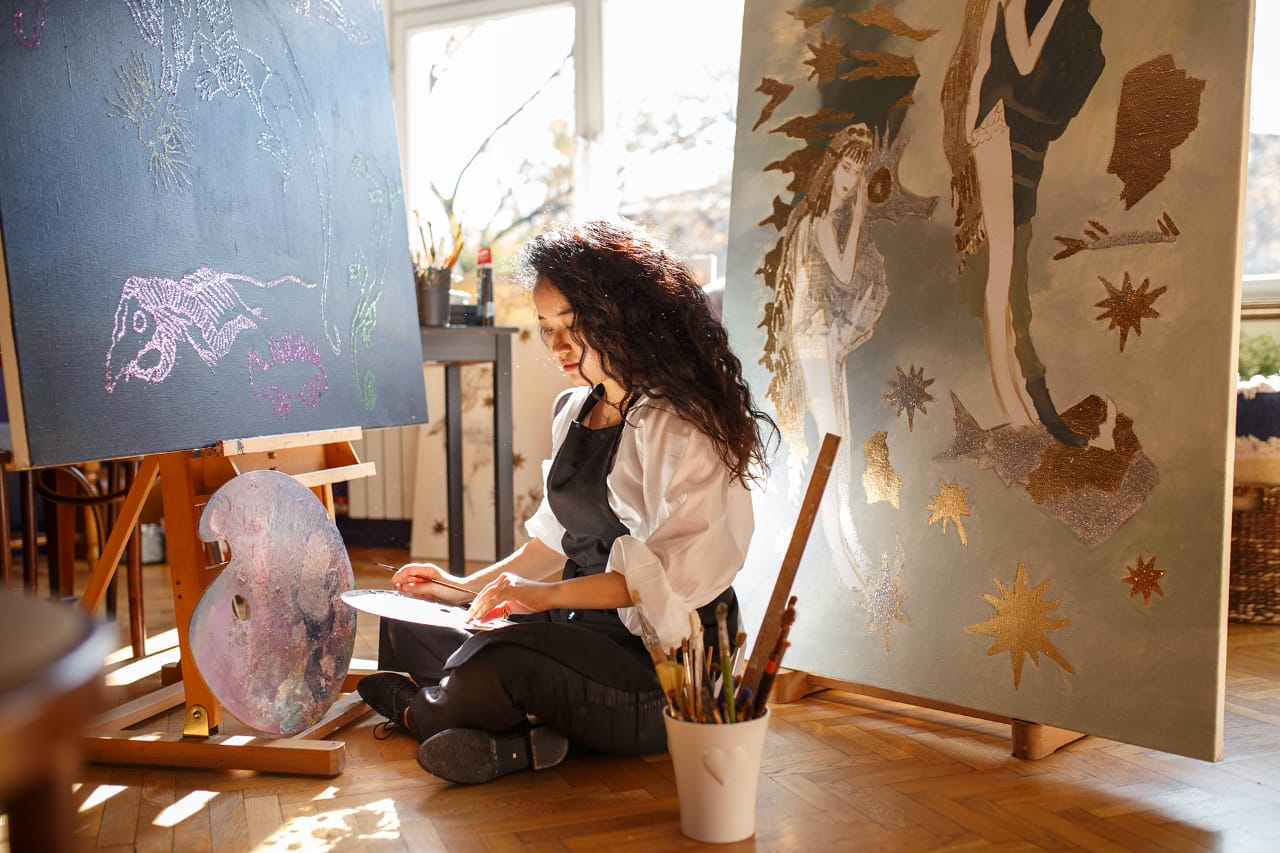
A graduate of Abai Kazakh National Pedagogical University, Badambayeva began as a devoted studio painter before expanding into applied art. Photo credit: Indira Raimkulova.
For Badambayeva, art has always been the foundation around which everything else is built. Trained as a classical painter and later known for her design objects inspired by Kazakh culture, Badambayeva represents a new generation of artists who combine tradition, discipline and entrepreneurial independence.
A graduate of Abai Kazakh National Pedagogical University, majoring in easel painting, she began as a devoted studio painter before expanding into applied art. According to her, everything she does today was laid during years of strict artistic training and near-total immersion in painting.
Badambayeva’s career began early. At just 20, she held her first solo exhibition, where more than half the paintings were sold on opening day. After graduating from the university, she continued exhibiting and working on major artistic commissions.
An artistic path she chose from childhood

Indira Badambayeva. Photo credit: Dasha Pushkina.
Badambayeva emphasized that the decision to become an artist was not spontaneous. It was a deep, early internal realization that never changed.
“By the time I was around 11, I already knew I would pursue a creative profession. I couldn’t imagine myself doing anything else. At some point, I realized. I am an artist,” she said.
According to her, this awareness shaped her lifestyle. While many young people explore different interests, she chose focus and restraint. Social life, entertainment and even family gatherings were often sacrificed for time in the studio.
“I missed weddings, birthdays, and meetings. Not because someone forbade me – I have a very free, democratic family. But time is limited, and to become a real master, you have to sacrifice something,” Badambayeva said.
She believes classical art demands complete immersion and does not tolerate constant switching between professional and social roles.
“You can’t paint in the morning, go to a glamorous event in the afternoon, do pilates, fly somewhere, and expect deep results. This constant switching is very badly compatible with classical painting,” she said.
Rebellion inside the system
For all her dedication, Badambayeva does not describe herself as an obedient student. She often questioned the educational system and openly expressed dissatisfaction when she felt standards were declining. She recalled that during her studies, the art academy was moved to a building that, in her view, did not meet the needs of serious art training.
“I protested, I skipped classes, but not to relax or hang out. I stayed home and painted even more than my classmates. From morning to evening,” she said, adding that discipline did not always mean compliance with institutions, but it always meant relentless work.
Rejecting the image of the ‘poor, helpless artist’

Her silk scarves, decorated with Kazakh ornaments, cultural symbols and fairy-tale imagery, are produced locally in small batches. Photo credit: Dasha Pushkina.
Badambayeva spoke critically of the enduring stereotype that casts artists as suffering and financially dependent. According to her, creative talent alone is not enough as artists should also take responsibility for the practical side of their profession.
“I don’t like the idea of the artist as a poor person. It is a very distorted image,” she said.
“Many people live with the illusion that one day an agent, a parent, a spouse or a patron will arrange everything for them. I think the sooner an artist understands that they must be their own agent, the sooner they take responsibility for their development and well-being,” Badambayeva said.
She emphasized that selling work is not a betrayal of art but a professional skill that can and should be learned.
“We think an artist should only care about talent and skill. But sales are also part of our profession. You can learn it like any other skill,” she said.
From painting to photography and design
Over time, Badambayeva said she felt the need to explore new forms of visual expression. Photography became one of those areas. According to her, photography allowed her to capture beauty more immediately than painting.
“Through photography I could reveal a person’s beauty quickly – something that takes much longer in painting,” the artist said.
This experimentation eventually led her toward applied art and design collaborations, including projects with major retail networks. That shift marked the beginning of a new stage where art moved beyond galleries and into everyday life.
Postcards and the image of the ‘beautiful Kazakh’
One of Badambayeva’s most recognizable projects is a series of illustrated postcards, widely sold across Kazakhstan. She explained that the idea grew from a deeply personal reaction to how Kazakhs were visually represented in books in the 1990s.
“With postcards, I finally did what I wanted as a teenager – to draw beautiful Kazakhs. We were often portrayed with distorted features back then. I reshaped the vision of illustrated Kazakhs. And not just for schoolchildren, but for everyone,” she said.
According to her, postcards carry emotional weight because they are used for meaningful moments such as weddings, birthdays, declarations of love, and pregnancy announcements.
“Postcards only exist for good reasons. People give them at important life moments. That’s very touching to me,” she said.
Why scarves became the next step
Designing scarves had been a long-held ambition for Badambayeva, but it was only after opening her own showroom that the idea became reality. Accessories, she said, appealed to her because they are inclusive and adaptable.
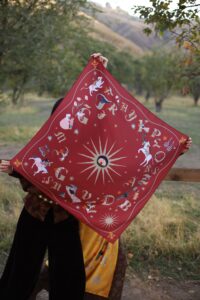
Among her most conceptually rich projects is the Kazakh Alphabet collection, where each letter is paired with a cultural symbol. Photo credit: Dasha Pushkin.
“At first I thought about dresses, but clothing design is more complicated. I like accessories. I like making things that suit many people and don’t force them to change their body or lifestyle,” Badambayeva said.
Her silk scarves, decorated with Kazakh ornaments, cultural symbols and fairy-tale imagery, are produced locally in small batches. She said what sets them apart is their multifunctionality, with clients often suggesting new and unexpected ways to style them.
Among her most conceptually rich projects is the Kazakh Alphabet collection, where each letter is paired with a cultural symbol. Badambayeva emphasized that the idea was to visually preserve and celebrate elements of Kazakh cultural heritage.
“I wanted to capture the cultural code of the Kazakh people. Everything beautiful, musical and poetic that we have in our culture can be found on my scarves,” she said.
Her fascination with letters dates back to childhood, when books and fairy tales played a central role in her life. The project, she noted, connects language, memory and visual art.
Badambayeva openly describes her style as a synthesis of different visual traditions. She combines Kazakh ornamental motifs with European decorative approaches, Gothic lettering and even subtle influences from early animation.
“Walt Disney had a huge influence on me. Those early cartoons shaped my sense of character, proportion and color,” she said.
At the same time, she stressed that these references are transformed into something personal rather than copied.
A cultural signature in the sky
One of the most memorable collaborations in Badambayeva’s career was her project with Air Astana, which brought her artistic vision to thousands of travelers. The partnership, she noted, was the result of a lengthy and complex process.
“The negotiations with Air Astana took almost two years, it was a long process,” Badambayeva said, highlighting the scale of the project. The collaboration involved designing exclusive travel kits for the airline, which are now gifted to passengers on international flights.
Badambayeva was one of five artists selected to contribute as her works were chosen to be printed on the kits, transforming a simple travel accessory into a showcase of contemporary Kazakh art.
Independence above all
Badambayeva underlined that she built her career step by step, without loans or investors.
“I rely only on myself. Sometimes growth is slower, but I feel comfortable. I don’t want to report to banks or relatives,” she said.
For Badambayeva, art is inseparable from discipline and personal independence. Her journey from classical easel painting to widely recognized cultural design reflects a belief that an artist’s role extends beyond the studio. Recognition from famous names, she added, is far less important than meaningful projects.
“I’m interested only if the project is beautiful and meaningful. I’m not attracted to artificial fame built up from the lists of companies to integrate with,” she said.
