
ASTANA – Trading volume at the Kazakhstan Stock Exchange (KASE) increased by 20% year on year in 2025, while the number of transactions rose by 74% to 3.4 million (US$6,906), reflecting stronger investor activity across multiple asset classes, said Adil Mukhamejanov, chairperson of the KASE management board, on Feb. 10 in Astana.
Photo credit: kase.kz
Delivering his remarks at the KASE Day, Mukhamejanov reported strong growth across key market segments in 2025, driven by higher trading volumes, rising market capitalization and growing participation from both domestic and international investors.
He noted that the year was marked by accelerating inflation, which peaked at 13.9% and ended the year at 12.4%. In response, the National Bank of Kazakhstan pursued a tight monetary policy, raising the base rate to 18%.
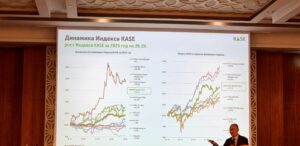
During the KASE Day, Adil Mukhamejanov, chairperson of the KASE management board reported strong growth across key market segments in 2025. Photo credit: The Astana Times
“Despite this, the market consensus expects a gradual easing of inflationary pressure. Money market rates remained within the corridor between the base rate and inflation, reflecting a balanced adjustment to macroeconomic conditions,” Mukhamejanov said.
He added that the money market remained KASE’s largest segment, while swap indices, the most volatile indicators, also formed part of money market dynamics.
Commenting on global trends, Mukhamejanov said the European Central Bank (ECB) showed cautious optimism about economic growth and had reduced its key rate, while the U.S. Federal Reserve was expected to keep rates unchanged amid concerns about economic overheating and elevated inflation.
According to forecasts, U.S. inflation is expected to stand at 2.8% in 2026, with the Federal Reserve rate projected at 3.25%, while eurozone inflation is forecast to decline to 1.9%, with the ECB’s key rate at 1.98%.
Stock market and investor structure
The stock market showed particularly strong performance. Market capitalization grew by 19% to 39 trillion tenge (US$79 billion), while the KASE Index rose 26.1% over the year. Average daily equity trading volume reached 1.2 billion tenge (US$2.4 million), with an average of 11,399 transactions per day.
Retail investors played a dominant role in equity trading. Individuals accounted for 55.8% of secondary market turnover, followed by other legal entities at 27.1% and broker-dealers at 13.2%.
“Individuals are becoming a significant class of market participants. They generate additional demand and, at times, higher volatility, but this segment now represents a stable base with which brokers can actively work,” Mukhamejanov said.
Capital-raising activity also expanded in 2025, with total placements rising by 20% to 11.7 trillion tenge (US$23.7 billion). Corporate bonds made up around 40% of the primary market, highlighting their growing role in financing the economy.
Trading in corporate bonds increased by 38%, with average daily turnover reaching 5.2 billion tenge (US$10.5 million) and an average of 832 transactions. KASE also expanded its ESG segment, adding 11 new ESG bond issues. The total volume of ESG issuances reached 1.28 trillion tenge (US$2.6 billion), of which 1.1 trillion tenge (US$ 2.2 billion) was placed.
Foreign exchange
Foreign exchange trading volumes rose by 35%. Trading in USD/KZT increased by 19%, while RUB/KZT volumes surged by 50%, reflecting heightened demand for currency instruments.
The KASE Global international trading platform recorded a 3.7-fold increase in trading volume. Average daily turnover reached 701.8 million tenge (US$1.4 million), while the average transaction size stood at 568,500 tenge (US$1,154).
Retail participation continued to grow. By the end of 2025, the number of individual investor subaccounts reached 698,000, while omnibus accounts totaled 4.4 million (US$8,937). Non-residents accounted for 8% of secondary market trading.
KASE also expanded its product offering and membership base, adding nine new exchange members and 351 new financial instruments, including 41 new issuers, strengthening market depth and liquidity.
Clearing and settlement
Alongside market growth, KASE Clearing Center (KACC) reported a substantial expansion in clearing and settlement activity, according to KACC Chair Natalia Khoroshevskaya.
In 2025, the total volume of cleared transactions reached 385.1 trillion tenge (US$782 billion), while transactions cleared through a central counterparty accounted for 78% of secondary market trades in the T+2 regime.
Khoroshevskaya said KACC’s key priorities are to make the market more efficient and convenient for participants, guarantee the execution of exchange trades and ensure reliable cash settlements. The clearing center conducts settlements through its own network of correspondent banks and currently services more than 2,000 financial instruments.
The volume of repo transactions cleared through KACC reached 247.3 trillion tenge (US$502 billion), representing 98% of the total repo market. Overall, 98% of transactions were guaranteed by the central counterparty, and 100% of exchange transactions were accepted for clearing.
KACC also expanded its product offering by launching the NTPro platform for centralized clearing of over-the-counter foreign exchange transactions and introducing new mechanisms for bond placements and post-margining in foreign currencies.
