
ALMATY – Kazakhstan will allocate around 8 trillion tenge (approximately US$17 billion) to support the real sector of the economy and ensure GDP growth of at least 5%, Deputy Prime Minister and Minister of National Economy Serik Zhumangarin said at a Jan. 21 government meeting, following the fifth session of the National Kurultai.
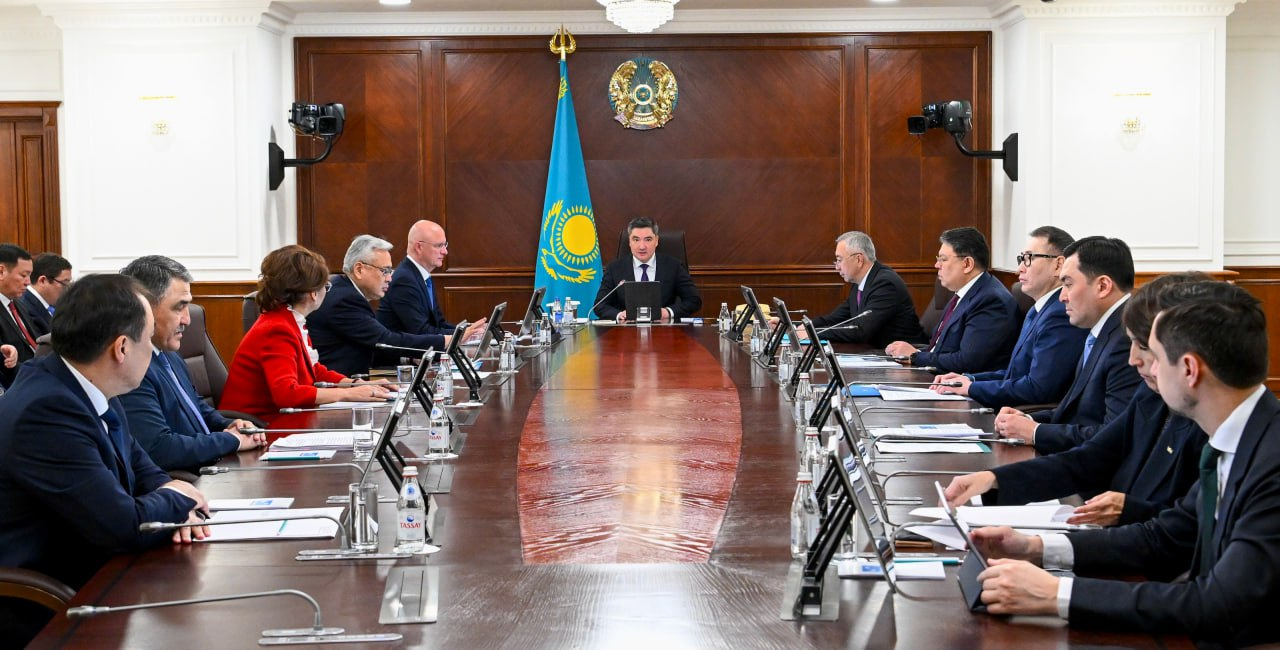
Kazakhstan launches large-scale economic support measures after National Kurultai. Photo credit: Prime Minister’s press service.
According to Zhumangarin, the government will continue its macroeconomic stabilization program, increasing investment in fixed capital to 18% of GDP and ensuring that real household incomes grow by 2–3%, the Prime Minister’s press service reported.
“In the framework of a proactive economic growth policy, a state mechanism will be created to organize new production capacities that ensure growth in gross value added, export revenues and labor productivity. The main emphasis will be placed on the development of deep-processing clusters focused on exports and import substitution,” Zhumangarin said.
The government also aims to reduce inflation to a 9–11% corridor. To stabilize prices, the list of socially significant food products has been expanded from 19 to 31 items, while tariff increases by natural monopolies will be tightly regulated and aligned with inflation targets.
“Planned measures will create a foundation for further sustainable and high-quality growth, accompanied by rising living standards. All constructive proposals will be carefully studied, and decisions on possible amendments will be made based on their feasibility,” Zhumangarin added.
Criminal liability proposed for mass data leaks
Vice Minister of Digital Development, Innovation and Aerospace Industry Rostislav Konyashkin announced plans to tighten liability for violations of personal data protection significantly.
“Implementing citizens’ constitutional rights to privacy and personal data protection, we are moving toward a policy of ‘zero tolerance’ in this area. For this purpose, we propose increasing administrative fines several times, up to 5,000 monthly calculation indices, and introducing criminal liability for mass leaks of personal data,” Konyashkin said.
He stressed that digital transformation should not undermine citizens’ security and that stricter regulation is necessary as online platforms and data flows expand.
Five hydropower plants to gain strategic status
Minister of Water Resources and Irrigation Nurzhan Nurzhigitov reported that five hydropower plants with a combined capacity exceeding 1,000 megawatts are planned to be included in Kazakhstan’s list of strategic facilities.
“The ministry has developed a draft government resolution to include five hydropower plants in the East Kazakhstan and Zhetysu regions in the list of strategic water management and hydraulic structures,” Nurzhigitov said.
He added that the state enterprise Kazvodkhoz is also working to expand the number of small hydropower plants, with 29 hydraulic structures already selected that could host facilities with a total capacity of 20 megawatts.
Ekibastuz chosen as pilot site for data center valley
Konyashkin also reported on progress in implementing the Data Center Valley project, which President Tokayev described at the National Kurultai as a “reasonable initiative.”
“As a pilot location for the data center valley, the city of Ekibastuz in Pavlodar Region has been selected. The regional administration is reserving a land plot of 200 hectares,” he said.
The project requires comprehensive infrastructure development, including water supply, roads, telecommunications, and power networks. Officials noted that the initiative lays the foundation for Kazakhstan to become an international hub for data centers and cloud-based AI infrastructure, attracting hyperscaler companies, creating high-skilled jobs, and boosting exports of digital services.
Expanding gas exploration to strengthen energy security
Minister of Energy Erlan Akkenzhenov reported that Kazakhstan plans to significantly expand its gas exploration portfolio to strengthen long-term energy security.
“At present, geological exploration is underway at 14 subsoil areas with preliminary gas resources estimated at about 515 billion cubic meters,” Akkenzhenov said.
“In the medium term, it is planned to expand the exploration portfolio to 30 areas with total estimated gas resources of around 1.7 trillion cubic meters. This will create a sustainable foundation for increasing production and covering projected domestic demand,” he added.
To stimulate investment and share geological risks, about 50 subsoil areas are planned for electronic auctions. QazaqGaz, Samruk-Kazyna, and private investors will provide financing for exploration.
