
ASTANA – President Kassym-Jomart Tokayev and President of Iran Masoud Pezeshkian took part in the Kazakhstan–Iran Business Forum in Astana on Dec. 11, reaffirming the growing economic and strategic partnership between the two countries.
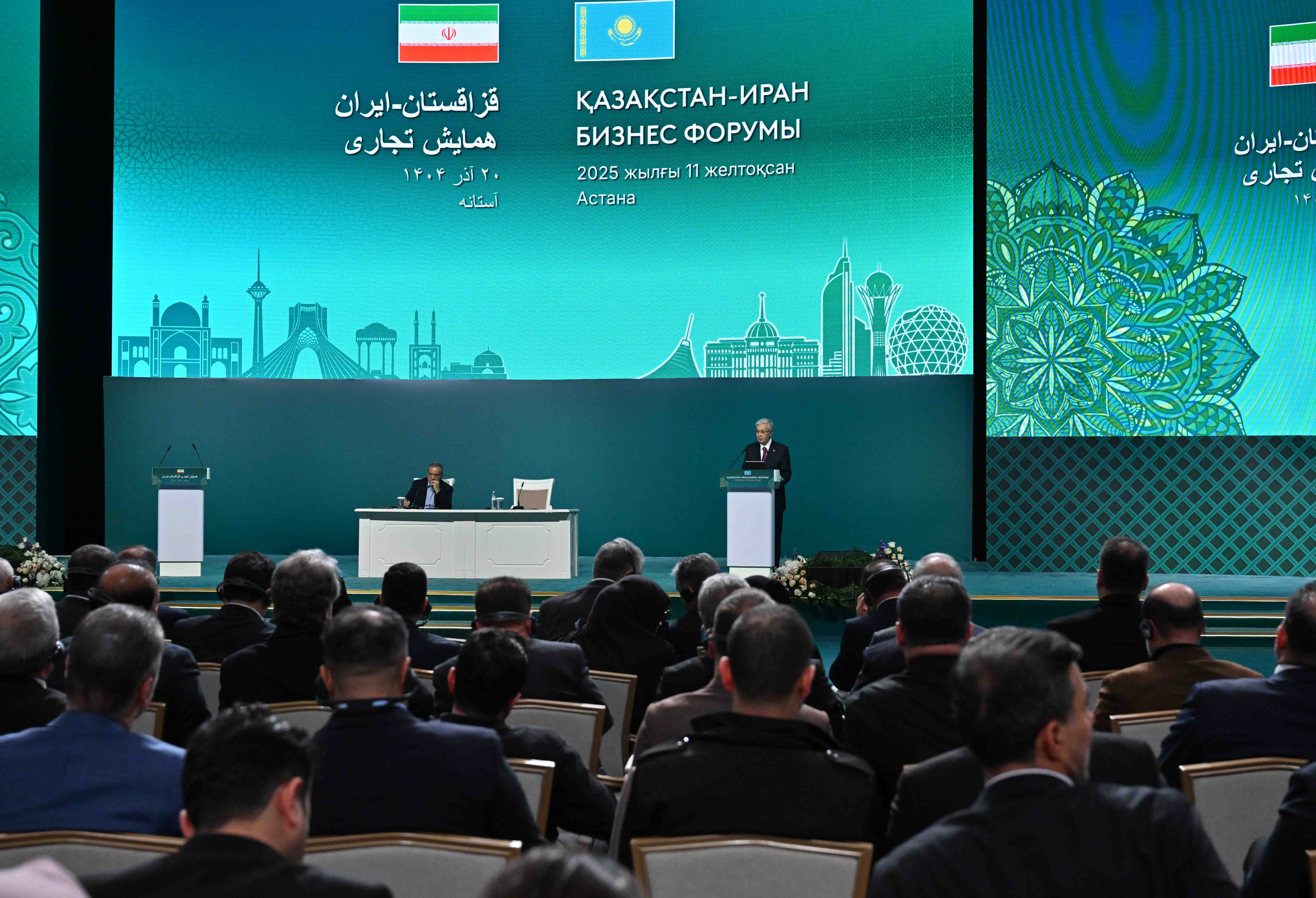
President Kassym-Jomart Tokayev and President of Iran Masoud Pezeshkian emphasized the bilateral trade during the Kazakhstan–Iran Business Forum. Photo credit: Akorda
The event brought together senior officials and business leaders to discuss trade, investment, transport, agriculture, and technological cooperation. according to Akorda.
Trade and investment ties strengthen as turnover rises
In his address, Tokayev emphasized the steady upward trajectory of bilateral trade, noting that Kazakhstan and Iran are well positioned to expand economic cooperation at an accelerated pace.
“Last year, the volume of mutual trade exceeded $340 million. According to forecasts, this figure will increase many times this year. We agreed on a significant increase in trade between our countries, with the goal of bringing it to 1 billion dollars in the first stage and to $2 billion in the next. We have the necessary potential for this,” he said.
Tokayev noted that the initiative to open the Kazakhstan Trading House in Tehran is expected to support these goals by ensuring a systematic supply of Kazakh goods to the Iranian market. Over the past 20 years, Iran has invested more than $226 million in Kazakhstan’s economy, and today over 350 Iranian enterprises operate successfully in the country.
A new phase of connectivity
Tokayev underscored that transport and logistics remain central to future cooperation. Kazakhstan’s geographic position, he noted, makes it a key transit hub on the Eurasian landmass.
“Kazakhstan is one of the key transport and logistics hubs in the Eurasian space. Today, 85% of cargo turnover between China and Europe passes through our territory,” Tokayev said.
He stressed that Kazakhstan views Iran as an essential partner in expanding regional connectivity. Several joint initiatives are already underway, including plans to build a transport and logistics terminal in the port of Shahid Rajaei, enabling direct delivery of Kazakh products to global markets.
Tokayev also spoke of Kazakhstan’s interest in strengthening ties between the ports of Aktau and Kuryk with Iranian ports Amirabad and Anzali, as well as potential cooperation with Bandar Abbas and Chabahar. A priority is the further development of multimodal corridors linking Central Asia with the Persian Gulf.
The President highlighted the importance of the Kazakhstan–Turkmenistan–Iran railway, noting its potential to double freight volumes by 2030.
“The volume of cargo transportation along this route may double by 2030, which will undoubtedly have a colossal economic effect,” he said.
Agriculture as a key area of expansion
Turning to agriculture, Tokayev emphasized Iran’s important role as a major buyer of Kazakh grain. Last year, trade in the agro-industrial sector totaled $220 million, and in the first ten months of this year, grain exports alone reached $280 million.
He pointed to several joint projects already underway, including plans by Iran’s Solico Group to build a dairy plant with an annual capacity of 200,000 tons and launch production of baby food in Kazakhstan. Another Iranian company, Kourosh Food Industry, has expressed interest in entering the Kazakh market to produce vegetable oil and develop poultry farming.
“I want to emphasize once again that we are always open to cooperation. I invite Iranian entrepreneurs to launch joint projects and open modern production facilities in Kazakhstan,” Tokayev said.
Preserving the Caspian sea
Tokayev placed special emphasis on the protection of the Caspian Sea, describing its declining water level as an issue requiring immediate action.
“Today, the fate of the Caspian Sea is becoming one of the most urgent issues requiring immediate action. The decline in sea level is already having a serious impact on both the ecology and the economy of the region,” he said.
He called for closer cooperation among the five Caspian states, along with greater involvement from international organizations and financial institutions. Kazakhstan plans to participate in the seventh Caspian Summit in Tehran next year and proposes hosting the fourth Caspian Economic Forum within the next two years.
A Partnership built on history and future potential
Pezeshkian emphasized that the forum symbolizes not only centuries-old ties between the Iranian and Kazakh peoples but also a step toward strengthening trade and economic relations.
He highlighted several promising initiatives identified by the private sector, including a joint Kazakhstan–Iran shipping consortium on the Caspian Sea, a logistics and agricultural distribution center in Aktau, a joint food production and packaging plant in Kazakhstan, an export park for Iranian construction materials in Almaty, and deeper cooperation in mining and raw material processing.
“We also support the creation of an Iran–Kazakhstan Joint Trade Council, the launch of direct flights, simplified business visas, and the organization of trade exhibitions in both countries,” Pezeshkian said.
Both leaders affirmed that Kazakhstan and Iran are entering a qualitatively new stage of cooperation. With shared goals in trade, logistics, technology, agriculture, and environmental protection, the two countries are laying the foundation for long-term partnership.
