
ASTANA – It is this time of year when world leaders are gathering in New York for the United Nations General Assembly’s High-Level Week, an annual diplomatic marathon that sets the tone for global priorities, from peace and security to climate action and development. This year, it coincides with a particularly important occasion as the organization marks its 80th anniversary.
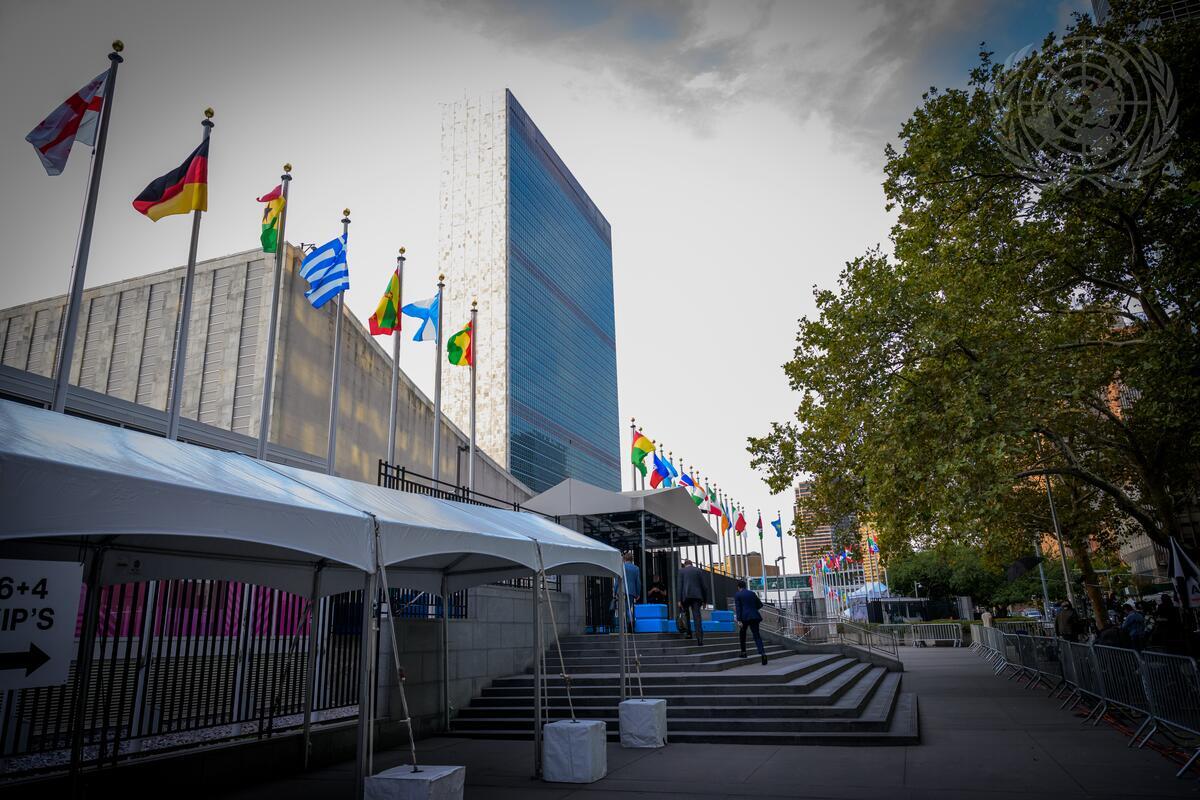
UN headquarters in New York. Photo credit: UN Photo/ Loey Felipe
More than 150 world leaders convened in New York, including Kazakhstan’s President Kassym-Jomart Tokayev.
Key events of this week include the High-level International Conference for the Peaceful Settlement of the Question of Palestine and the Implementation of the Two-State Solution, the General Debate, Climate Summit, High-level Meeting to Launch the Global Dialogue on AI Governance and High-level Meeting to Commemorate and Promote the International Day for the Total Elimination of Nuclear Weapons.
The 80th session’s General Debate will run from Sept. 23, through Saturday, Sept. 27, and close on Monday, Sept. 29. This year’s theme is Better Together: 80 Years and More for Peace, Development and Human Rights.
The debate takes place in two daily sessions: a morning session from 9 a.m. to 2.45 p.m. and an afternoon session from 3 p.m. to 9 p.m., with a voluntary time limit of 15 minutes. However, each meeting lasts until all scheduled speakers have spoken.
UN General Assembly President Annalena Baerbock will open the debate, followed by UN Secretary-General António Guterres.

President of General Assembly opens General Debate of 80th session of UN General Assembly. Photo credit: UN Photo/ Loey Felipe
The first to address the General Debate is Brazil. This tradition dates back to 1947, when Brazilian diplomat Oswaldo Aranha chaired the first UN General Assembly special session and its second regular session.
The United States, a host country, follows Brazil. Kazakhstan will be the 16th to deliver remarks.
President Tokayev, a former UN diplomat himself, has regularly addressed General Assembly sessions since he assumed the presidency in 2019. He did so in 2019, 2022 and 2023. 2020 and 2021 were held in a virtual format due to the pandemic.
In his statements, Tokayev consistently urged the international community to embrace dialogue and pursue peaceful solutions. On multiple occasions at the UN and other global platforms, Kazakhstan has also pressed for comprehensive reform of the UN Security Council to make global decision-making more inclusive and representative.
This echoes the remarks of UN General Assembly President Annalena Baerbock, which she delivered at a Sept. 17 press conference in New York.
She stressed that the UN was created for dialogue, diplomacy, and debate to “sort out differences peacefully together.” This is what nearly 150 heads of state and government would do over the course of the week.
“I would use every opportunity to underscore this moment in history, to reaffirm our commitments to the UN Charter and the principles that it represents,” said Baerbock, a former German foreign minister, and only the fifth woman to preside over the UN General Assembly in its eight-decade history.
“This theme [Better Together] reflects the reality that no single nation, regardless of its size, might or wealth, can confront the challenges that we face all alone. We have to work together. Better together. The organization was born in a moment of deep fracture, perhaps one of the darkest in human history. But it brought us the UN Charter. To this day, it is the North Star that guides our work and reminds us of what we want to accomplish together,” she said.
Priorities for her one-year presidency in the General Assembly include advancing the UN80 reform agenda, guiding the selection of the next Secretary General, and building on the Pact for the Future to “regain momentum on SDGs.”
“Yes, we are at a crossroads – a make-or-break moment,” Baerbock said. “Our forebearers had the humility and grace to put aside their differences and work together in 1945; we need that same principled conviction today.”
UN Secretary General António Guterres points to the intensifying conflicts and the geopolitical divides that hinder efforts to address them effectively.
“There is a sense of impunity – every country believes they can do whatever they want. On the other hand, we see that developing countries are facing enormous difficulties. Many of them are drowning in debt without access to concessional funding that they require to redress their economies. Inequality is growing,” Guterres said as he sat down for an interview with Melissa Fleming, Under-Secretary-General for Global Communications.
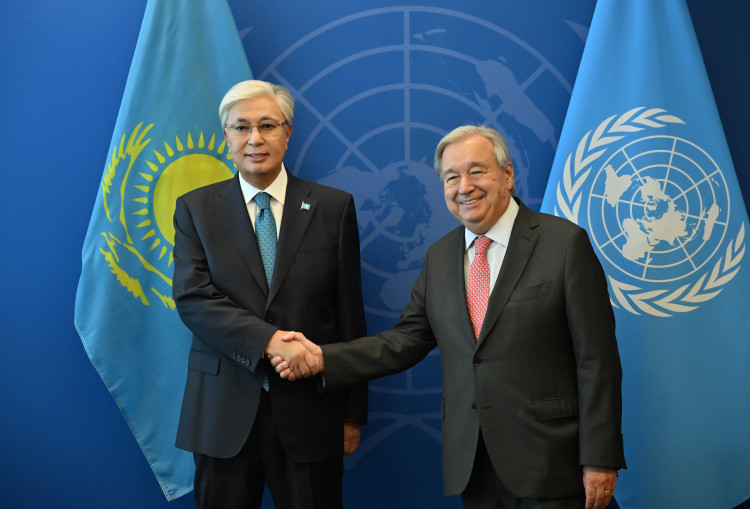
Tokayev and Guterres during their meeting in New York. Photo credit: Akorda
The Secretary-General met with President Tokayev on Sept. 22. During the meeting, they discussed Kazakhstan-UN cooperation, as well as key global and regional developments.
Both met the last time in Almaty in August at the opening of the UN Regional Center for Sustainable Development Goals for Central Asia and Afghanistan.
“The Secretary-General commended Kazakhstan for its role in promoting regional cooperation, including through its generous hosting of the UN Regional Center for Sustainable Development Goals for Central Asia and Afghanistan. The Secretary-General and the President discussed the importance of digitalization and artificial intelligence for the future,” reads an official readout of the meeting.
