
VIENNA – The Comprehensive Nuclear-Test-Ban Treaty Organization (CTBTO) continues meaningful engagement with nine states that have yet to ratify the treaty that prevents testing of nuclear weapons, said the organization’s executive secretary Robert Floyd in an interview with The Astana Times.
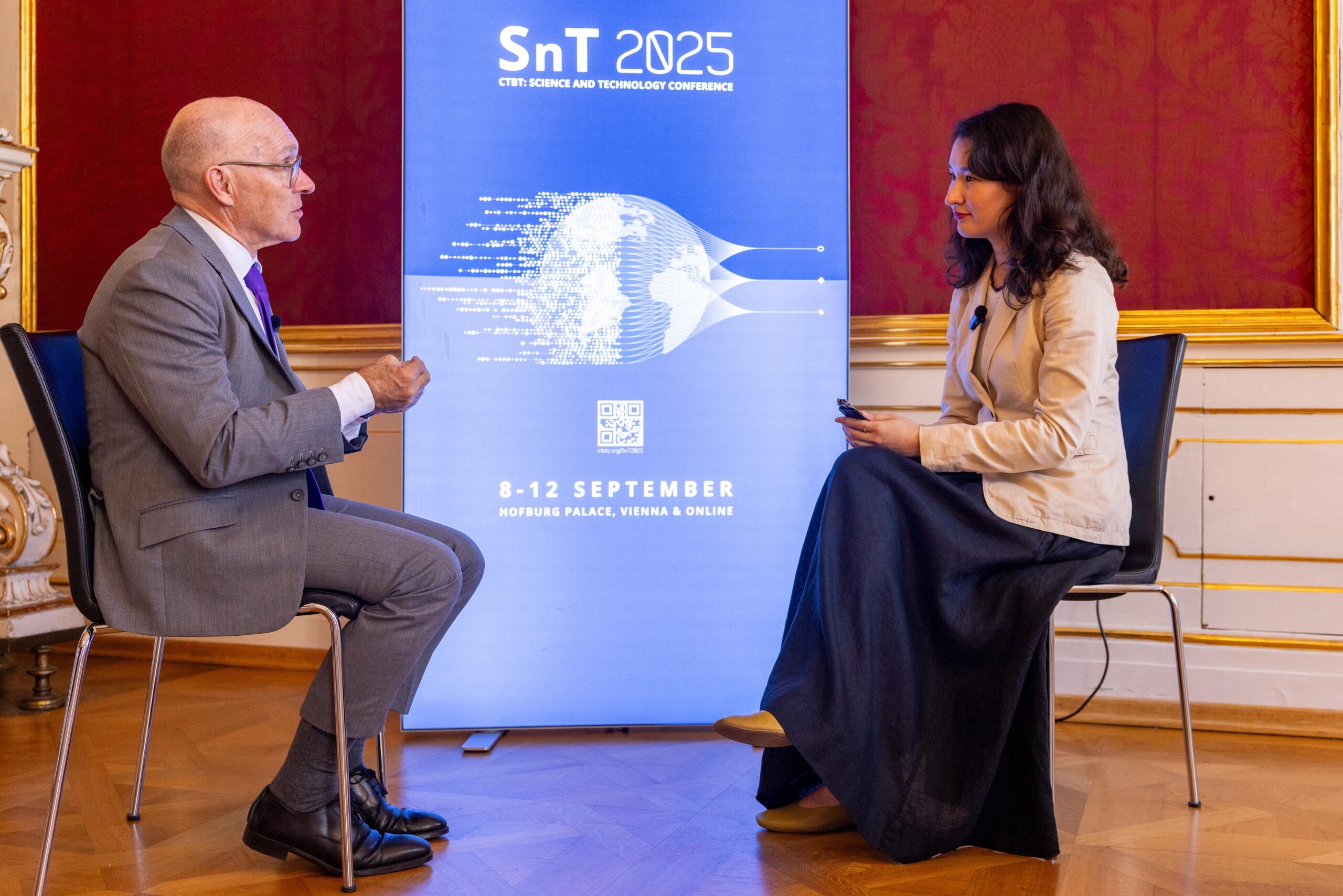
CTBTO Executive Secretary Robert Floyd sat for an interview with The Astana Times correspondent Aibarshyn Akhmetkali. Photo credit: CTBTO
In a conversation that took place on the sidelines of CTBTO’s Science and Technology conference on Sept. 8-12 in Vienna, Floyd discussed the progress towards universal ratification of the Comprehensive Nuclear-Test-Ban Treaty (CTBT) and the applications of its nuclear test monitoring system.
On Sept. 24, 1996, the CTBT was opened for signature. Since then, 187 of the world’s 196 countries have signed it. However, the treaty can only enter into force once all 44 nations designated as Annex 2 states have ratified it, and nine of those key states have yet to do so.
“Many of them have signed, so they’re committed to the treaty, but they haven’t ratified for their own particular geostrategic reasons. At the current time, that’s difficult for quite a number of those to move forward, but we’re engaging meaningfully with each one of them on their particular issues, and working with them to see how they could move forward into the support of a treaty that they actually are committed to,” said Floyd.
He noted that the treaty’s framework for stopping nuclear testing has made significant progress, both through the growing number of ratifications and the sharp decline in nuclear detonations. In the four decades following the first atomic test in 1945, more than 2,000 nuclear tests took place at 60 sites worldwide. Since the treaty was introduced, that figure has fallen to fewer than a dozen.
“In the last four years, nine new ratifications. One country signed, yet to ratify. That is showing the commitment of the states of the world,” he said.
Russia revoked its ratification in 2023, which Floyd described as a “deeply regrettable” move. However, according to Floyd, Russia continues to support the purpose of the treaty as a signatory state.
“What is important for people to understand is that they remain signatories to the treaty, which means they are committed to the object and purpose of the treaty. So they have not withdrawn from the treaty, they have not said that they’re no longer committed to a ban on nuclear testing. They remain committed, but it has had an effect. The effect it’s had is that countries of the world are more committed to the treaty and seeing its universalization and ultimate entry into force,” said Floyd.
When asked how to respond to states that justify nuclear testing on national security grounds, Floyd emphasized that such actions should not be supported, warning of a dangerous cascade effect of nuclear proliferation race.
“Our response is that we very much do not want to see states embrace testing of a nuclear device, or states that have previously tested to return to testing, because this can cause a cascading effect where more and more states would then see the need to develop nuclear weapons. That is in nobody’s interest, and that is what we are very focused on and keen about,” said Floyd.
Most states understand the catastrophic humanitarian fallout of testing, let alone deploying even a single nuclear weapon.
“There is a strong understanding of most states that we would do better if nuclear weapons did not exist, because for as long as they exist, there is that risk they could actually be used,” he said.
Scientific application of CTBTO’s monitoring system
The International Monitoring System (IMS) has been at the heart of CTBTO’s verification to ensure compliance with the treaty. Although the primary objective of the IMS is to detect nuclear tests, the data collected by IMS stations have been used for a variety of civil and scientific purposes.
“Every day, there are state signatories using that data to manage natural disasters. Every day, that data is being used by a number of tsunami warning system alert centers around the world. They’re using that data to refine and make more precise warnings that they can put out on tsunamis. Every day, this data is being used to monitor earthquakes, possible volcanic activity. Even some of our data is being used to predict the onset of monsoonal rains in some tropical areas,” Floyd said.
The CTBTO chief’s comments came on the week of this year’s Science and Technology (SnT) conference in Vienna, where scientists, technical and policy experts from all over the world have gathered to discuss how the CTBT verification system is evolving and adapting to new challenges.
“On our website, there is a process that any researcher with a valid research need can go through to request access to data for scientific research. We get many applications every year from researchers around the world to use our data in such a wide range of different disciplines,” said Floyd.
“There are many aspects of our data that are being used for climate related research around the world. The physics that sits behind the data we’ve got are temperature dependent, and so it can give a really good indication of the average temperature movements, either in the ocean or the atmosphere – very valuable for those doing climate related research,” he said.
Kazakhstan’s role in nuclear disarmament
Back in 2021, Floyd visited Kazakhstan’s Semipalatinsk nuclear test site. In the interview, he said that Kazakhstan is regarded as a leader in nuclear disarmament and the cessation of nuclear testing.
“Kazakhstan has been very active diplomatically. Your first president was very active to support a world without nuclear weapons, and that is greatly appreciated,” Floyd said.
“It was Kazakhstan that proposed there should be a day every year, the International Day Against nuclear tests, and it’s been established. It’s Aug. 29, the exact same day that the Semipalatinsk test site was closed down forever, a place where 456 nuclear explosions had taken place, and it doesn’t surprise me that out of that history, Kazakhstan uses its voice as a leader, and we greatly appreciate that,” he concluded.
