
ASTANA – “What’s in a name?” Juliet asks Romeo, suggesting that names are just labels and do not define who someone truly is. Yet, across cultures, there seems to be a perpetual interest in where the names come from – whether they belong to individuals or entire groups. This article explores the meanings and origins of five Turkic nationalities in Central Asia, offering a lens to understand how national identities were shaped over time.
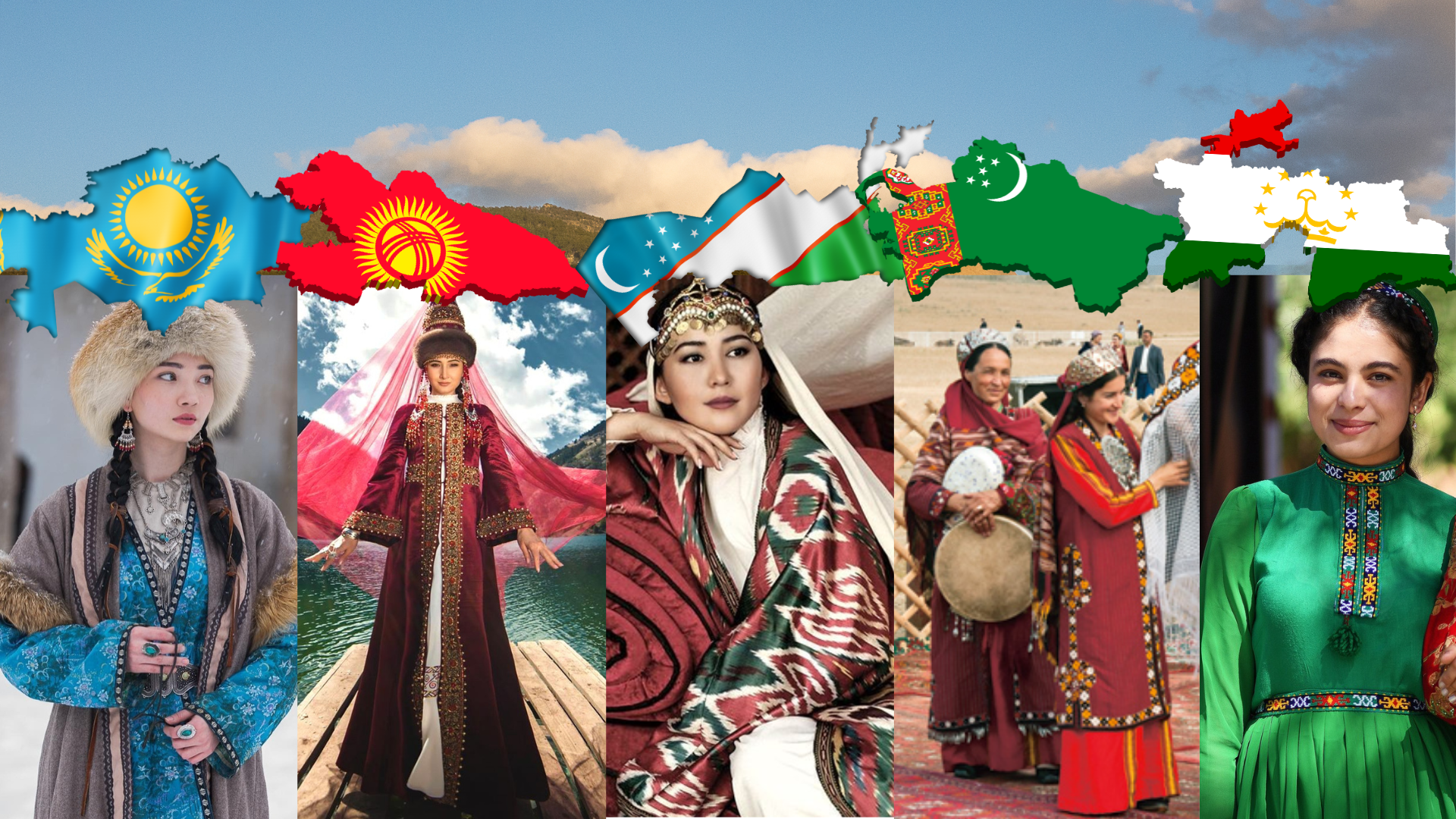
Photo illustration created by Fatima Kemelova/ The Astana Times
Kazakhs, people living by their own will
The Kazakh ethnonym has been around for many centuries, dating back to the 15th century with the formation of the Kazakh Khanate on the steppes.
According to Arlen Seitbatkal, a junior researcher at the Institute of Linguistics named after Akhmet Baitursynuly, the etymology is linked to the notions of freedom.
“In the works of academician Abduali Kaidarov and professor Telkozha Januzakov, it is explained that the word ‘qazaq’ can be associated both with ‘qas saq’ [true Sakas] and with the combination of the words ‘qaz’ [goose] and ‘aq’ [white]. But most researchers agree that the concepts of yerkin [free] and batyr [warrior] are at the core. The people who broke away from Khan Abulkhair called themselves free, i.e. qazaq,” Seitbatkal said, as quoted by the Kazinform news agency.
Historian Nurtas Smagulov from the Karaganda Buketov University said that the origin of the term Kazakh evoked numerous scientific hypotheses, but none have been proven.
“Nevertheless, some versions deserve attention. According to ancient Turkic sources, the word ‘qazaq’ could be derived from the expression found in Orkhon-Yenisei inscriptions — ‘qazghaq oghlum,’ where the letter ‘gh’ eventually dropped out. However, this version does not conform to the laws of Turkic phonetics and therefore did not receive widespread support,” Smagulov said.
According to him, among ancient Siberian languages, the word Kazakh meant strong or powerful. Ethnographer Shokan Ualikhanov called the Kazakhs brave and courageous, while ethnographer and archaeologist Vasily Radlov translated it as “free man.”
“In turn, Shakarim Kudayberdiev, in his work ‘Kazakh Shezheresi’ [Kazakh Chronicles], interpreted the ethnonym as ‘people living by their own will,’” said Smagulov.
Kyrgyz—the people of forty tribes
The ethnonym Kyrgyz is one of the oldest among Turkic-speaking peoples, supported by historical evidence for the name. It is found in ancient Turkic inscriptions and historical chronicles of Central Asia. In its literal translation, the word means 40 tribes from “qyryq” (forty) and “oghyz” (tribal union).
Historian Yuri Zuyev wrote that the ancestors of the Kyrgyz originate from Hunnic tribes, a nomadic confederation that originated in the steppes of modern-day Mongolia or northwest China and migrated westward. He associates the term with the ancient ethnonym “qyrkun,” which translates as steppe Huns.
Uzbeks—people of the Uzbek Khan
Scholars link the origin of the term Uzbek to the name of Uzbek Khan, the ruler of the Golden Horde in the 14th century. When the horde began to disintegrate, the nomadic tribes within his ulus began to call themselves Uzbeks.
“In the nomadic tradition, a strong leader has always been identified with the people. If someone had power and authority, people followed them, and their name became fixed after the group,” said Seitbatkal.
Smagulov further explained that the term “özbek” became widely used during the time of Amir Temir and his rival, Muhammad Shaybani—two dominant figures in Central Asia’s political landscape of the 16th century.
At that time, Shaybani led an estimated 300,000 nomads in an invasion of Maverrennahr, modern-day Uzbekistan, which had been under Amir Temir’s control. As these nomadic groups entered and settled in the area, the local sedentary population began referring to them collectively as “Özbeks.” Thus, the term became associated with the new political reality, and an ethnic group was born.
Tajik—bearers of a crown
In Tajik language (which belongs to the Persian language group), as well as in Persian and Arabic, the word “taj” means crown or diadem. Consequently, the term Tajik (also spelled Tojik) can be interpreted as “one who is crowned.” Thus, interpretations such as crown-bearing people or heirs to the crown are rooted in folk etymology.
Another version suggests that the etymology of the word tajik is not native to the region. Back in the seventh century, during the time of the Sasanian Empire in the Middle East, Arab tribes were referred to as “tazi” or “tazik” by Iranians. These same “tazi” soon went on to conquer much of Asia, spreading Islam and establishing a Caliphate. Thus, the term Tajik originally referred to the Arabs who brought the Muslim faith to the eastern regions.
Turkmens—true Turks
The word Turkmen stems from “Turk” and the intensifying suffix “men,” meaning true Turk. Ottoman chronicler Mehmed Neşri suggested an interpretation from the Persian words “Türik” and “iman,” meaning Muslim Turk, but this hypothesis has been deemed linguistically incorrect.
The word Trkmen is also mentioned in Mahmud al-Kashgari’s 11th-century dictionary, “Dīwān Lughāt al-Turk,” where it refers to an ethnic group and carries the meaning of Turk or Turkish person.
The article is based on materials published on Kazinform.
