
ASTANA – The Khorgos International Center for Cross-Border Cooperation is becoming a growth driver of the Zhetisu Region in Kazakhstan’s south-eastern part. The visit of Deputy Prime Minister and Foreign Minister Murat Nurtleu to the region on Aug. 8 underscores the importance of Khorgos. Trade remains strong, large-scale infrastructure is being built, and employment is steadily rising. The Astana Times explored the center’s achievements and upcoming plans.
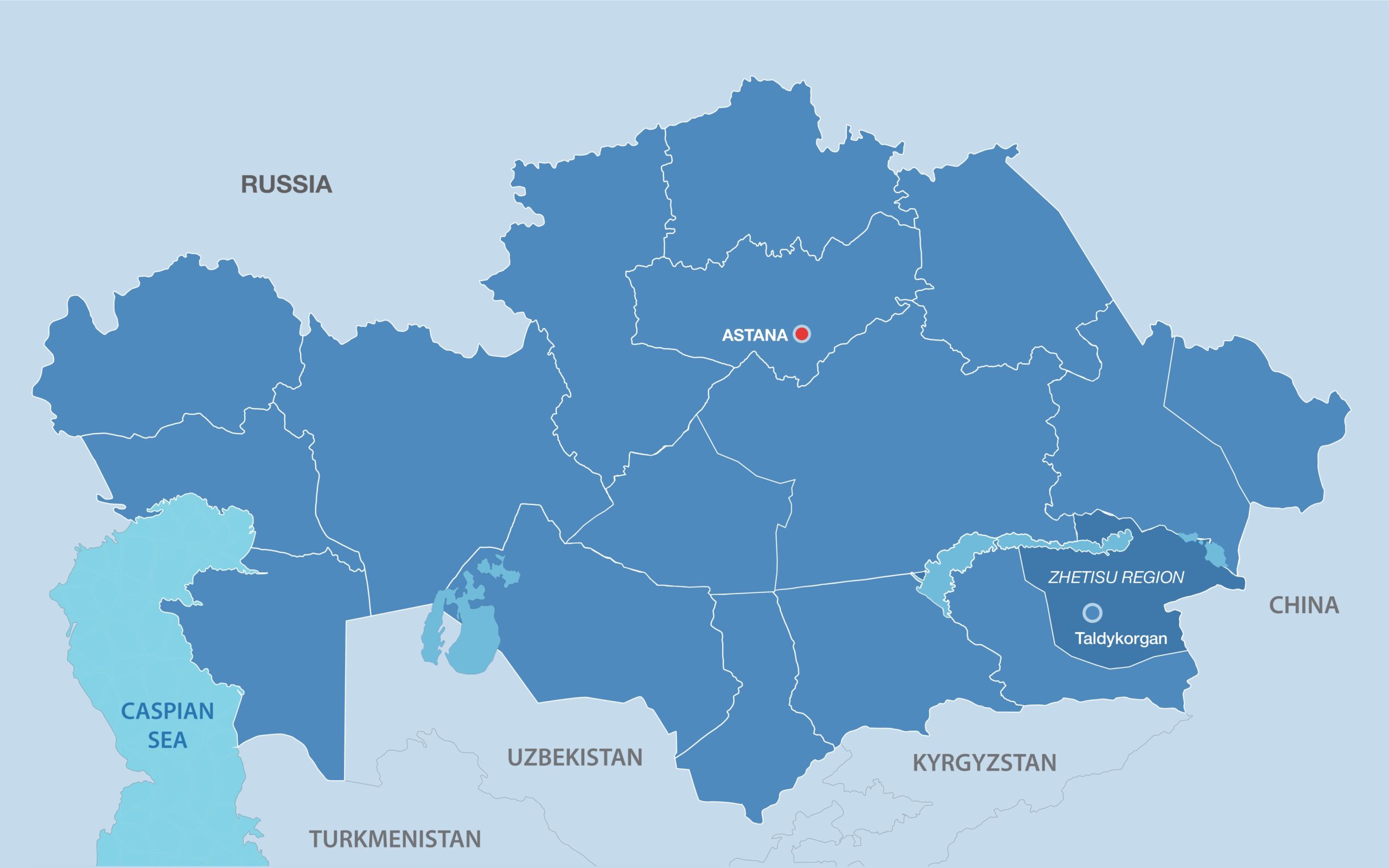
Photo credit: Irina Bektyarova. Click to see the map in full size. The map is designed by The Astana Times.
About Khorgos
Established in 2005 as a joint project under the country’s Nurly Zhol economic policy and China’s Belt and Road Initiative, the center is located on the border of the two countries. In 2017, Kazakhstan’s part of Khorgos gained the status of a special economic zone (SEZ), and in 2019, its managing company became the official operator of the SEZ. The site covers a total of 560 hectares, including 217 hectares on the Kazakh side and 343 hectares on the Chinese side.
Kazakhstan’s part is situated on the territory of the Panfilov district of the Zhetisu Region, and China’s part is on the territory of the Ili-Kazakh Autonomous Prefecture of the Xinjiang-Uyghur Autonomous Region. The latter has four zones performing the functions of customs clearance, port operations, as well as logistics and integrated services.
Khorgos functions as a dry port, providing efficient cargo transit and customs services. It is more than a checkpoint: it resembles a small city, with malls, hotels, parks, logistics warehouses, and administrative offices. It lies 321 kilometers from Taldykorgan and 361 kilometers from Almaty, while on the Chinese side, it is located just one kilometer from the border city of Khorgos, 90 kilometers from Yining, and 670 kilometers from Urumqi.
Trade trends
According to the managing company of the Khorgos SEZ, the center is a vital hub for trade between China, Central Asia, and Europe. Between 2022 and 2024, trade volumes via Khorgos have undergone significant changes due to both external (geopolitical, economic) and internal (infrastructure, logistics) factors.
According to the figures provided to The Astana Times by the managing company, the trade volume via Khorgos in 2022 reached nearly $10 billion, which is 15% more than in 2021. In 2023, it grew 20% to $12 billion, and only 4% to approximately $12.5 billion in 2024.
While the growth rate has slowed, attributed to a global economic downturn and softer demand in Europe and China, Khorgos has maintained its strategic importance. Rising competition from alternative routes and decreased consumer demand have influenced trade dynamics, yet Khorgos continues to play a critical role in the regional supply chain.
The cargo volume at the Khorgos checkpoint from January to June this year reached 22.2 million tons, a 4.3% increase compared to the same period last year. This makes Khorgos the first checkpoint by volume in all of China’s Xinjiang region, according to data from the Khorgos Customs.
Infrastructure boost
Khorgos has also contributed to the development of the Zhetisu Region. As stated by the managing company, the government has financed 78 infrastructure facilities worth 40.7 billion tenge (US$77.5 million), including roads, overpasses, bridges, energy and water supply systems, a passenger terminal, and a vehicle inspection complex with automated lanes.
The second stage of the sewage pumping station has been put into operation, and work is being completed on the construction of a gas pipeline from the Nur Zholy block gas control station to the 115-megawatt boiler house, which will improve the reliability of heat and gas supplies.
Plans are also underway for a public-private partnership to build an autonomous energy complex, expected to supply 108,208 gigacalories of thermal energy and 173.9 million kilowatt hours of electricity to the center’s industrial and logistics operations.
The region is receiving a boost from the newly established Khorgos – Eastern Gate SEZ, approved on July 1. Investments are expected to reach 522.7 billion tenge (US$1 billion) by 2030 and 715.5 billion tenge (US$1.3 billion) by 2035, aimed at developing advanced production, logistics, and cross-border cooperation.
Additionally, a new international cargo and passenger airport will be built nearby by the Kazakh-German company Skyhansa, with an initial passenger terminal to be completed by 2027. By 2032, capacity is set to grow to 500 passengers per hour. A nearly 250 billion tenge (US$481 million) project will prioritize local materials and employ at least 90% Kazakh citizens.
As part of the visit to the region, Minister Nurtleu met with management of the China Minmetals Corporation, discussing the construction of a logistics hub in Khorgos, and CITIC Construction, discussing the creation of an industrial park for deep processing of agricultural products in the Zhetisu Region.
Chinese influence
The rapid development of Khorgos has also deepened economic ties with China. According to Lyazzat Kabdelova, an expert at the Astana-based Economic Research Institute, China now accounts for around 22.2% of Kazakhstan’s foreign trade, and this figure is even higher in border regions. This trend is driven not only by China’s Belt and Road initiative, but also by a number of foreign policy and economic factors.
After the outbreak of the war in Ukraine and the subsequent redistribution of logistics routes, the importance of Kazakhstan as a transit hub has increased dramatically.
Speaking to The Astana Times, Kabdelova noted that with Western sanctions prompting many global car manufacturers to leave the Russian market, China has emerged as a major supplier of vehicles to Kazakhstan. While this growing dependency is not inherently problematic, Kabdelova emphasized the importance of maintaining economic balance.
“When a high concentration of one partner, even a reliable one, arises in any sector or region, it creates certain risks – both in terms of diversification and resilience to external shocks,” she said.
Rather than limiting cooperation, Kazakhstan should focus on strengthening its own economic positions, supporting local business, expanding logistics services, and boosting industrial processing.
At the same time, Kabdelova noted the country is working to deepen ties with other countries, including Uzbekistan, Azerbaijan, Türkiye, and Afghanistan, helping to ensure that Kazakhstan’s foreign trade structure remains diverse and sustainable.
Logistical bottlenecks
Rapid growth has also brought logistical challenges. The rise in cargo traffic on the Altynkol-Khorgos sections and throughout the international center has put increased pressure on customs and transport systems. Kabdelova stressed that these are not systemic failures but natural bottlenecks in a fast-growing infrastructure hub.
In some cases, temporary delays are caused by differences in regulations, inconsistencies in information systems, and the volume of documentation. However, technical and coordination efforts are already underway. Bilateral commissions are discussing the synchronization of procedures, expanded digitalization, and the possible introduction of joint customs checkpoints.
“We are not talking about barriers as such, but about temporary limitations of a growing system that needs technological and organizational adaptation to new trade scales,” Kabdelova noted.
Khorgos uniqueness
The Khorgos – Eastern Gate SEZ stands out among Kazakhstan’s SEZs due to its logistics potential and geo-economic position.
Kabdelova noted that Khorgos currently leans toward warehousing and transit activities, a reflection of its specialization rather than a disadvantage. However, she and other experts agree on the need to attract more investment into value-added processing and local production.
She added that the long-term success of the zone should not be measured only by the number of companies or amount of investment, but by how effectively these projects create local jobs, transfer technologies, and multiply benefits for the regional economy.
As of March 31, the Khorgos center has created 1,135 permanent jobs, according to the managing company. With new infrastructure projects and the launch of industrial sites, the number of jobs is planned to double by the end of 2026.
