
ASTANA – Canada and Kazakhstan share common views on global challenges and see strong potential to deepen cooperation in trade, investment, energy, education, and diplomacy. These opportunities were discussed during a July 21 meeting between the Kazakh and Canadian officials, organized by the Canadian Institute for Peace and Diplomacy.
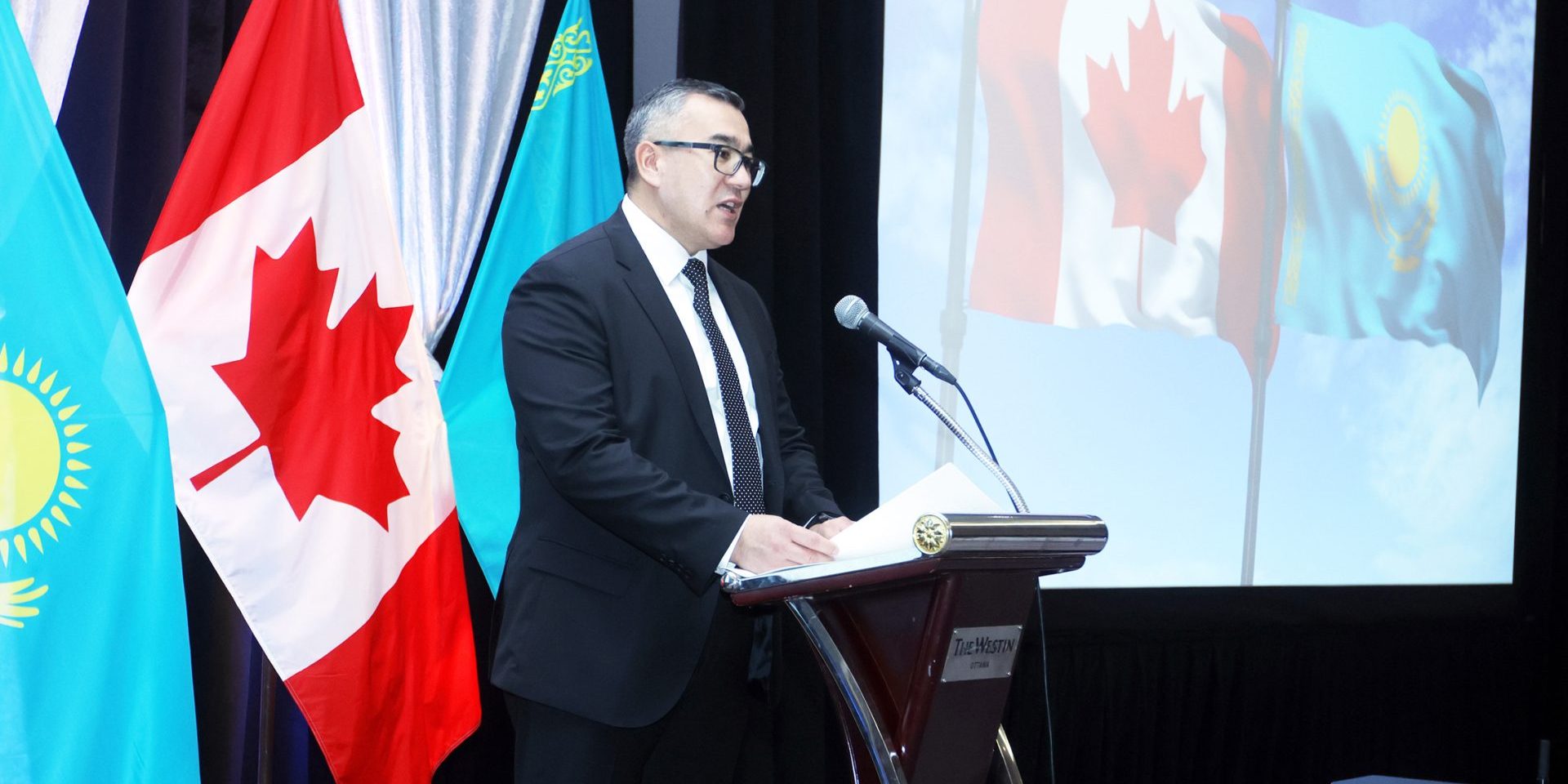
Kazakh Ambassador to Canada Dauletbek Kussainov. Photo credit: The Hill Times photograph by Sam Garcia
Opening the discussion, Kazakh Ambassador to Canada Dauletbek Kussainov emphasized Canada’s significance as a partner in North and South America, noting its influential role as a G7 and G20 member.
“Under Canada’s leadership, the recent G7 summit delivered several positive outcomes for global development and infrastructure. Canada plays a vital role in promoting the global agenda, and we see many opportunities for mutually beneficial cooperation,” said Kussainov.
He added that Kazakhstan’s key sectors—mining, energy, and agriculture—are attracting Canadian companies, reflecting Kazakhstan’s open market and growing appeal to foreign investors.
Kussainov cited the example of Aras Minerals, a Canadian company working in Kazakhstan on copper and gold portfolios. He also noted growing interest from Kazakh businesses in the Canadian market, with companies like BI Group [the largest property developer in Kazakhstan] preparing to enter.
Canadian Ambassador to Kazakhstan Christopher Duggan echoed Kussainov’s remarks, emphasizing the growing commercial relationship.
“Kazakhstan is Canada’s most important trading partner in Central Asia. Bilateral merchandise trade totaled $500 million in 2024, representing a 35% decrease from 2023, mainly due to fluctuations in uranium and iron markets. Uranium alone accounted for nearly $300 million in Canadian imports, with iron totaling around $13 million,” said Duggan.
Canadian exports to Kazakhstan increased slightly in 2024 to $146 million, led by industrial machinery, aircraft, and agricultural equipment.
In addition to economic ties, Duggan highlighted ongoing cooperation on governance and legislative reform.
“A recent milestone was Canada’s support for Kazakhstan’s new anti-stalking legislation, signed into law on July 16. This builds on our existing technical assistance program, which includes legal reforms to address domestic violence. It’s a shared commitment to improving governance and legal protections,” he said.
While Kussainov and Duggan acknowledged the geographical distance as a challenge, both agreed that shared geopolitical views and long-term strategic interests make bilateral engagement worthwhile.
“Despite the distance, we have much in common. Canadian companies visiting Kazakhstan are often impressed by the opportunities. But it takes time and a pragmatic approach to build lasting engagement,” said Duggan.
Kussainov noted that awareness of Kazakhstan remains limited in Canada, and stereotypes about the region persist.
“We need to raise awareness among Canadian people and businesses about life in Kazakhstan and the opportunities available,” he said.
He proposed that Canada develop a regional strategy for Central Asia, similar to its Indo-Pacific strategy.
Miras Zhiyenbayev, advisor to the chairman of the board at Maqsut Narikbayev University, emphasized the potential for middle powers such as Kazakhstan and Canada to collaborate in maintaining a rules-based international order.
“Kazakhstan favors a multipolar equilibrium that allows it to maintain relationships with multiple countries without being forced to choose sides. While Kazakhstan and Canada don’t have a deep bilateral alliance historically, today’s fragmented geopolitical landscape offers new opportunities for strategic collaboration,” said Zhiyenbayev.
He said middle powers can diversify alliances, reduce reliance on dominant players, and build horizontal networks of cooperation.
“In an era of fragmentation, cultivating a web of relationships is the best insurance for preserving an open international system. A middle-power partnership between Kazakhstan and Canada would also carry symbolic weight,” he said.
Zhiyenbayev also pointed to areas for practical cooperation, including investment, regional stability, and sustainable development.
“Kazakhstan and Canada are both resource-rich nations with diverse economies and growing infrastructure. Kazakhstan is expanding its foreign policy reach, including into Africa, and sees great potential for working with Canada in multiple sectors,” said Zhiyenbayev.
