
ASTANA – Central Asia faces growing pressure on its water resources as river flows decline, freshwater reserves remain below normal, and glaciers continue to lose mass, the Eurasian Briefing Telegram channel reported, citing data from the World Meteorological Organization.
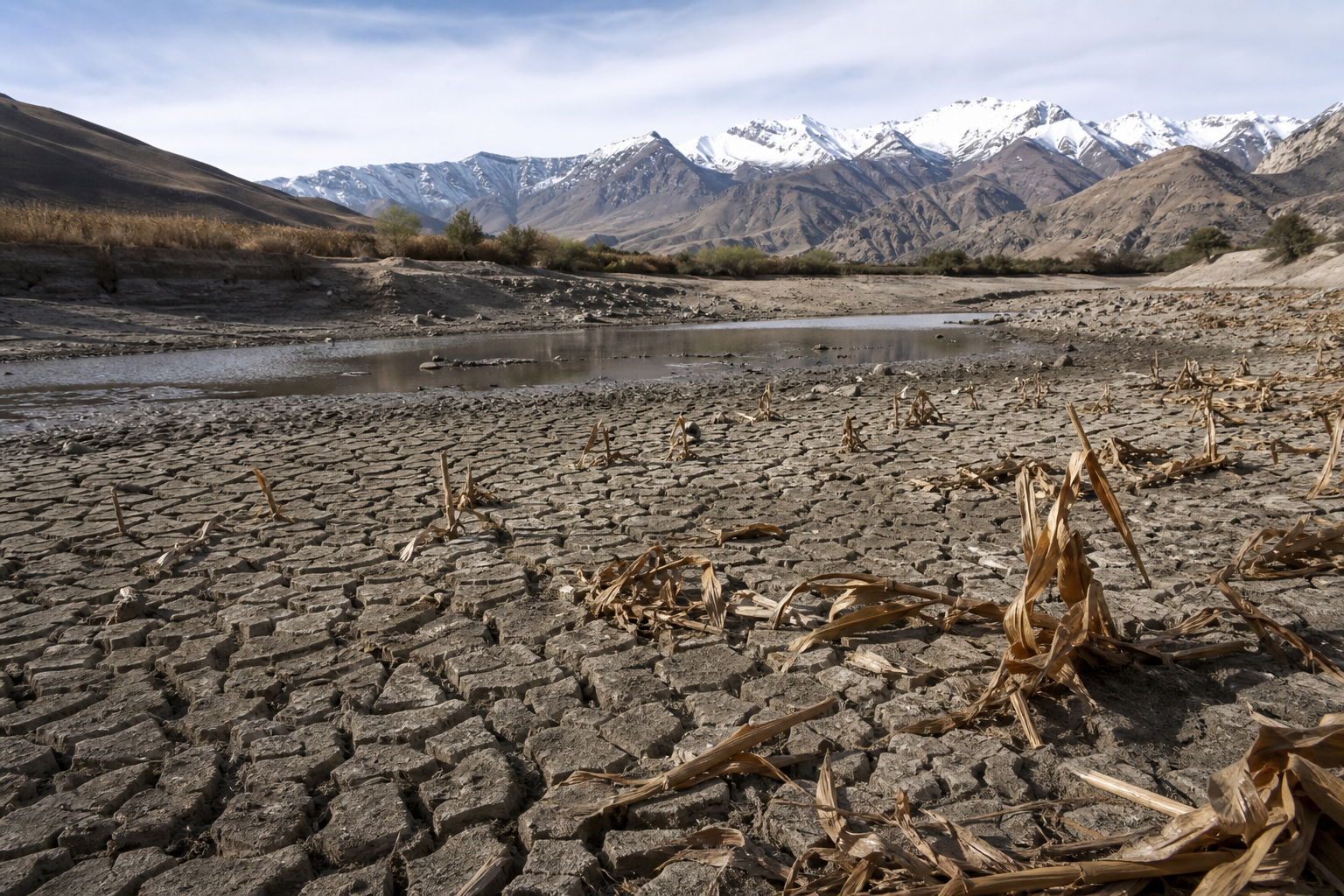
Photo credit: AI-generated image/ Atameken Business
The assessment compares recent indicators with data from 2022 and earlier periods. It found significant declines in water inflows to reservoirs in Tajikistan, Uzbekistan, the Kyrgyz Republic and Afghanistan. The Aral Sea basin was among the areas where river flows fell below normal levels. Recent years have been among the driest in Central Asia since observations began in 1991.
Glacier loss is another major concern. Central Asia’s glacier mass balance ranked among the three most negative on record, meaning glaciers lost more ice than they accumulated. More than half of the region’s river runoff is generated by snow and ice, making water supplies particularly vulnerable to changes in the cryosphere.
Tajikistan has around 14,000 glaciers. More than 10% of its glacier cover has disappeared, while the total glaciated area has declined by about one-third. Tajik glaciers, including the Fedchenko Glacier, contribute significantly to the Amu Darya flow.
The Kyrgyz Republic has more than 8,000 glaciers, with more than 25% of its glacier cover lost. If the current trend continues, around another third of the country’s glacier mass could disappear by 2040. The Kyrgyz part of the Syr Darya basin depends on meltwater from the Tien Shan glaciers, while declining glacier mass also affects flows in the Naryn River.
Uzbekistan is particularly dependent on transboundary water resources, with more than 80% of its water coming from sources outside the country. Declining glacier contributions to the upper reaches of the Amu Darya and Syr Darya therefore have direct implications for the country’s water security.
Kazakhstan’s southern regions also depend on the Syr Darya. Declining inflows to the Shardara Reservoir have been recorded repeatedly in recent years.
In Turkmenistan, more than 90% of water resources are supplied through the Karakum Canal from the Amu Darya. Changes in the river’s flow therefore directly affect agricultural irrigation and water supplies to populated areas.
Regional water management
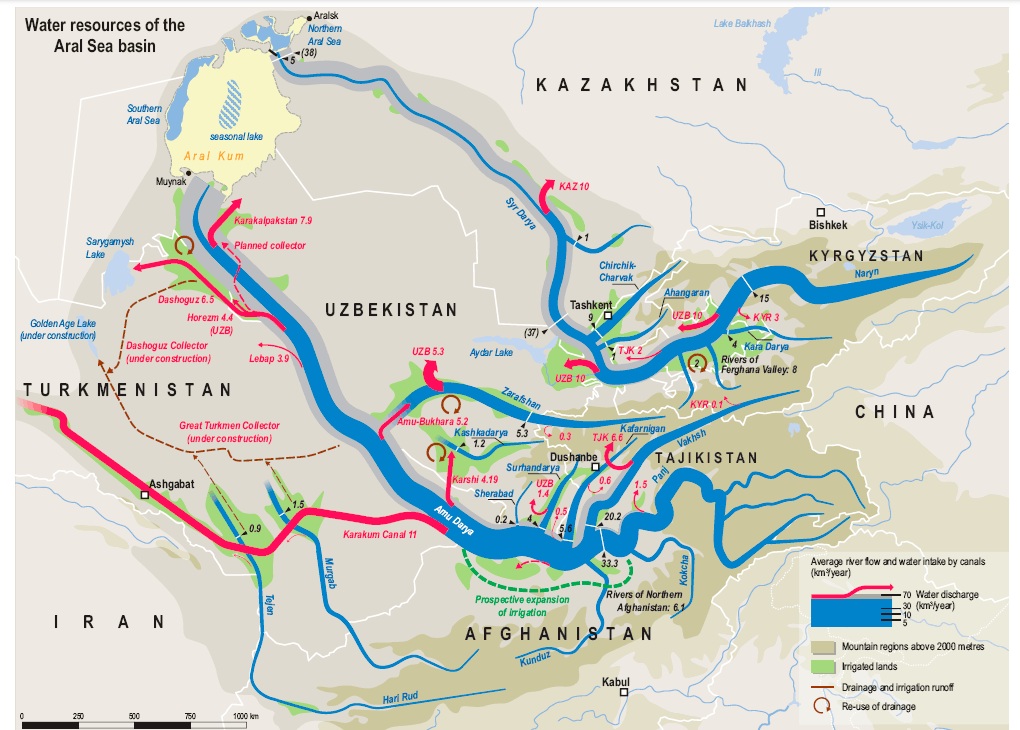
Water shortages have been a longstanding challenge for Central Asia. During the Soviet period, the region operated within a unified water and energy system. The Kyrgyz Republic and Tajikistan used their mountain rivers primarily for hydropower generation, while Uzbekistan, Kazakhstan and Turkmenistan relied heavily on the same water resources for agricultural irrigation.
Data on water flows and use. Photo credit: cawater-info.net
After the Soviet Union collapsed, the end of the unified energy system and worsening drought increased pressure on water resources. The Amu Darya and Syr Darya, the region’s two major rivers, became increasingly important to national water and agricultural needs.
The situation is complicated by various priorities between upstream and downstream countries. Tajikistan and the Kyrgyz Republic have significant hydropower interests, while Uzbekistan, Turkmenistan and Kazakhstan depend heavily on water for agriculture.
The 1998 agreement governing the use of water and energy resources in the Syr Darya basin is also described in the source material as no longer reflecting current consumption patterns and climate conditions. The Eurasian Briefing argues that the existing framework needs to be updated to reflect changing consumption patterns and climate conditions. It points to options including a new multilateral agreement on the Naryn hydropower cascade or financial compensation mechanisms related to reservoir operations.
Kazakhstan focuses on coordination and infrastructure
Kazakhstan is working with neighboring countries to coordinate water releases and ensure supplies during the irrigation season.
In a written response to The Astana Times, the Kazakh Ministry of Water Resources and Irrigation said that the heads of water management agencies from Central Asian countries annually approve reservoir operation schedules for the Syr Darya and Amu Darya basins, as well as water withdrawal limits, through meetings of the Interstate Commission for Water Coordination.
In the Kazakhstan-Kyrgyz Republic-Uzbekistan trilateral format, water and energy authorities annually coordinate the operating mode of the Uch-Kurgan hydropower plant, located downstream from the Toktogul Reservoir and serving as the final link in the Lower Naryn cascade.
“This coordination of operating modes makes it possible to ensure stable water supply, taking into account the needs of the countries of the region during the growing season,” the ministry said.
The ministry also noted that Kazakhstan, Tajikistan and Uzbekistan coordinate annually on the operating mode of the Bakhri-Tojik Reservoir during the peak vegetation period. The arrangement allows additional water releases through the Dostyk interstate canal, helping supply agricultural land in the Turkistan Region’s Maktaaral and Zhetysai districts and reduce water-scarcity risks during periods of high demand.
Kazakhstan is also investing in irrigation infrastructure. Under the Water Resources Management System Development Concept for 2024-2030 and the Integrated Water Industry Development Plan for 2024-2028, the government plans to reconstruct and modernize 14,500 kilometers of irrigation canals.
The country has 8,577 irrigation canals with a combined length of around 45,000 kilometers. By 2030, the government plans to reduce water losses in irrigation canals from 50% to 25% and save about 2.268 billion cubic meters of water annually.
According to the ministry, in 2024-2025, the country reconstructed and modernized around 1,458 kilometers of irrigation canals. From 2021 to 2024, major repairs and reconstruction were carried out on 884 canals with a combined length of more than 5,406 kilometers.
“The scale of work has increased significantly this year, with more than 4,600 kilometers of irrigation canals being reconstructed. By the end of the year, we expect to complete more than 976.6 kilometers, which will reduce water losses and improve the efficiency of water supplies to agricultural land,” the ministry said.
Outlook
The Eurasian Development Bank estimates that Central Asian countries could face chronic water shortages over the next five years if they do not change their approaches to water-resource management. The bank has identified the lower reaches of the Amu Darya and Syr Darya, including Karakalpakstan, Kazakhstan’s Kyzylorda Region and parts of Turkmenistan, among the areas facing particular pressure.
According to the United Nations, the area of irrigated land affected by salinization and desertification in Central Asia has increased by 12% over the past five years to nearly 3 million hectares.
Against this backdrop, countries across the region are pursuing more efficient water use, digital technologies and stronger regional cooperation. Cooperation on the joint management of transboundary water resources has also expanded in recent years, as governments seek to balance agricultural, energy and environmental needs amid growing pressure on water supplies.
