
ASTANA – Government and business representatives from Central Asia and Italy convened on Sept. 16 in Astana for the launch of the B5+Italy platform aimed at turning growing political engagement into investment, industrial cooperation and stronger trade links across the region.
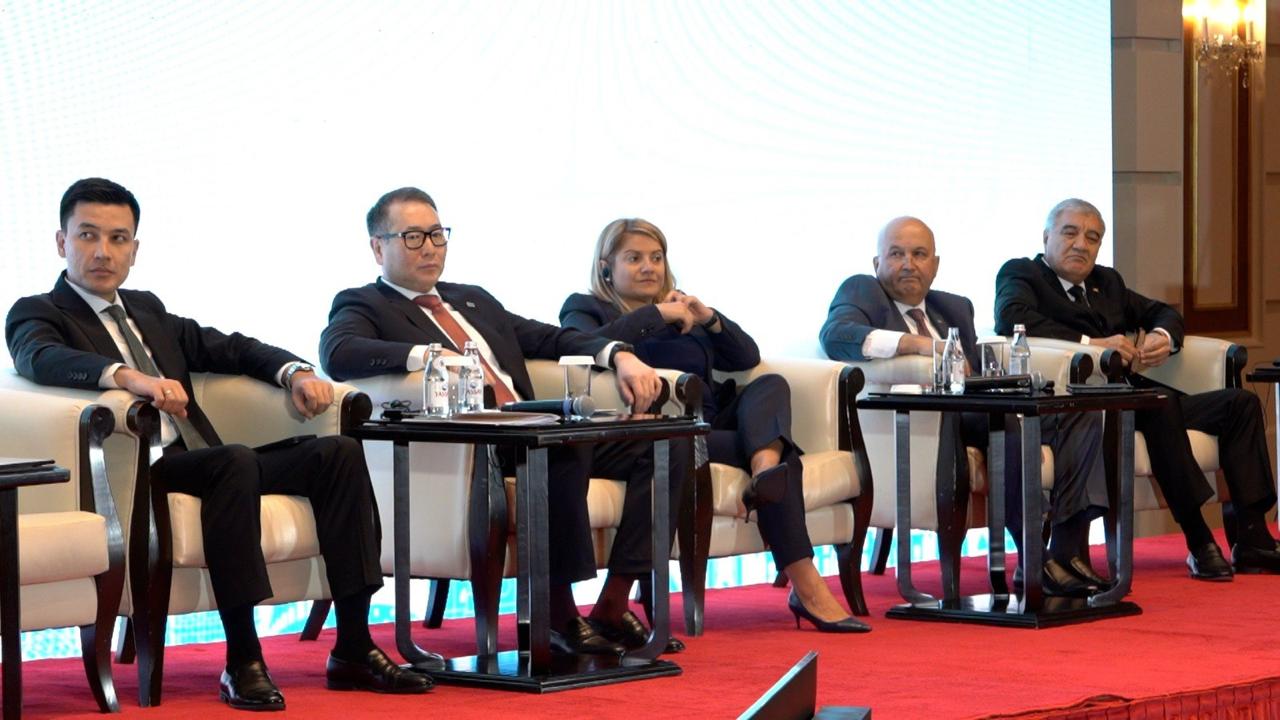
Launch of the B5+Italy platform in Astana. Photo credit: Kazakh Ministry of Trade and Integration
The forum in Astana brought together government officials and businesses from Italy, Kazakhstan, the Kyrgyz Republic, Tajikistan, Turkmenistan and Uzbekistan, with discussions focused on connectivity, sustainable growth and new opportunities for companies operating across Central Asia.
The meeting follows the first Central Asia-Italy summit at the leaders’ level, held in Astana in May 2025, when Italian Prime Minister Giorgia Meloni and the presidents of the five Central Asian states agreed to deepen cooperation across trade, investment, transport, energy and other sectors.
The platform, proposed by President Kassym-Jomart Tokayev, is designed to complement the political dialogue in C5+1 format by giving businesses a more direct role in shaping economic cooperation.
Italian Undersecretary of State for Foreign Affairs and International Cooperation Maria Tripodi said the new business format was intended to give that political dialogue an economic dimension.
“We consider that today’s meeting is important because it is the beginning of a new era. (…) We want to transform the political dialogue into investments, partnerships and new opportunities for our countries,” Tripodi told the forum participants.
“It is the companies, in fact, that are subject to transform the political relationship into a more solid one, investing time and effort,” she said.
A dynamic market
Arman Shakkaliyev. Photo credit: Kazakh Ministry of Trade and Integration
Addressing the gathering, Kazakh Minister of Trade and Integration Arman Shakkaliyev said the forum gives an opportunity to Italian companies to approach Central Asia increasingly as a regional market rather than five isolated economies.
“Today, Central Asia is a market with a rapidly growing economy,” said the minister. “For Italian businesses, today’s forum represents an opportunity to work with the entire region and to expand production and market presence across several countries simultaneously.”
He said Central Asia should increasingly be viewed as an interconnected economic space where companies can establish production in one country while reaching consumers and supply chains across several neighboring markets.
For Kazakhstan, the regional format also offers an opportunity to use existing business infrastructure with Italy more broadly. Shakkaliyev highlighted the Kazakh-Italian Trade House that opened in Almaty earlier this year, saying it could serve not only bilateral commerce but wider links between Italian companies and Central Asia.
Growing interest from businesses
The push toward a regional format is also coming from companies and business associations that have traditionally worked through bilateral Kazakhstan-Italy ties. Marco Beretta, president of the Italian-Kazakh Trade Association, said the leaders’ summit in May 2025 convinced businesses that cooperation could be expanded beyond the two countries.
“In the last three years, we have been working very hard in order to promote collaboration between Italy and Kazakhstan,” Beretta told The Astana Times. “But after the visit of our prime minister last year in May, we understood that a much wider scope of work can be executed.”
He described Central Asia as an increasingly important economic link for Europe and said the expansion toward a five-country regional format represented a significant shift. Beretta said the association now wants to expand its Kazakh-Italian business forum into a broader Central Asian platform while keeping Kazakhstan as its base.
Diversifying trade structure
The forum comes at a time as Italy expands its economic engagement with Central Asia, with Kazakhstan accounting for a large share of that relationship. Italy was Kazakhstan’s third-largest trading partner last year, with bilateral trade reaching almost $17 billion in 2025, according to Kazakhstan’s Ministry of Trade and Integration. Trade reached $9.79 billion in January-July this year, including $9 billion in Kazakh exports to Italy and $789.6 million in imports.
But Shakkaliyev said maintaining high trade volumes alone was not enough. He pointed to the big role of commodities in the current structure of bilateral commerce.
Kazakhstan is seeking to expand exports of higher-value goods and estimates that it has an additional $307.5 million in export potential on the Italian market, particularly in metallurgy, petrochemicals, food products, chemicals and machinery.
Shakkaliyev said Kazakhstan was interested in changing the structure of trade by increasing exports of processed and higher-value products. He pointed to opportunities in agriculture, chemicals, manufacturing and industrial cooperation, while Tripodi emphasized Italian expertise in engineering, machinery and advanced industrial technologies.
This ambition reflects a broader challenge for Central Asian economies of moving from exports of raw materials toward local processing, manufacturing and bigger participation in international value chains.
Connectivity as central theme
Transport and logistics featured prominently in the forum as Central Asian states seek to strengthen links between Asian and European markets. Kazakhstan, which has invested around $35 billion in this area in the past 15 years, has promoted its position along transcontinental trade routes, particularly the Middle Corridor across the Caspian Sea. The Middle Corridor, formally known as the Trans-Caspian International Transport Route, links China and Central Asia with Europe through the Caspian Sea, the South Caucasus and Türkiye.
Shakkaliyev said the region’s transport infrastructure could provide Italian producers and investors with access not only to Central Asian markets but also to wider international supply chains.
Tripodi said Italy was ready to share technology and experience to support Kazakhstan’s economic diversification, pointing to logistics as one area for cooperation.
“Our connectivity depends on growth and on being connected in a safe, self-sufficient way in large international markets,” she said. “We want Italy to be at the same time the driver of this new road to Europe and also the protagonist of its realization. Our companies are ready to contribute.”
Diversifying economic ties
Beretta pointed to logistics, agriculture, technology and petrochemicals as areas where Italian companies could work across the region. He also tied diversification to the development of higher-value production in Kazakhstan rather than continued reliance on raw-material exports.
“We need to create added value,” Beretta said.
Beretta also said one project under discussion is the development of a logistics hub in Kazakhstan accompanied by local production, including sustainable aviation fuel. He said such projects could also be part of a wider push into decarbonization, renewable power generation, sustainable development and water treatment.
“Decarbonization, power generation in a green way, sustainable development and water treatment are very important for Central Asia,” he said, stressing that Italian companies could bring technologies and industrial experience in those areas.
According to Tripodi, Italian companies have built extensive presence in oil and gas, but they are also looking to expand into renewable energy, critical minerals and areas linked to energy transition.
Shakkaliyev also noted Italy’s experience with small and medium-sized industrial companies could be particularly relevant for Central Asia, where governments are seeking investment that creates production capacity and jobs.
In her remarks, Tripodi noted the region offered a large and relatively young market of around 80 million people, combined with energy resources, critical materials and a strategic position between Europe and Asia. The country sees potential for its companies in sectors where Central Asian governments are trying to move further up value chains, she said.
Tripodi said Italian companies could contribute through design, engineering and industrial technologies as Central Asian economies seek greater diversification.
