
ALMATY – The relationship between Kazakhstan and the United States has reached a period of “unprecedented momentum,” U.S. Consul General Peter Kaufman said at a Sept. 17 press briefing in Almaty, as Kazakhstan prepares for President Kassym-Jomart Tokayev’s participation in the G20 Summit in Miami in December and the two sides deepen cooperation on critical minerals and other strategic areas.
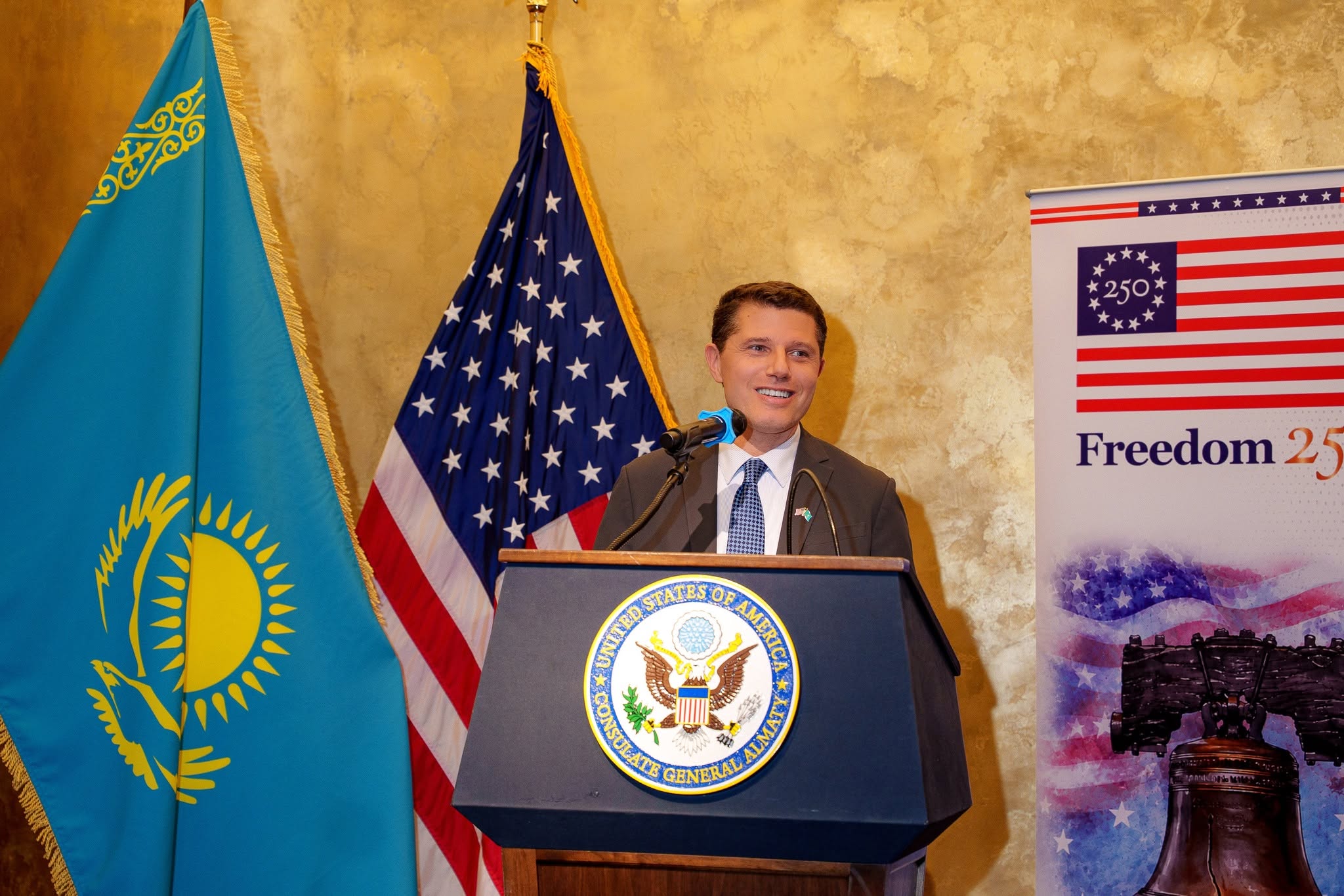
The consul general began his assignment in Almaty in July. Photo credit: U.S. Consulate General.
Tokayev is expected to attend the G20 Summit at the invitation of U.S. President Donald Trump, with Kazakhstan’s participation in the December meeting adding a high-level dimension to an already active period in bilateral relations. Kazakhstan and the U.S. have also been expanding cooperation through the C5+1 framework, including the first C5+1 Critical Minerals Dialogue held in Astana in June.
“The U.S. was the first to establish diplomatic ties with Kazakhstan, and since that moment, our relationship, our ties, have only grown stronger. We remain committed to Kazakhstan’s independence, sovereignty, and territorial integrity,” Kaufman said.
The consul general, who began his assignment in Almaty in July, said his priority is to build on the existing momentum.
“My work here is to build on that momentum. My main message is, this relationship has never been stronger. We’re seeing tremendous momentum across all of these sectors,” he said.
The timing also places economic cooperation at the center of the bilateral agenda. According to Kaufman, agreements between U.S. and Kazakh companies reached $17 billion over the past year, while bilateral trade reached $7 billion, doubling since 2020. American companies have invested more than $100 billion in Kazakhstan over the past 35 years.
“Transportation, logistics, AI, minerals, Kazakhstan’s mineral wealth, of course. That’s where we’ve seen the most tremendous commercial successes in recent years. But I wouldn’t limit it to those sectors,” he said.
Critical minerals gain strategic importance
U.S. Consul General Peter Kaufman. Photo credit: The Astana Times.
Critical minerals have emerged as one of the most significant areas of potential cooperation, particularly as Kazakhstan seeks to develop its resource base beyond raw material extraction and attract investment and technology for processing. Kaufman said U.S. companies are increasingly interested in Kazakhstan’s mineral potential.
He also said U.S. investment can bring technology and expertise while creating economic opportunities in Kazakhstan.
“U.S. companies bring top-notch equipment and technology. They bring the highest standards of corporate governance and environmental protection. And, of course, they bring economic opportunities for Kazakh citizens. They have the creation of jobs, the creation of training opportunities, the creation of professional development opportunities. So I think critical minerals in particular are a good example of a sector in which we’ll see prosperity on both sides,” Kaufman added.
G20 to provide another high-level platform
The upcoming G20 Summit in Miami will provide another opportunity for Kazakhstan and the U.S. to discuss their expanding partnership. Kazakhstan’s Foreign Ministry has said Tokayev’s participation in the December summit will be accompanied by preparations for a substantive agenda at the highest level. Kaufman described the relationship as having reached a particularly strong point and linked its momentum to growing contacts at both the government and business levels.
He also pointed to Kazakhstan’s broader regional role and the C5+1 framework, which has expanded from regional integration into economic cooperation, AI and critical minerals.
“What began primarily as a platform for regional integration, one that would connect the Central Asian countries with the U.S., and on that we’ve, I think, very successfully built to expand it into other areas,” he said.
The consul general said Kazakhstan has played a significant role in developing contacts between Washington and Central Asia.
AI, trade and regional connectivity
Beyond critical minerals, Kaufman highlighted AI, transportation and logistics as other areas where the relationship is expanding.
“What I’ll say on AI is that the U.S. brings world-class AI technology to the world. We’re extraordinarily proud of our AI companies, our AI industry, and our AI technology,” he said, noting that AI is also becoming part of the C5+1 agenda, with a dedicated meeting planned within the framework.
Speaking to The Astana Times about Pax Silica, a U.S.-led initiative focused on strengthening cooperation around artificial intelligence, semiconductors and resilient technology supply chains, Kaufman said the initiative is closely connected to the broader strategic partnership between the U.S. and Kazakhstan.
“What you asked about is the State Department-originated platform for building consensus on how to take AI into the future and also to make sure that we are building the resilience of our supply chains. And so on that, I would say that it is at the very core of the strength of our relationship with Kazakhstan,” he said.
“I think I mentioned earlier that there is actually an AI meeting in the C5+1 framework at the end of this month, where I think those questions will be very much at the center of those discussions,” he added.
Visa applicants urged to rely on official information
Kaufman also addressed the continuing interest among Kazakh citizens in traveling to and studying in the U.S., urging applicants to rely exclusively on official sources for visa information.
“Our main advice, our main message is for visa applicants to rely exclusively on official sources of information, such as travel.state.gov, the official State Department website on visa issues, and of course on our embassy website and our consulate website, to make sure that they are receiving the most accurate information on these issues.” he said.
He said the U.S. continues to issue visas to tourists, business people and students in large numbers, while warning applicants about agencies that claim to facilitate or guarantee visa issuance.
“There is a lot of inaccurate, unofficial information out there, a lot of rumors out there. There are agencies that charge money for facilitating the visa process, and even in some cases, trying to guarantee the issuance of a visa,” Kaufman said.
‘I hope so’ on potential Trump visit
Asked whether U.S. President Donald Trump could visit Kazakhstan following invitations from Tokayev, Kaufman responded briefly but positively.
“I hope so. I hope so,” he said.
He also added that the relationship between the two presidents reflected the broader momentum in bilateral ties.
“President Tokayev and President Trump speak frequently. They have a very strong relationship, and I think that’s really emblematic of the momentum, the extraordinary, unprecedented momentum we’re seeing currently in the relationship,” he said.
For Kaufman, the current period represents an opportunity to build on three decades of diplomatic relations through stronger commercial ties, investment, technological cooperation and closer people-to-people connections.
“And my main priority is to make sure that we can preserve this momentum and build on it so that we can develop this relationship even further. That’s what I look forward to doing, especially as I get started in my new capacity here,” he said.
