
ASTANA – Kazakhstan is celebrating Kazakh Tazy Day for the first time on Sept. 3, commemorating the anniversary of the breed’s preliminary recognition by the Fédération Cynologique Internationale (FCI) in 2024, reported the Ministry of Ecology and Natural Resources.
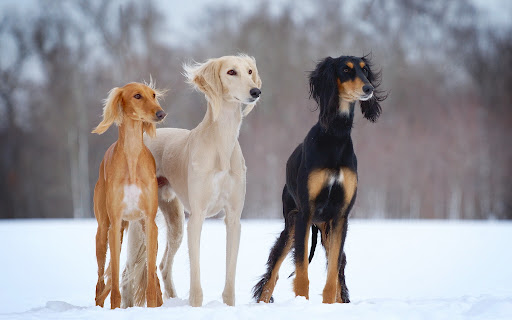
Photo credit: tazy.kz
The FCI made the decision in Amsterdam on Sept. 3, 2024, granting preliminary recognition to the Kazakh tazy and officially recognizing Kazakhstan as the breed’s country of origin.
The tazy has lived alongside people in the Great Steppe for centuries, serving as a hunting companion and becoming an important part of Kazakh culture and daily life. Its place in Kazakh tradition is also reflected in the FCI breed standard, which refers to the tazy as one of the Zheti Kazyna (Seven Treasures) of the Kazakh people.
From national heritage to international recognition
Efforts to preserve and promote the breed gained momentum in recent years. In 2022, President Kassym-Jomart Tokayev instructed the government to take measures to preserve the national breed and promote it internationally.

President Kassym-Jomart Tokayev and French President Emmanuel Macron during a walk accompanied by Jules and Jeanne, Tazy dogs gifted by the Kazakh President. Photo credit: Akorda
A major step came Aug. 22, 2023, when the Union of Cynologists of Kazakhstan became a full member of the FCI at the federation’s General Assembly in Geneva. The membership enabled the country to formally submit the tazy for international recognition. In March 2024, Kazakhstan submitted documentation on the breed to the FCI.
The same year, Astana hosted a specialized breed exhibition where international experts examined 100 Kazakh tazy of various ages, colors, origins and types. The dogs were evaluated for their physical structure, movement and compliance with the breed standard.
In an interview with The Astana Times, FCI President Tamás Jakkel praised Kazakhstan’s progress and said a long-term program is now underway to achieve full recognition.
“We have outlined a program for the next several years to reach final recognition. I offered my support and partnership, and we agreed to continue cooperation,” he said.
Jakkel noted that the issue has broad public relevance given the large number of households that own dogs.
Preserving the breed through science
Preliminary recognition is only one stage of the process. The tazy must undergo a lengthy observation period during which the stability of the breed is assessed across several generations. This includes monitoring pedigree records, health, genetic diversity, breed characteristics and natural and working abilities.

The world-famous singer Dimash Kudaibergen with Tazy dog presented by President Kasym-Jomart Tokayev. Photo credit: Dimash Kudaibergen’s Instagram page
Kazakhstan has also established its first DNA bank for the tazy and tobet, another national dog breed. The initiative follows several years of nationwide genetic research aimed at preserving the breeds’ genetic heritage and preventing genetic loss.
According to Anastasia Perfilyeva, a biology researcher at the Institute of Genetics and Physiology, genetic analysis confirmed that the tazy is an ancient, independent breed.
Researchers also found that the tobet developed at the intersection of Arctic and East Asian dog lineages and is genetically distinct from more than 140 dog breeds worldwide, including other guardian breeds.
Today, nearly 4,000 tazy are registered in the Union of Cynologists of Kazakhstan’s unified pedigree book. The actual population is believed to be higher because many dogs in rural and remote areas have yet to be included in centralized records.
Specialists continue working across the regions to conduct breeding assessments, document pedigrees and monitor the breed’s genetic diversity.
In 2025, The tazy received a patent from National Institute of Intellectual Property Qazpatent.
Tazy gains global visibility
Alongside scientific and breeding work, Kazakhstan has stepped up efforts to promote the tazy internationally.
The breed made its official debut at the World Dog Show in Helsinki in 2025.
In June 2026, Kazakhstan presented 12 tazy at the World Dog Show in Bologna. The breed was also showcased to international judges during the FCI World Judges Congress. A national pavilion introduced visitors to the tazy and Kazakhstan’s traditions and culture.
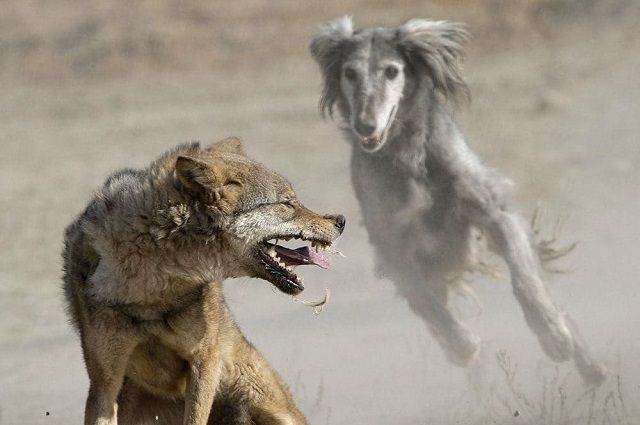
Photo credit: kzaif.kz
The breed has also featured in high-profile diplomatic and cultural exchanges. Tokayev has previously gifted Kazakh tazy dogs to French President Emmanuel Macron and renowned Kazakh singer Dimash Qudaibergen, drawing further attention to the breed as a symbol of the country’s national heritage.
The Kazakh tazy was also included for the first time in “Dogs of the World,” a book by U.S. illustrator Lili Chin featuring more than 600 dog breeds.
“I remember seeing a video from Kazakhstan of tazy dogs hunting a wolf. They were incredibly fast and worked as a team. I love that tazy are valued not only as hunters but also as beloved companions and family dogs,” Chin told The Astana Times.
Kazakhstan is also expanding infrastructure for the preservation and development of its national dog breeds. A National Center for Kazakh Dog Breeds is under construction in the Zhetysu Region. The facility will support breeding programs, maintain the national pedigree registry, train cynology specialists and host exhibitions, trials and competitions.
The next stage will be particularly important for the tazy. Full FCI recognition will depend on demonstrating the breed’s stability over several generations while preserving its distinctive characteristics, genetic diversity and working qualities.
