
I had lived in Astana for years before I finally visited the greenhouse at the city’s Botanical Garden. Looking back, I’m not entirely sure why it took me so long. I’d walked through the park countless times, watched runners weave between its paths, admired the flower beds in summer and the endless white snow in winter, yet somehow I had never stepped inside the greenhouse. Maybe that’s because from the outside it doesn’t prepare you for what’s waiting behind the glass.
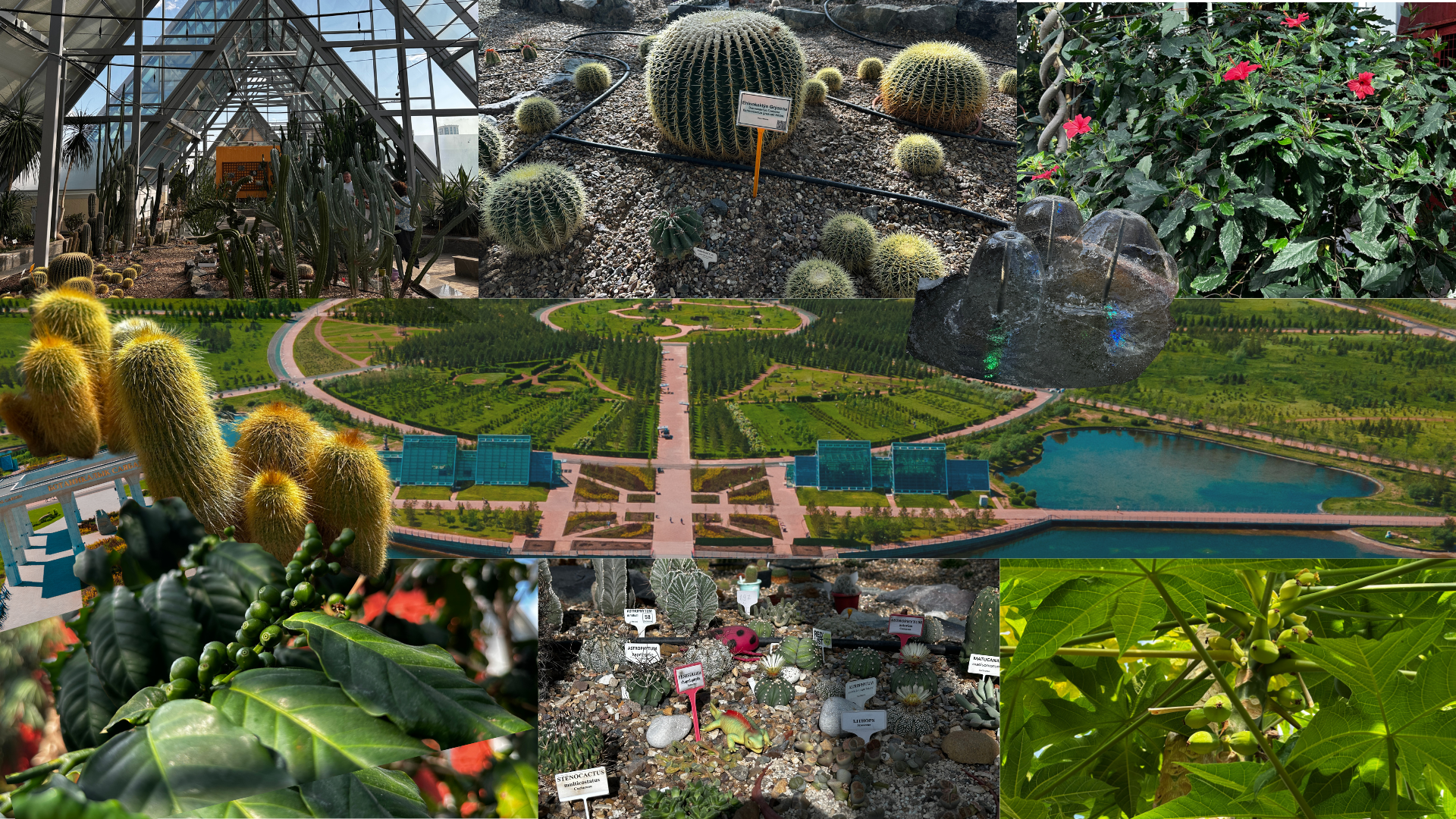
Photo credit: The Astana Times. Collage is created by The Astana Times.
The moment the doors close, Astana disappears. The dry steppe air gives way to warm humidity. The scent of wet soil replaces the smell of asphalt. Palm leaves stretch above your head, citrus trees are heavy with fruit, papayas quietly ripen in one corner, coffee berries turn bright red in another, and for a second your brain struggles to reconcile what your eyes are seeing. You are still standing in one of the coldest capitals in the world, yet everything around you belongs somewhere thousands of kilometers to the south. It feels almost impossible.
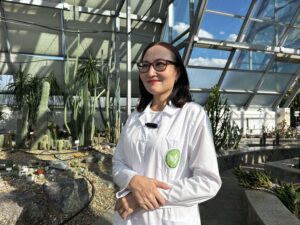
Laila Zekenova, the head of the greenhouse. Photo credit: The Astana Times.
The Astana Botanical Garden officially opened in 2018 as part of the celebrations marking the capital’s twentieth anniversary. Scientists from Kazakhstan worked alongside colleagues from Germany, Italy, France and several CIS countries to create what has become not only a public attraction but also an important scientific collection dedicated to preserving plant biodiversity.
That scientific mission is exactly what brought me to Laila Zekenova, the head of the greenhouse, who has spent years looking after hundreds of species that have somehow learned to call Astana home.
“Our main goal is to preserve biodiversity. The species that were brought here and added to our collection—we have to preserve them. That is our primary mission,” she told me almost immediately.
It sounds simple enough when she says it. In reality, keeping tropical plants alive through Astana’s winters is anything but simple.
“We also organize workshops, tastings and educational activities for visitors. It’s all about introducing people to tropical species,” she added.
Growing the impossible
As we slowly walked between the different sections of the greenhouse, it became obvious that every plant here had its own story, and every story seemed to begin with adaptation.
One of the first things that caught my eye was an orange tree covered in fruit. Seeing oranges growing in Astana feels strangely intimate. Perhaps it’s because oranges belong so firmly to my childhood memories of New Year’s celebrations that seeing them hanging from a tree rather than stacked in supermarket boxes somehow makes them seem even more exotic.
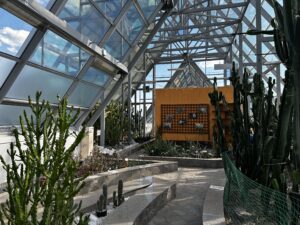
Photo credit: The Astana Times.
I asked Zekenova how long they had been growing here.
“This orange tree has been here since the greenhouse opened in 2018. It was planted from cuttings rather than from seed. If you grow an orange tree from seed, it can take around fifteen years before it starts producing fruit,” she explained.
That explained why this particular tree was already generous with its harvest.
“For the past three years it has been producing abundant fruit. We organize tastings for visitors,” she said.
The oranges usually ripen in late December and throughout January. It suddenly made perfect sense. There is probably no better place to smell fresh oranges than inside a tropical greenhouse while Astana disappears beneath snow outside.
A few steps later we stopped beside an Arabica coffee tree. Even after she explained what it was, I kept staring at it. Coffee trees are the sort of thing my brain still associates with documentaries filmed somewhere in Latin America or East Africa, not with a greenhouse in Kazakhstan.
“When the fruits ripen, they turn red,” she explained. “The outer layer is edible, and the coffee beans are inside.”
Naturally, I asked whether they ever roast the beans themselves. She laughed.
“No. We only have two trees. This isn’t production. As I told you, our goal is to preserve the species,” she said.
Then she gently touched one of the branches.
“It’s a very delicate tree. It reacts to every draft, so it has to be grown very carefully,” she shared.
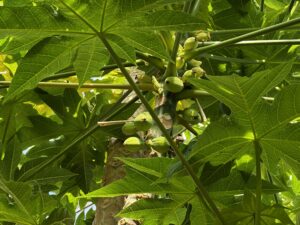
Photo credit: The Astana Times.
There was something unexpectedly comforting about the answer. We often imagine exotic plants as somehow stronger or more extraordinary simply because they come from far away. In reality, many of them survive only because someone quietly pays attention every single day.
The papaya, however, turned out to be even more demanding. Several trees grow inside the greenhouse, but only one actually bears fruit.
“Only one produces fruit because it is hermaphroditic. The others have female flowers,” Zekenova explained.
Maintaining the right conditions requires a careful balance of temperature and humidity. Zekenova said that they keep humidity between 70 and 80 %. Even then, Astana cannot completely imitate Southeast Asia.
“What we really lack is daylight. In their native habitat they receive around fourteen hours of daylight,” she explained.
I looked outside through the glass and instinctively protested. “But we have so much sunshine here,” I said.
She smiled.
“No. Our daylight hours are simply shorter than in Southeast Asia. Still, the plant has adapted and produces fruit,” she said.
It has also adapted to completely different soil and water.
“It has adjusted to our water, our soil and our conditions. It has successfully gone through the introduction process,” she said.
Everything adapts
As she spoke about adaptation, I caught myself doing what I almost always do: turning a conversation into something philosophical. Standing there among plants that receive less light than they evolved for, grow in unfamiliar soil and drink unfamiliar water, I realized that none of them spend their energy wishing life were different. They simply adapt.
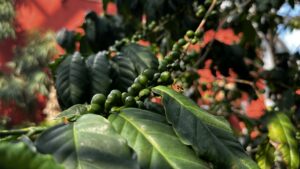
Photo credit: The Astana Times.
Maybe that’s why I found myself thinking less about plants and more about people. We spend so much of our lives waiting for better circumstances. Better jobs. Better cities. Better timing. Better weather. The plants don’t negotiate with reality. They simply get on with living.
When I asked Zekenova whether adaptation is, ultimately, nature’s greatest lesson, she answered without hesitation.
“The purpose of every species is to preserve life and leave offspring behind. When conditions change, we have to adapt. That’s how evolution happened. The most adaptable survived and left descendants. Every living organism, plants, animals and humans, tries to adapt and pass on its genes,” she said.
I don’t know whether she realized how much bigger that answer sounded than the question I had asked. We often think of plants as fragile things. But perhaps resilience looks exactly like this. Not loud or dramatic. Just quietly continuing to grow despite circumstances that are far from ideal. Zekenova believes our role is simply to make survival possible.
“It’s important to create favorable conditions, but ultimately nature has given every living organism the desire to live,” she said.
Where winter doesn’t exist
By then I had almost forgotten that outside it was still Astana. Instead, I found myself wondering what it must feel like to work here in January, when the city becomes almost monochrome. Outside in the winter there is snow and ice. Inside everything is green. I asked whether visitors feel the same contrast.
“They’re always surprised. From the outside the greenhouse looks quite small. Then they come inside and see all of this,” she said.
“Outside there’s snow, and then you walk in here—and your mood immediately improves,” she shared.
I believed her. Even after less than an hour, I could already feel my shoulders relax. Perhaps there really is something about being surrounded by living green things that reminds the nervous system to slow down. When I asked why she had chosen plants over animals, her answer became almost childlike in its enthusiasm.
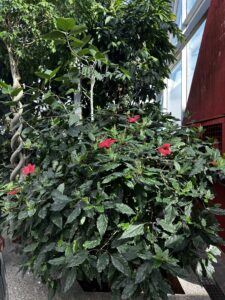
Photo credit: The Astana Times.
“I love plants more than animals because their physiology is completely different. Their nutrition is different. They produce their own organic matter, and that entire process fascinates me,” she said.
Then she began talking about regeneration.
“Plants retain meristematic tissue throughout their lives. Humans can regenerate only certain tissues, but plants are different. Through micropropagation you can grow an entire plant from a tiny piece of meristem.”
Listening to her, it became obvious that this wasn’t simply a job. This was genuine fascination that hadn’t disappeared after years of working in the same greenhouse. Of course, fascination alone doesn’t keep hundreds of plants alive. Behind the beauty visitors see is an enormous amount of physical work. The collection keeps growing. The trees keep growing. Every species competes for light, space and humidity. Every day someone has to notice the smallest change before it becomes a real problem.
Later I asked Zekenova something that had little to do with botany. People often say working with soil is therapeutic. Was that simply another romantic myth? She shook her head.
“Yes, I believe it is true because plants and human energy are connected on a wave level. They sense one another. The human body accumulates negative electrical charges. When you touch the ground, those charges become neutralized. That’s why people often feel calmer afterwards.You can feel it yourself. So no, I wouldn’t call it a myth,” she said.
The Agave’s last bloom
By the time we reached the cactus section, the air had changed again. It was noticeably drier, almost as though we had traveled to yet another continent without ever leaving the building. There she introduced me to an agave that had recently flowered.
“Agave is monocarpic. It flowers only once, and then the main plant dies. But before it does, it produces offsets that grow into new plants,” she explained.
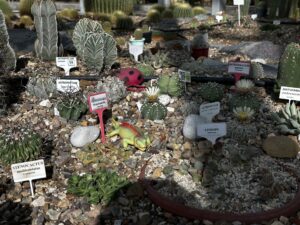
Photo credit: The Astana Times.
I asked why.
“Because the plant has to devote all of its energy to flowering,” she answered.
For the second time that afternoon, I found myself quietly translating botany into life. Some things exhaust themselves completely in order to create something that outlives them. That isn’t tragedy. It’s simply another strategy for survival.
As our tour continued, I kept discovering stories hidden inside plants I had never paid much attention to before. The rubber plant, Ficus elastica, was once cultivated commercially for natural rubber. An ancient leafy cactus challenged everything I thought I knew about cacti.
“All cacti originally looked more like this. Over time, because of heat, intense sunlight and dry climates, their leaves gradually evolved into spines,” Zekenova explained.
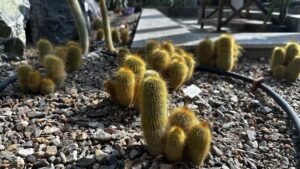
Photo credit: The Astana Times.
I honestly would never have guessed. Before leaving, I asked whether the greenhouse had become more than just a scientific space. It has. Visitors come for guided tours, workshops, seasonal fruit tastings and educational programs. Couples choose it for wedding photographs or proposals. Children leave carrying plants they have grown with their own hands during the popular Young Floriculturist workshop. At the end, every child takes home the plant they have planted.
Walking back outside, I realized people probably come here expecting to see exotic plants. They certainly do. But I suspect many of them leave with something else. I know I did.
Because somewhere between the oranges, the coffee trees, the papayas and the agave, this stopped feeling like a story about botany. It became a quiet reminder that survival rarely depends on perfect conditions. More often than not, it depends on our willingness to adapt to imperfect ones and to keep growing anyway.
